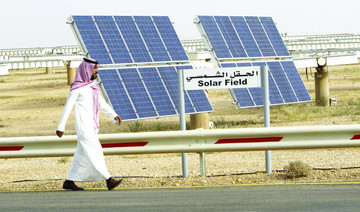
ABU DHABI: The sun is shining on Saudi Arabia’s renewable energy sector — with plans for dozens of contracts over the coming years posing a “golden opportunity” for investors, according to delegates at the Abu Dhabi Sustainability Week (ADSW).
Speaking at the clean-energy conference, Saudi Energy Minister Khalid Al-Falih on Tuesday outlined ambitious plans for solar and wind power, as the Kingdom plans to create “a global hub of renewable energy capability” over the coming decades.
Saudi Arabia plans to generate some 59 gigawatts (GW) of electricity from solar and wind by 2030, and eventually produce upward of 200 GW from renewable sources, Al-Falih said, according to AFP.
Under Saudi Arabia’s clean-energy program, Al-Falih said Riyadh would tender dozens of renewable energy projects every year, with at least 12 such deals slated for 2019, it was reported.
The news follows a string of renewable-energy deals struck by the Kingdom, which last week signed a deal to establish a 400-megawatt (MW) wind farm, following an agreement last year to build a 300-MW solar plant.
On Monday, plans were announced to develop a $2 billion solar and carbon black integrated complex in the heart of the Kingdom.
The deal was struck between Saudi Arabia’s National Industrial Clusters Development Program (NICDP) and the Kingdom’s diversified manufacturing company SABIC, in partnership with China’s Longi and South Korea’s OCI, two global solar powerhouses.
“We plan to complete the feasibility study in the next six months, and maybe by the end of the year we will be identifying the shape and legal and financial structure of the project,” said Tariq Bakhsh, vice president of the chemicals and renewables program at NICDP.
“Saudi Arabia is a leader in the region for renewable energy targets.”
Mohammad AlHajjaj, general manager of the energy and water sector for Saudi Arabia’s General Investment Authority (GIA), told Arab News that now is “the key time” to invest in renewable energy resources across the Kingdom.
“Renewable energy and solar power are very important as part of Saudi Arabia’s diversification plans,” he said. “Saudi Arabia is taking huge steps into... renewable energy to improve the energy mix for the new generation.”
AlHajjaj said the Saudi government aims not just to reshape its energy mix within the boundaries of the Kingdom, but also to emerge as a global force in clean power.
“Recently it has been announced what will be the new energy mix and the plan for 2030 — what will be the portion of solar, of wind, of gas/power generation,” he said.
“What we are doing at the GIA (is) playing the role of an investment promotion agency by developing new business opportunities, talking to investors who want to come do business in Saudi Arabia, playing the role of the advocate for the investors, and making sure their investment is sustainable and growing inside the country.”
The Kingdom has laid out an ambitious plan to move its economy away from its dependence on oil, with a key factor being a focus on renewable energy resources and tapping one of the country’s most abundant natural resources: Sunlight.
The shift is described by officials at King Abdullah University of Science and Technology (KAUST) as not only a move toward sustainable energy, but also as a way for the Kingdom to become a world leader in solar technology, training a new generation of Saudis in the technology, and to eventually become an exporter of both solar panels and power.
AlHajjaj said Saudi Arabia has some of the world’s most intense sunlight, and therefore has the potential to be a major producer of solar energy.
“The lowest cost of renewable energy is also in Saudi Arabia because the efficiency is very high... It is considered one of the top countries globally in terms of the efficiency of solar power to generate electricity,” said AlHajjaj.
“Our objectives are not only to build solar projects and renewable energy resources, but to also recognize the key value chains such as manufacturing the components needed for solar power within the Kingdom itself.
“We are well located on the map, with a very good geographical location that is connected to the Gulf but also to both East and West... So we have ambitious plans.
“Each country has its plan when it comes to solar, but Saudi Arabia has the highest plan when it comes to the Gulf. So there is no better time than now when it comes to making the decision to invest in this sector in Saudi Arabia.”
AlHajjaj said the Kingdom is seeing “a lot” of outside interest in its renewable energy sector, which forms a key part of the Vision 2030 reform plan.
“We are working with several companies into recognizing the (potential) of manufacturing solar panels, wind turbines and gas turbines. We are working with several big names globally,” he said.
As the annual ADSW returns to Abu Dhabi this week, delegations from around the world, including Saudi Arabia, have descended on the UAE capital to discuss advancing the world’s sustainable development.
Fahad Al-Shammari, a general manager at Saudi Arabia’s Marafiq, the power and water utility company for Jubail and Yanbu, said the company had a slate of sustainable projects on its books for 2019.
“We are shifting out plans to renewable energy. So just now we are anticipating that by the end of this month, we will sign an agreement in Yanbu to generate 300 MW of power from solar,” he told Arab News.
Al-Shammari said 2019 “is the golden opportunity” to invest in the renewable energy sector in Saudi Arabia.
“It is not just a business opportunity, but there is a drive behind it,” he said.
“It is one of the pillars of the Kingdom’s Vision (2030) that we will produce a portion of power from the renewable sector.”