

Pompeo: US relationship with Saudi Arabia essential for Middle East stability

1 / 5
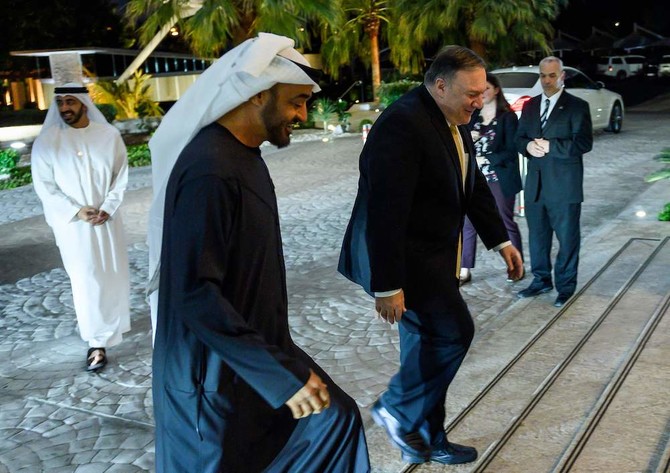
Abu Dhabi Crown Prince Sheikh Mohammed bin Zayed greets Secretary of State Mike Pompeo in the UAE capital. (AFP)
2 / 5
Abu Dhabi's Crown Prince Mohammed bin Zayed Al-Nahyan (C-L) receives visiting US Secretary of State Mike Pompeo (C-R) prior to their meeting at Al-Shati Palace in the UAE capital Abu Dhabi on January 12, 2019. (AFP)
3 / 5
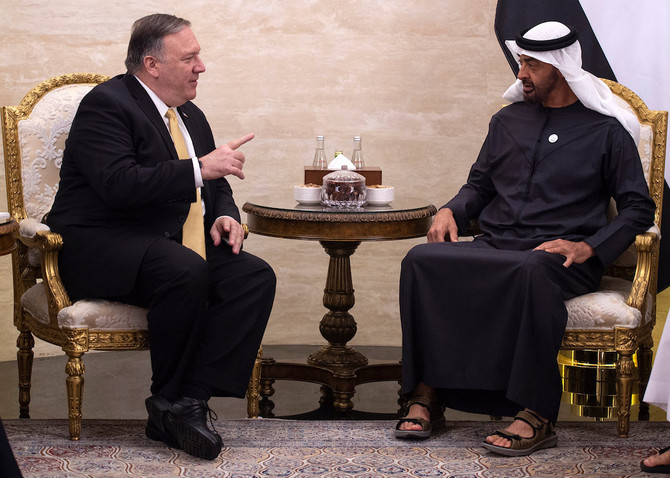
Abu Dhabi's Crown Prince Mohammed bin Zayed Al-Nahyan speaks with U.S. Secretary of State Mike Pompeo during a meeting at Al-Shati Palace in Abu Dhabi, United Arab Emirates January 12, 2019. (Reuters)
4 / 5
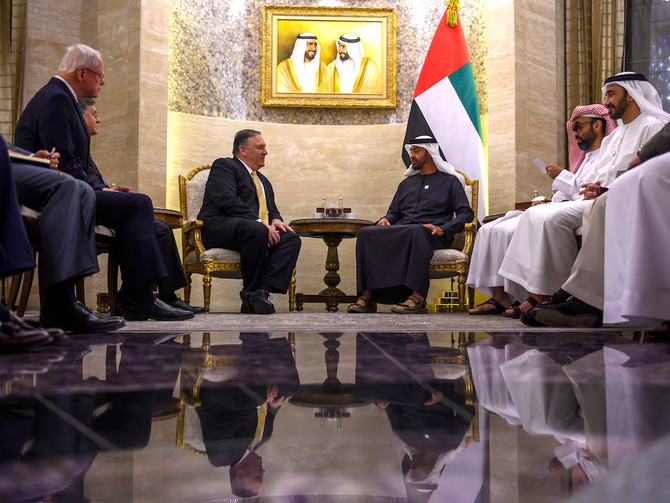
Abu Dhabi's Crown Prince Mohammed bin Zayed Al-Nahyan speaks with U.S. Secretary of State Mike Pompeo during a meeting at Al-Shati Palace in Abu Dhabi, United Arab Emirates January 12, 2019. (Reuters)
5 / 5
US Secretary of State Mike Pompeo, right, walks with Vice Adm. James Malloy, commander of the US Naval Forces Central Command/5th Fleet, after a tour of the US Naval Forces Central Command center in Manama, Bahrain, Friday, Jan. 11, 2019. (AP)
Updated 13 January 2019
Follow

Pompeo: US relationship with Saudi Arabia essential for Middle East stability

  •  US secretary of state says America wants an Arab coalition capable of facing the different challenges in the region
  • Pompeo holds talks in Abu Dhabi with Crown Prince Sheikh Mohammed bin Zayed

DUBAI/LONDON:  Washington’s relationship with Saudi Arabia is “fundamental to the stability and security of the region,” US Secretary of State Mike Pompeo said on Saturday.

“The relationship must go forward. We have to have good relations with the Kingdom of Saudi Arabia and this administration intends to do so,” Pompeo said in an interview with Al Arabiya.

The secretary of state was speaking in Abu Dhabi on the latest leg of a nine-nation Middle East tour aimed at reassuring allies of US commitment to the region after President Donald Trump’s announcement that American troops would be withdrawn from Syria. He is expected in Saudi Arabia this week

The pullout caused particular concern among Kurdish YPG forces in northern Syria, who fought with the US-led anti-Daesh coalition but fear the withdrawal of US protection will lead to an attack by Turkey, which views the YPG as terrorists.

Pompeo said he had discussed the issue with Turkish Foreign Minister Mevlut Cavusoglu and was confident that it could be resolved.

“We recognize the Turkish people’s right to defend their country from terrorists, but we also know that those ... who are not terrorists and fought alongside us for all this time deserve to be protected,” he said.

“There are many details to be worked out but I am optimistic we can achieve a good outcome.” 

He said the US envoy for Syria, Jim Jeffrey, had traveled to northeast Syria last week and would soon go to Ankara for talks on a UN-led political process to end the conflict in Syria.

He suggested that talks between the Assad regime and the Syrian Kurds could be part of a broader political solution in Syria. “We hope we can turn the corner here,” he said.

Pompeo said the withdrawal of US troops from Syria would make no difference to America’s regional strategic objectives; the mission to destroy Daesh and counter Iran’s influence remained the same.

“The fact that a couple of thousand uniformed personnel in Syria will be withdrawing is a tactical change,” he said.

“It doesn’t materially alter our capacity to continue to perform the military actions that we need to perform.”

In a speech in Cairo on Thursday, Pompeo vowed that the US would “expel every last Iranian boot” from Syria. “It’s an ambitious objective, but it is ours, and it is our mission,” he said.

The US wants to create a Middle East Strategic Alliance against Iran, comprising the Gulf states, Egypt and Jordan.

Washington will convene an international summit in Poland next month focusing on peace and stability in the Middle East, including Iran’s influence.


UN rights chief Shocked by ‘unbearable’ Darfur atrocities

Updated 18 January 2026
Follow

UN rights chief Shocked by ‘unbearable’ Darfur atrocities

  • Mediation efforts have failed to produce a ceasefire, even after international outrage intensified last year with reports of mass killings, rape, and abductions during the RSF’s takeover of El-Fasher in Darfur

PORT SUDAN: Nearly three years of war have put the Sudanese people through “hell,” the UN’s rights chief said on Sunday, blasting the vast sums spent on advanced weaponry at the expense of humanitarian aid and the recruitment of child soldiers.
Since April 2023, Sudan has been gripped by a conflict between the army and the paramilitary Rapid Support Forces that has left tens of thousands of people dead and around 11 million displaced.
Speaking in Port Sudan during his first wartime visit, UN Human Rights commissioner Volker Turk said the population had endured “horror and hell,” calling it “despicable” that funds that “should be used to alleviate the suffering of the population” are instead spent on advanced weapons, particularly drones.
More than 21 million people are facing acute food insecurity, and two-thirds of Sudan’s population is in urgent need of humanitarian aid, according to the UN.
In addition to the world’s largest hunger and displacement crisis, Sudan is also facing “the increasing militarization of society by all parties to the conflict, including through the arming of civilians and recruitment and use of children,” Turk added.
He said he had heard testimony of “unbearable” atrocities from survivors of attacks in Darfur, and warned of similar crimes unfolding in the Kordofan region — the current epicenter of the fighting.
Testimony of these atrocities must be heard by “the commanders of this conflict and those who are arming, funding and profiting from this war,” he said.
Mediation efforts have failed to produce a ceasefire, even after international outrage intensified last year with reports of mass killings, rape, and abductions during the RSF’s takeover of El-Fasher in Darfur.
“We must ensure that the perpetrators of these horrific violations face justice regardless of the affiliation,” Turk said on Sunday, adding that repeated attacks on civilian infrastructure could constitute “war crimes.”
He called on both sides to “cease intolerable attacks against civilian objects that are indispensable to the civilian population, including markets, health facilities, schools and shelters.”
Turk again warned on Sunday that crimes similar to those seen in El-Fasher could recur in volatile Kordofan, where the RSF has advanced, besieging and attacking several key cities.
Hundreds of thousands face starvation across the region, where more than 65,000 people have been displaced since October, according to the latest UN figures.