Chinese consulate assault ordered by RAW, planned in Afghanistan — police chief 

In this file photo, paramilitary soldiers and police officers gather outside, after an attack on the Chinese consulate, where blasts and shots were heard, in Karachi, Pakistan Nov, 23, 2018. (REUTERS)
Updated 11 January 2019
Follow

Chinese consulate assault ordered by RAW, planned in Afghanistan — police chief 

  • Alleges five militants involved in November attack arrested today
  • Attack planned by separatist group’s head of planning and training

KARACHI: An attack by a Pakistani separatist group on the Chinese consulate in Karachi in November last year was planned in Afghanistan on the orders of India’s main spy agency, Research and Analysis Wing (RAW), a senior police official in the port city said on Friday.
Three attackers stormed the Chinese consulate in Karachi on November 23, killing four people. Security forces killed the three attackers who were carrying explosives.
“The terrorists arrested during a joint operation by the Special Security Unit (SSU) and intelligence agencies today morning have divulged that the plan to carry out terrorist attack on the Chinese consulate was prepared in Afghanistan at the behest of RAW,” Additional Inspector General Police Dr. Amir Ahmed Shaikh told Arab News.
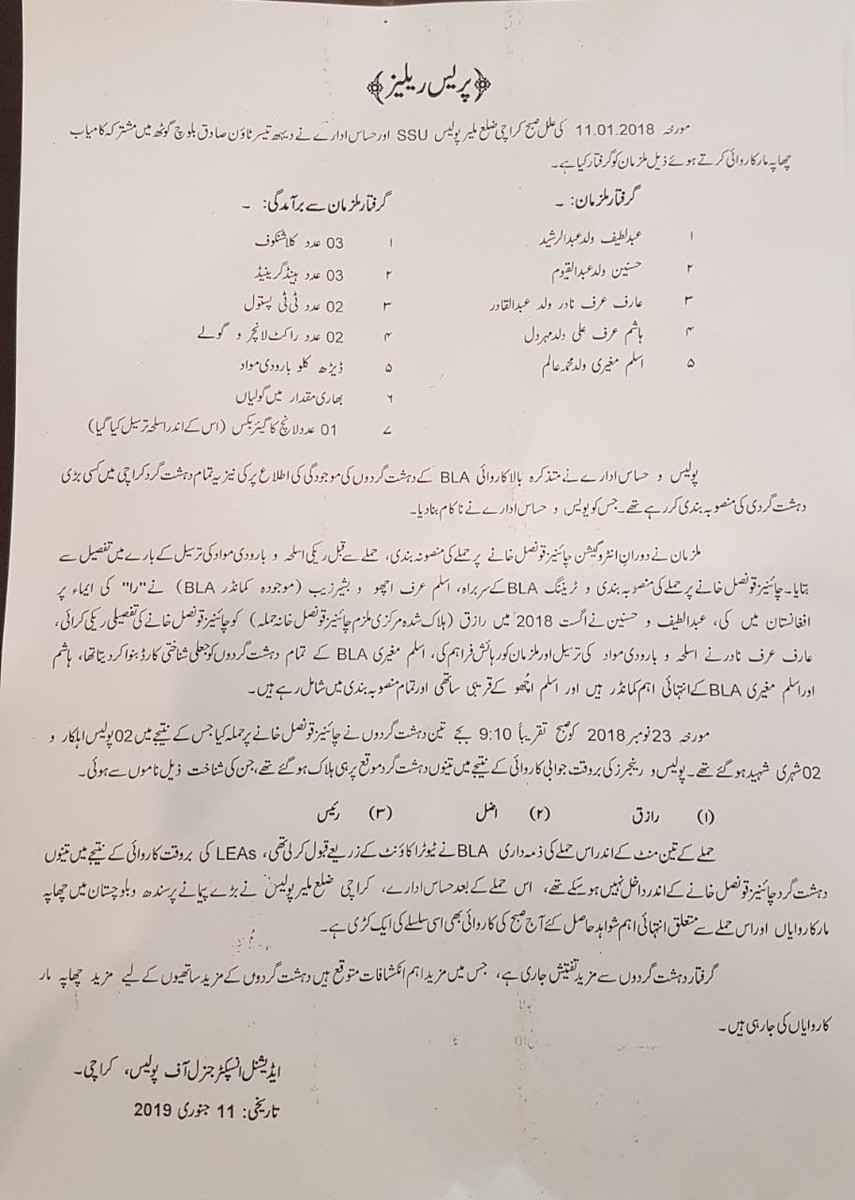


A statement by police in Karachi issued on Friday, January 11, 2019, alleging that the attack on the Chinese consulate in Karachi last November was planned in Afghanistan on the orders of India's main spy agency, Research and Analysis Wing (RAW).

Earlier, while briefing media at his office, Shaikh had said the SSU and intelligence agencies had conducted a joint raid early on Friday in the Sadiq Baloch Goth area on the outskirts of Karachi and arrested five militants associated with the Baloch Liberation Army, who he said were planning a major attack.
“Law enforcement agencies thwarted the attack,” Shaikh told reporters, giving the names of the militants and saying a huge cache of arms and ammunition was recovered from their custody. 
He alleged that during interrogation, the arrested militants had revealed that the attack on the Chinese consulate was planned by BLA’s head of planning and training, Aslam alias Acho and Basheer Zeb, the incumbent commander of the BLA, on the orders of the Indian spy agency. The reconnaissance was conducted in Aigust 2018 by Razzaq, one of the militants killed during the attack, explosives were provided by Arif alias Nadir, while Aslam Mugheri had helped the attackers obtain fake identity cards.
“Mugheri is an important commander of BLA and a close aide of Aslam Acho, who had been involved in the entire planning,” Shaikh said.
The Baloch Liberation Army is a separatist group that opposes projects linked to China’s Belt and Road infrastructure initiative in the resource-rich Baluchistan province. The group confirmed the death of Aslam Baloch and five others in a statement last month. 


Pakistan urges Hajj pilgrims to complete Saudi biometrics till Sunday

Updated 5 sec ago
Follow

Pakistan urges Hajj pilgrims to complete Saudi biometrics till Sunday

  • Saudi Arabia has allocated Pakistan a quota of 179,210 pilgrims for this year’s Hajj
  • Saudi biometric verification is mandatory for issuance of Hajj visas, ministry says

ISLAMABAD: The Pakistani religious affairs ministry has urged aspiring Hajj pilgrims to complete mandatory Saudi biometric verification for Hajj visas by Sunday, Pakistani state media reported, with preparations for the 2026 pilgrimage gathering pace following stricter oversight of the Hajj process.

Saudi Arabia has allocated Pakistan a quota of 179,210 pilgrims for Hajj 2026, with the majority of seats reserved under the government scheme and the remainder allocated to private tour operators.

Regulations for private Hajj operators have been tightened and their quota reduced following widespread complaints last year, when tens of thousands of pilgrims were unable to travel under the private Hajj scheme.

The Pakistani religious affairs ministry said last month that Saudi biometric verification is mandatory for the issuance of Hajj visas and pilgrims should complete it at home using the ‘Saudi Visa Bio’ app.

“Hajj visas will not be issued without biometrics, however pilgrims over 80 years of age are exempted from biometrics,” the Radio Pakistan broadcaster reported, citing the religious affairs ministry.

Pakistan has been steadily implementing digital and procedural requirements for pilgrims ahead of Hajj 2026, including mandatory training sessions, biometric checks and greater use of mobile applications, as part of efforts to reduce mismanagement.

Pilgrims who were unable to complete biometric verification through the mobile application should visit designated Saudi Tasheer centers before Feb. 8, according to the religious affairs ministry.

Details of the centers are available on Pakistan’s official Hajj mobile application. Tasheer centers will remain open from 9am to 5pm today and on Sunday to facilitate Hajj pilgrims, it added.