

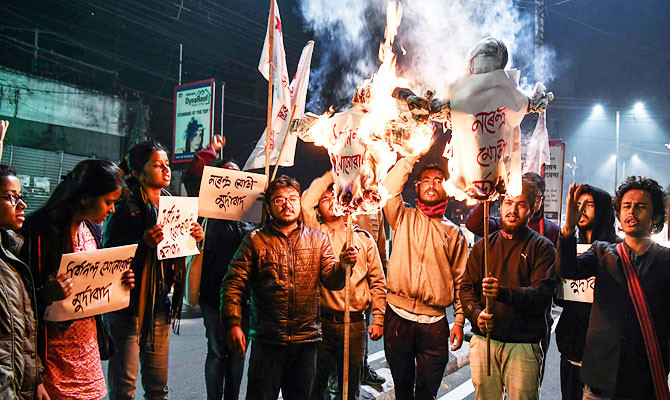
Demonstrations flare in India over ‘divisive’ asylum bill

Activists of Students' Federation of India (SFI) burn the effigies of India's Prime Minister and Chief Minister of Assam in Guwahati on January 8, 2019 after India's lower house passed today legislation that will grant citizenship to members of certain religious minorities but not Muslims. (AFP)
Updated 09 January 2019
Follow

Demonstrations flare in India over ‘divisive’ asylum bill

  • Congress claims Citizenship (Amendment) Bill will lead to widespread unrest
  • Minorities are persecuted in Pakistan and other neighboring countries

NEW DELHI: India’s parliamentary lower house on Tuesday passed a controversial bill that gives non-Muslim communities from neighboring Afghanistan, Pakistan and Bangladesh citizenship rights despite strong dissent from opposition parties. 

The opposition called the bill “an attack on the core of the Indian constitution.”

The bill was passed on a day when all seven northeastern states were brought to a standstill by protests over the proposed legislation. 

“The Citizenship (Amendment) Bill is not for Assam alone or for the betterment of migrants coming from a particular country,” the Home Minister Rajnath Singh told Parliament.

“This bill is also for migrants who have come from the western borders and have settled down in Rajasthan, Punjab, New Delhi and Rajasthan,” he said.

“Minorities are persecuted in Pakistan and other neighboring countries. They have faced violence. The bill offers security to persecuted minorities.”

The bill will grant citizenship to Hindus, Sikhs, Buddhists, Jains, Parsis and Christians who fled religious persecution in Bangladesh, Pakistan and Afghanistan and entered India before Dec. 31, 2014. 

However, the opposition Congress Party walked out of Parliament, saying the bill was discriminatory and against the spirit of the constitution.

“The bill will lead to unrest not only in Assam but also in several parts of India,” Mallikarjun Kharge, the party’s parliamentary leader, said.

Saugata Roy, a senior opposition leader with the Trinamool Congress based in West Bengal, condemned what he described “as the most diabolical and divisive bill of the past 70 years.”

“Muslims are not included among the six religions mentioned in the bill. Make it secular. Anyone who comes out of religious persecution should be included if they seek asylum in India,” he said.

While Parliament debated the contentious bill, protests brought states in India’s northeast to a near standstill after student organizations and civil rights groups demanded an 11-hour shutdown.

Assam was worst affected by the strike with some street protests descending into violence. The call for the shutdown was made by the All Assam Student Union (AASU) and several civil rights groups.

“The overwhelming response to the call for the strike shows how agitated the people of Assam are over the Citizenship Bill,” said Sammujal Bhattacharya, an adviser to the AASU.

“The bill is sectarian and communal in nature. In India, citizenship cannot be decided on the basis of religion. We will fight with all that we have,” he said.

Bhattacharya said the Assam accord of 1985 fixed the cut-off date for granting citizenship to people who entered India from Bangladesh as March 1971, and any attempt to tamper with the deadline would be met with resistance.

The BJP government, under the leadership of Prime Minister Narendra Modi, introduced the bill in 2016. 

Critics say that by amending the Citizenship Act, the BJP wants to protect Bengali Hindus who have come from Bangladesh while ignoring Muslims.

Rezaul Karim Sarkar, of the AASU, claimed the bill “will disturb communal harmony in Assam. It will incite violence between Hindu and Muslim. The BJP is aiming at the 2019 elections and wants to win on the basis of religious violence.”

However, the Bengali United Forum of Assam said the bill will help Hindu Bengalis “live a respectable life.”

Mahananda Sarkar Dutta, the forum’s chief coordinator, said: “We are not part of the BJP or any political party. The people of Assam should not blame us for the bill. Other communities will also benefit,” he said.


Russia strikes power plant, kills four in Ukraine barrage

Updated 5 sec ago
Follow

Russia strikes power plant, kills four in Ukraine barrage

KHARKIV: Russia battered Ukraine with more than two dozen missiles and hundreds of drones early Tuesday, killing four people and pummelling another power plant, piling more pressure on Ukraine’s brittle energy system.
An AFP journalist in the eastern Kharkiv region, where four people were killed, saw firefighters battling a fire at a postal hub and rescue workers helping survivors by lamp light in freezing temperatures.
Ukrainian President Volodymyr Zelensky said “several hundred thousand” households near Kyiv were without power after the strikes, and again called on allies to bolster his country’s air defense systems.
“The world can respond to this Russian terror with new assistance packages for Ukraine,” President Volodymyr Zelensky wrote on social media.
“Russia must come to learn that cold will not help it win the war,” he added.
Authorities in Kyiv and the surrounding region rolled out emergency power cuts in the hours after the attack, saying freezing temperatures were complicating their work.
DTEK, Ukraine’s largest energy provider, said Russian forces had struck one of its power plants, saying it was the eighth such attack since October.
The operator did not reveal which of its plants was struck, but said Russia had attacked its power plants over 220 times since Moscow invaded Ukraine in 2022.
Daily attacks
Moscow has pummelled Ukraine with daily drone and missile barrages in recent months, targeting energy infrastructure and cutting power and heating in the frigid height of winter.
The Ukrainian air force said that Tuesday’s bombardment included 25 missiles and 247 drones.
The Kharkiv governor gave the death toll and added that six people were wounded in the overnight hit outside the region’s main city, also called Kharkiv.
White helmeted emergency workers could be seen clambering through the still-smoking wreckage of a building occupied by postal company Nova Poshta, in a video posted by the regional prosecutor’s office.
Within Ukraine’s second city, Kharkiv Mayor Igor Terekhov said a Russian long-range drone struck a medical facility for children, causing a fire. No casualties were reported.
The overnight strikes hit other regions as well, including southern city Odesa.
Residential buildings, a hospital and a kindergarten were damaged, with at least five people wounded in two waves of attacks, regional governor Sergiy Lysak said.
Russia’s use last week of a nuclear-capable Oreshnik ballistic missile on Ukraine sparked condemnation from Kyiv’s allies, including Washington, which called it a “dangerous and inexplicable escalation of this war.”
Moscow on Monday said the missile hit an aviation repair factory in the Lviv region and that it was fired in response to Ukraine’s attempt to strike one of Russian President Vladimir Putin’s residences — a claim Kyiv denies and that Washington has said it does not believe happened.