

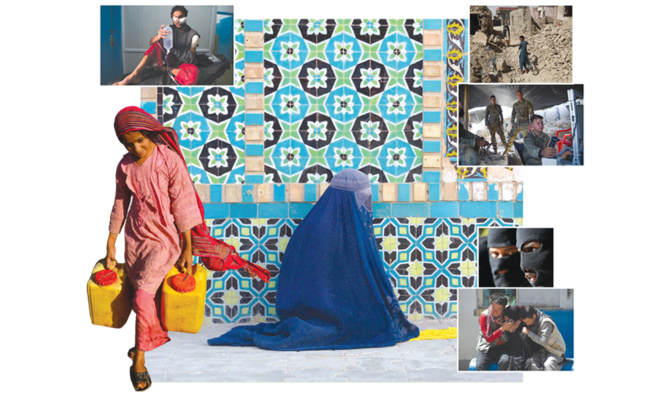

KABUL: At home or abroad, few people have any doubt that from a political and military standpoint, Afghanistan has been going through its most turbulent year since a US-led force toppled the Taliban government in late 2001 after it refused to hand over Osama bin Laden, the mastermind of the 9/11 Al-Qaeda attacks.
For Afghanistan, the way forward looks more uncertain than perhaps at any time since political tensions first flared more than four decades ago, with a Communist coup backed by the Soviet Union followed by a fully fledged military intervention.
With the Taliban making territorial gains and targeting Afghan soldiers and security forces in their bases and outposts, 2018 has witnessed a surge in violence across the country. The fighters have carried out a large number of attacks, starting with a bombing in January that killed more than 100 people and wounded hundreds of others in the capital Kabul.
For their part, the NATO-led international force and the US military have turned up the heat on both the Taliban and the Islamic State-Khorasan Province, also known as Daesh-KP, Daesh’s local affiliate with strongholds in some eastern provinces. But the pressure has not put an end to deadly attacks in Kabul and elsewhere, many of them involving suicide bombers.
In view of the administrative paralysis and the rising tide of violence, including the attacks that marred October’s parliamentary elections, which were held more than a year after their actual date, there are doubts that the crucial presidential vote will be held to schedule in April next year.
The election commission still has not been able to release even the preliminary results of the October ballot, which has been described by the UN as the most violent and disorganized of all elections since the overthrow of the Taliban 17 years ago.
With the incumbent president, Ashraf Ghani, seeking re-election, some of his political opponents have openly speculated that he might use his clout to divert state resources to swing the vote’s outcome in his favor.
A number of Afghan politicians and American diplomats are pushing for the formation of an interim government to give the talks between the US administration and the Taliban in Qatar time to succeed. But some analysts say that Ghani is opposed to the idea because his re-election prospects are brightest as long as he is in office.
US President Donald Trump is on record as saying that Afghans should be allowed to choose their leader according to their traditions. If they were to accept such a system, it would mean the country would be ruled by a man chosen by an assembly of tribal chiefs rather than elected by popular vote.

Many American taxpayers are also questioning why US troops need to be in Afghanistan after so many years. Pressure is building on the Trump administration, some analysts say, to stage a complete troop pullout before it becomes obvious that the Taliban has won the war.
After years of a military stalemate, Trump hesitantly accepted a Pentagon proposal in the summer of 2017 to send additional troops and escalate the intensity of the military campaign against the Taliban and other groups as part of a new war strategy.
For a short time this year, it seemed that the Taliban was willing to give peace a chance. In June the Kabul government and the fighters observed a rare three-day cease-fire during the Eid Al-Fitr holiday. President Ghani extended the truce for several days and repeated his call for the group to enter into peace talks without preconditions. But his overture was rebuffed by the Taliban.
A month later, hopes rose again on reports that US government officials had met Taliban representatives in Doha to discuss potential talks. In Kabul, President Ghani went the extra mile in August to propose a three-month conditional cease-fire on the occasion of Eid Al-Adha. The Taliban responded with continued attacks.
During this year alone, the US is said to have dropped nearly 6,000 bombs — a very high number compared with previous years’ statistics — in Afghanistan on suspected militant hideouts and places with a high concentration of insurgents.
However, the escalation has not only failed to make a dent in the Taliban’s morale, the group has continued to gain ground across the country. In fact, the casualties on all sides — civilians, insurgents and Afghan army and security forces — have surged to unprecedented levels.
President Ghani recently put the number of security personnel killed battling the insurgency since he took office four years ago at 28,000. But observers say that the overall casualty figures are much higher as tens of thousands of Afghan families struggle with the burden of caring for the wounded. It is, after all, a conflict that mainly pits Afghans against fellow Afghans.
For the US defense department, there is no escaping the handwriting on the wall; the military strategy that they sold to a reluctant President Trump has fallen far short of delivering a victory over the Taliban and other insurgent groups. For their part, the leaders of the insurgency must also have realized that the goal of recapturing power remains well beyond reach.
The deadlock should have convinced both sides that a negotiated settlement is the only feasible solution. But the Taliban’s insistence on total withdrawal of US forces before they agree to hold talks with the Kabul government has been a sticking point in all negotiations.
Even though the US has so far spent a trillion dollars on the Afghan war, the longest one in American history, the results of this mammoth investment are hard to see. Many Afghans now doubt that President Trump has the political will to stay committed to winning the war, and could very well decide to cut his losses, prompting NATO allies to follow suit.
The uncertainty surrounding US plans is already seen as emboldening the Taliban and other groups, prompting them to escalate their attacks. Increased meddling by regional powers bent on having a say in Afghanistan’s future political make-up could touch off an open-ended civil war, similar to the one that erupted after the Soviet withdrawal three decades ago.
In another possible scenario, the Kabul government would collapse due to infighting compounded by the disappearance of the international coalition’s security umbrella. Such an eventuality is equally likely to lead to a multi-sided civil conflict and hasten Afghanistan’s transition to a failed state.
The third possibility is that the war in Afghanistan rages on indefinitely and inconclusively with neither side able to declare victory. This of course will further fuel tribal and sectarian divisions, destabilize both society and polity, and leave in its wake a bloody wake of death and destruction.
The outcome that perhaps worries Afghans the most is one in which the insurgency overwhelms government security forces, compels foreign countries to withdraw their forces, and prompts international donors to abandon the country to its fate.
Such a scenario, though, conjures up images of the Al-Qaeda attacks on New York City’s World Trade Center and the Pentagon among other places on Sept. 11, 2001, which claimed the lives of nearly 3,000 civilians and triggered the US-led invasion of Afghanistan. Can the international community afford to forget such a painful lesson?


