

Pakistan willing to help US for Afghan peace talks — Foreign Office

1 / 3
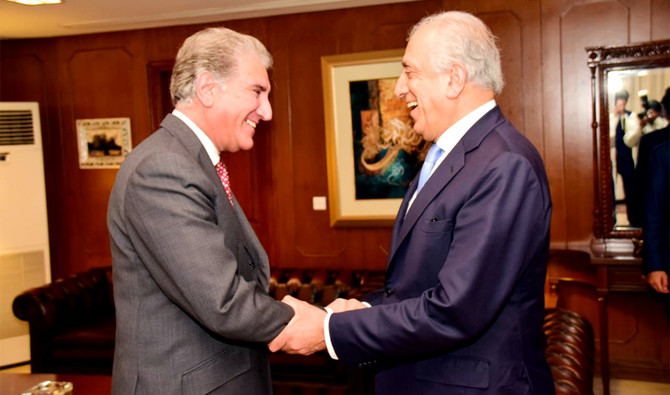
Zalmay Khalilzad, a special representative appointed by the US for the Afghan peace process, holds talks with Pakistan Foreign Minister Shah Mahmood Qureshi and Foreign Secretary Tehmina Janjua at the Ministry of Foreign Affairs in Islamabad on Tuesday. (Photo courtesy: Foreign Office)
2 / 3
Zalmay Khalilzad, a special representative appointed by the US for the Afghan peace process, center, at the Ministry of Foreign Affairs in Islamabad on Tuesday. (Photo courtesy: Foreign Office)
3 / 3
Zalmay Khalilzad, a special representative appointed by the US for the Afghan peace process, with Pakistan Foreign Minister Shah Mahmood Qureshi at the Ministry of Foreign Affairs in Islamabad on Tuesday. (Photo courtesy: Foreign Office)
Updated 04 December 2018
Follow

Pakistan willing to help US for Afghan peace talks — Foreign Office

  • US’ special envoy holds talks with the political and military leadership in Islamabad
  • Analysts stress on the need for a joint strategy to bring the Taliban to the negotiating table

ISLAMABAD: Pakistan’s Foreign Office said on Tuesday that it was ready to extend all possible help to the United States to bring the Taliban to the negotiating table and restore peace in conflict-ridden Afghanistan.

“The United States has finally agreed to initiate a dialogue with the Afghan Taliban which is a positive move,” Dr Mohammad Faisal, spokesman for the Ministry of Foreign Affairs, told Arab News.

This comes at a time when Zalmay Khalilzad, the US-appointed special envoy tasked with finding a solution to end the 17-year-old Afghan war, arrived in Islamabad on Tuesday to hold meetings with the country's political and military leadership. 

Khalilzad met with Pakistan Foreign Minister Shah Mahmood Qureshi and Foreign Secretary Tehmina Janjua at the Foreign Office on Tuesday where the two sides discussed an ambit of mutual cooperation to restore peace and stability in Afghanistan.  “Pakistan has been pressing the US for the last 10 years to settle the Afghan conflict through dialogue and negotiations with the Taliban,” Dr Faisal said.

“The important thing at this stage is that the US is finally engaging the Afghan Taliban in dialogue,” he said, adding that “the strategies and all other things can be worked out mutually”.

Khalilzad’s visit comes a day after US President Donald Trump wrote a letter to Prime Minister Imran Khan, seeking Islamabad’s “assistance and facilitation in achieving a negotiated settlement of the Afghan war”.

Khalilzad will also travel to Afghanistan, Russia, Uzbekistan, Turkmenistan, Belgium, the United Arab Emirates, and Qatar in a renewed effort to find a peaceful end to the Afghan war.

“He will meet with Afghan government officials and other interested parties to support and facilitate an inclusive peace process in Afghanistan, empowering the Afghan people to decide their nation’s fate,” the US State Department said in a statement.

Washington has been pushing Islamabad for long to play its role in bringing the Afghan Taliban to the negotiating table for a peaceful end to the decades-old conflict. The relations of both the allies, however, soured when President Trump accused Pakistan of providing a “safe haven to the terrorists we hunt” when he posted a series of tweets on January 1.

To ease the tensions and convince Pakistan to play its role in the Afghan peace process, Khalilzad held a series of meetings with the Pakistani leadership in Islamabad in October. The move was part of Washington’s renewed push to arrive at a political solution to the Afghan conflict.

Rahimullah Yousufzai, a security analyst and expert on Afghan affairs, said that Pakistan alone cannot help the US in achieving peace for Afghanistan as its influence over the Taliban has reduced with the passage of time. “There is a need to adopt a more regional approach to convince the Taliban to enter negotiations with the Afghan government,” he told Arab News. 

“China and Iran should also be involved in the negotiations process for a positive result,” he added.

Yousufzai said that no imminent solution of the Afghan conflict was on the cards but if both Pakistan and the US succeed in initiating a meaningful dialogue with the Taliban “this will at least help reduce frequency of bomb blasts and other terror attacks in the region”.

Last week, Afghan President Ashraf Ghani announced forming a 12-member team which would engage with the Taliban. However, he has yet to receive a positive response from the militants.

Professor Tahir Malik, an academic and an analyst, said that hurdles in the way of a dialogue with the Afghan Taliban can be removed only if “both Pakistan and the US move ahead with a joint strategy”.

“It is heartening to see that the relations of Islamabad and Washington are warming up after years, and hopefully this will help restore peace in Afghanistan,” he told Arab News.


German court rules spy service may not label AfD ‘extremist’ for now

Updated 6 sec ago
Follow

German court rules spy service may not label AfD ‘extremist’ for now

  • The court found that there were indeed efforts to undermine Germany’s free democratic order from within the AfD
  • Alice Weidel, the party’s co-leader, hailed the ruling as “a major victory not only for the AfD but also for democracy”

BERLIN: A German court ruled on Thursday that the domestic intelligence agency cannot label the far-right Alternative for Germany (AfD) party as a “confirmed right-wing extremist” group, at least for now.
The AfD had challenged the designation, which would empower the spy agency to use broader surveillance powers to monitor it and would embolden political opponents seeking a ban of the anti-immigration party.
The Cologne administrative court’s decision puts the designation on hold pending the final outcome of a legal battle between the AfD and Germany’s intelligence agency, the Federal Office for the Protection of the Constitution (BfV).
The court found that there were indeed efforts to undermine Germany’s free democratic order from within the AfD, highlighting its demands to ban Muslim minarets, public calls to prayer and headscarves in public institutions.
But it ruled that the party as a whole was not “shaped by these efforts” such that “an anti-constitutional tendency can be established” to characterise the party in its entirety as extremist.
Alice Weidel, the party’s co-leader, hailed the ruling as “a major victory not only for the AfD but also for democracy and the rule of law” in a post on X.
The decision had also “thrown a spanner in the works” for the “fanatics” seeking to outlaw the AfD, she added.
Interior Minister Alexander Dobrindt, a conservative, noted that the court decision still found reason to suspect the AfD of working “against the free democratic order” and “pursuing anti-constitutional aims.”
The party will continue to be monitored as a “suspected” extremist group, he added.

- Politically isolated -

The AfD was founded in 2013 primarily as a euroskeptic party, but has since become more hard-line nationalist, putting an anti-immigrant stance at the heart of its appeals to voters.
The party surged to become the largest opposition force in last year’s nationwide election, winning nearly 21 percent of the vote.
The AfD is particularly strong in the formerly communist East Germany, holding commanding leads in the polls ahead of several key state-level elections there later this year.
But it remains frozen out of power across the country, as all other political parties have maintained a “firewall” against it and refused to consider cooperating.
Many in mainstream German politics see the AfD’s far-right positions and rhetoric as taboo, a view informed in part by Germany’s dark Nazi history.
The intelligence agency moved to officially classify the national AfD party as a “confirmed extremist” organization on May 2 of last year, a step up from its previous designation as a “suspected” case.
The party filed a lawsuit against the move and the BfV agreed to suspend the classification until a court ruling on the matter is issued.
Several regional AfD party organizations have already been designated as “confirmed extremist” groups.

- Calls to ban -

Thursday’s decision by the Cologne court, which can still be appealed, keeps it on hold until a verdict is reached in the AfD’s broader challenge to the classification.
Some of the AfD’s political foes have advocated banning the party — a process for which there are high legal hurdles in Germany.
It would require, for example, evidence that a party is actively trying to abolish the democratic order and has the means to do so.
Dobrindt and a number of other conservatives have criticized such a move, arguing instead that the AfD must be defeated at the ballot box.
On Thursday, Dobrindt said the court decision only underscored how high the legal hurdles for action against a political party is.
“I have repeatedly said if we want the AfD to go away it should be by governing competently and not by banning them,” Dobrindt said.