

Pakistan says responding to Afghan ‘offensive operations’ after border fire as tensions escalate

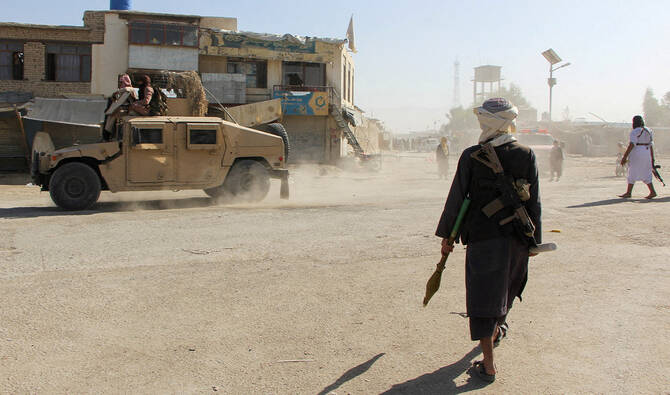
Afghan Taliban fighters patrol near the Afghanistan-Pakistan border in Spin Boldak, Kandahar Province, following exchanges of fire between Pakistani and Afghan forces in Afghanistan, October 15, 2025. (Reuters/File)
Short Url
Updated 26 February 2026
Follow

Pakistan says responding to Afghan ‘offensive operations’ after border fire as tensions escalate

  • Afghan Taliban spokesperson says “large-scale offensive operations” launched against Pakistani military bases
  • Pakistan says Afghan forces opened “unprovoked” fire across multiple sectors along shared border

ISLAMABAD: Afghanistan’s Taliban authorities said on Thursday they had launched “large-scale offensive operations” against Pakistani military bases and installations, prompting Pakistan to say its forces were responding to what it described as unprovoked fire along the shared border.

The escalation follows Islamabad’s weekend airstrikes targeting what it said were Tehreek-e-Taliban Pakistan (TTP) and Daesh militant camps inside Afghanistan in response to a wave of recent bombings and attacks in Pakistan. Islamabad said the strikes killed over 100 militants, while Kabul said dozens of civilians were killed and condemned the attacks as a violation of its sovereignty.

In a post on social media platform X, Afghan government spokesperson Zabihullah Mujahid said Afghanistan had launched “large-scale offensive operations” in response to repeated violations by the Pakistani military.


Pakistan’s Ministry of Information said Afghan forces had initiated hostilities along multiple points of the frontier.

“Afghan Taliban regime unprovoked action along the Pakistan–Afghanistan border given an immediate, and effective response,” the ministry said in a statement.

The statement said Pakistani forces were targeting Taliban positions in the Chitral, Khyber, Mohmand, Kurram and Bajaur sectors, claiming heavy Afghan casualties and the destruction of multiple posts and equipment. It added that Pakistan would take all necessary measures to safeguard its territorial integrity and the security of its citizens.


Separately, security officials said Pakistani forces had carried out counterattacks in several border sectors.

“Pakistan’s security forces are giving a befitting reply to the unprovoked Afghan aggression with full force,” a security official said, declining to be named. 

“The Pakistani security forces’ counter-attack destroyed Taliban’s hideouts and the Khawarij fled,” they added, referring to TTP militants. 

The claims from both sides could not be independently verified.

Cross-border violence has intensified in recent weeks, with Pakistan blaming a surge in suicide bombings and militant attacks on militants it says are based in Afghanistan. Kabul denies providing safe havens to anti-Pakistan militant groups.

The clashes mark the third major escalation between the neighbors in less than a year. Similar Pakistani strikes last year triggered weeklong clashes before Qatar, Türkiye and other regional actors mediated a ceasefire in October.

The 2,600-kilometer (1,600-mile) frontier, a key trade and transit corridor linking Pakistan to landlocked Afghanistan and onward to Central Asia, has faced repeated closures amid tensions, disrupting commerce and humanitarian movement. Trade between the two nations has remained closed since October 2025.


IAEA approves safeguards for Pakistan’s Chashma nuclear power plant unit — FO

Updated 6 sec ago
Follow

IAEA approves safeguards for Pakistan’s Chashma nuclear power plant unit — FO

  • Move reflects world’s confidence in Pakistan’s commitment to peaceful use of nuclear energy, non-proliferation, says FO
  • Says after completion, power plant’s unit will provide substantial source of low-carbon electricity to the national grid

ISLAMABAD: Pakistan’s foreign office said on Wednesday that the International Atomic Energy Agency’s (IAEA) board of governors has approved a safeguards agreement with Islamabad for a unit of its Chashma nuclear power plant, reflecting the world’s growing confidence in the South Asian country’s commitment to peaceful use of nuclear energy. 

Under a safeguards agreement, the IAEA has the right and obligation to ensure that safeguards are applied on all nuclear material in the territory, jurisdiction or control of a state to verify that such material is not diverted to nuclear weapons or other nuclear explosive devices.

The agreement pertains to Unit 5 of the Chashma nuclear power plant located in Pakistan’s eastern Punjab province. The plant will have a gross capacity to generate 1,200 megawatts, with its pressurized water reactor expected to become operational by 2030, the foreign office said. 

“This important development reflects the international community’s continued confidence in Pakistan’s commitment to the peaceful use of nuclear energy and its adherence to global non-proliferation and safeguards obligations,” the statement said. 

It said after completion, the plant’s Unit 5 will provide a substantial source of low-carbon electricity to Pakistan’s national grid, contributing to energy security, climate goals and sustainable economic growth.

Over the past year, nuclear power accounted for 18.3 percent of Pakistan’s national electricity mix and 34 percent of the country’s total low-carbon electricity generation. 

Pakistan currently operates six nuclear power plants with a combined installed capacity of 3,530 megawatts, the foreign office said. 

“With more than 100 reactor-years of operational experience, Pakistan maintains a strong record of safe, secure and fully safeguarded nuclear power operations in line with international standards,” the statement included. 

Despite contributing less than one percent to greenhouse gas emissions worldwide, Pakistan is ranked among the world’s most vulnerable nations to climate change effects. 

Torrential rains and floods in 2022 and 2025 wreaked havoc across the country, killing thousands and inflicting damages of billions of dollars on the country.