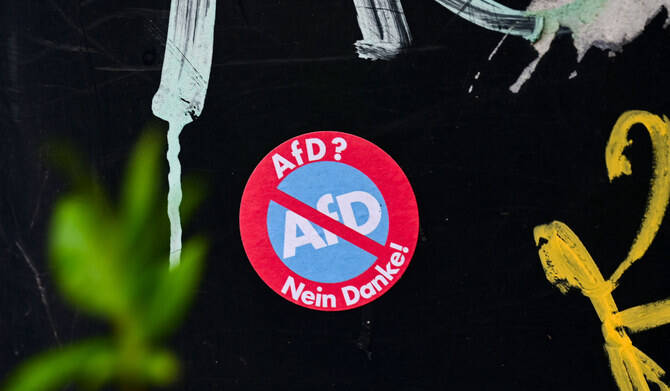

BERLIN: Germany’s spy agency on Friday classified the far-right Alternative for Germany (AfD) as “extremist,” enabling it to step up monitoring of the country’s biggest opposition party, which decried the move as a “blow against democracy.”
A 1,100-page experts’ report found the AfD to be a racist and anti-Muslim organization, a designation that allows the security services to recruit informants and intercept party communications, and which has revived calls for the party’s ban.
“Central to our assessment is the ethnically and ancestrally defined concept of the people that shapes the AfD, which devalues entire segments of the population in Germany and violates their human dignity,” the BfV domestic intelligence agency said in a statement.
“This concept is reflected in the party’s overall anti-migrant and anti-Muslim stance,” it said, accusing the AfD of stirring up “irrational fears and hostility” toward individuals and groups.
The BfV agency needs such a classification to be able to monitor a political party because it is more legally constrained than other European intelligence services, a reflection of Germany’s experience under both Nazi and Communist rule.
Other organizations classified as extremist in Germany are neo-Nazi groups such as the National Democratic Party (NDP), Islamist groups including Islamic State, and far-left ones such as the Marxist-Leninist Party of Germany.
The agency was able to act after the AfD last year lost a court case in which it had challenged its previous classification by the BfV as an entity suspected of extremism.
The move follows other setbacks the far-right across Europe has suffered in recent months as it seeks to translate surging support into power. They include a ban on France’s Marine Le Pen contesting the 2027 presidential election after her embezzlement conviction, and the postponement of Romania’s presidential vote after a far-right candidate won the first round.
“VERY SERIOUS. After France and Romania, another theft of Democracy?” wrote Matteo Salvini, deputy Italian prime minister and leader of far-right party, the League, on X.
The AfD denounced its designation as a politically motivated attempt to discredit and criminalize it.
“The AfD will continue to take legal action against these defamatory attacks that endanger democracy,” co-leaders Alice Weidel and Tino Chrupalla said in a statement.
A BAN?
German parliament could now attempt to limit or halt public funding for the AfD — but for that authorities would need evidence that the party is explicitly out to undermine or even overthrow German democracy.
Meanwhile, civil servants who belong to an organization classified as “extremist” face possible dismissal, depending on their role within the entity, according to Germany’s interior ministry.
The stigma could also make it harder for the AfD, which currently tops several polls and is Germany’s most successful far-right party since World War Two, to attract members.
The BfV decision comes days before conservative leader Friedrich Merz is due to be sworn in as Germany’s new chancellor and amid a heated debate within his party over how to deal with the AfD in the new Bundestag, or lower house of parliament.
The AfD won a record number of seats in the national election in February, coming in second behind Merz’s conservatives, which in theory entitled it to chair several key parliamentary committees.
A prominent Merz ally, Jens Spahn, has called for the AfD to be treated as a regular opposition party to prevent it casting itself as a “victim.”
However, other established parties, and many conservatives have rejected that approach — and could use Friday’s news to justify blocking AfD attempts to lead committees.
“Starting today, no one can make excuses anymore: This is not a democratic party,” said Manuela Schwesig, premier of Mecklenburg-Vorpommern and senior member of the Social Democrats (SPD), who are about to form a government with the conservatives.
Under the new government, the authorities should review whether to ban the AfD, SPD leader Lars Klingbeil told Bild newspaper.
SPD’s outgoing chancellor Olaf Scholz on Friday called for a careful evaluation and warned against rushing to outlaw the party.
Created in 2013 to protest the euro zone bailouts, the euroskeptic AfD morphed into an anti-migration party after Germany’s decision to take in a large wave of refugees in 2015.