

Tensions flare as world leaders fly to G20 forum

1 / 3
US President Donald Trump talks to reporters as he departs for travel to the G20 summit in Argentina from the White House in Washington on November 29, 2018. (REUTERS/Jonathan Ernst)
2 / 3
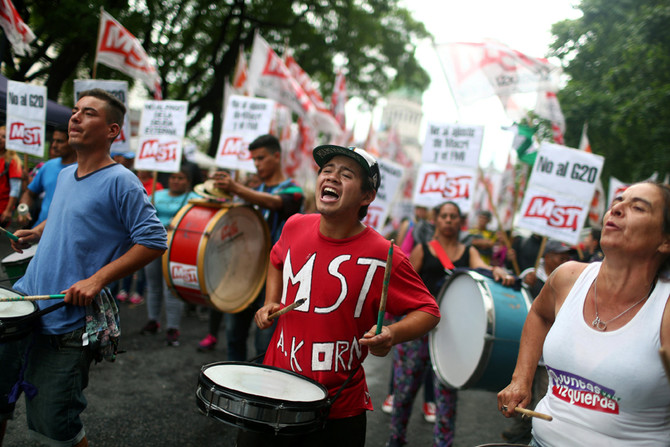
Demonstrators play drums and shout slogans, ahead of the Group 20 summit, in Buenos Aires, Argentina on November 29, 2018. (REUTERS/Pilar Olivares)
3 / 3
Demonstrators pose for a photograph ahead of the Group 20 summit, in Buenos Aires, Argentina on November 29, 2018. (REUTERS/Pilar Olivares)
Updated 30 November 2018
Follow

Tensions flare as world leaders fly to G20 forum

BUENOS AIRES: Global trade and geopolitical tensions grew at the G20 meeting in Buenos Aires even as world leaders flew into the Argentine capital for the annual summit of the biggest nations.

US President Donald Trump, en route to the summit, tweeted that he would not hold planned talks with Vladimir Putin, the Russian president, as a result of the continuing confrontation between Russia and Ukraine.

“I have decided it would be best for all parties concerned to cancel my previously scheduled meeting,” he wrote from US Air Force One on the way to Argentina. “I look forward to a meaningful summit again as soon as this situation is resolved.”

However, Trump did nothing to tone down the rhetoric in the confrontation looming at G20 between the US and China over tariffs imposed by the two countries on each other’s products.

“Billions of dollars are pouring into the coffers of the US because of the tariffs being charged to China, and there is a long way to go,” he tweeted.

That dashed earlier reports that Trump was “very close” to a deal with China on trade, and that US officials were preparing to delay the introduction of tariffs.

Trump is due to meet with President Xi Jinping of China over dinner in Buenos Aires. Trade and finance dominated the day before official meetings begin between the 20 leaders and their invitees today. 

Marisa Bircher, Argentina’s international trade secretary, said that her country was committed to free and open trade, and would do all it could to facilitate dialogue between the US and China at the summit.

Away from the main summit center, the World Bank organized an investment forum to discuss financial issues and cross-border investment flows. Several big companies from Saudi Arabia are believed to have taken part in the event, which was held behind closed doors.

Security concerns continued to dog the summit in the buildup to the opening day. Patricia Bullrich, the Argentine security minister, said in the first of what are expected to be daily briefings that she had held talks with the leaders of social opposition groups who had been planning demonstrations, and that the security situation was under control.


Voting passes peacefully in Nepal’s first election since September youth-led protests

Updated 6 sec ago
Follow

Voting passes peacefully in Nepal’s first election since September youth-led protests

KARMANDU: Voting was peaceful in Nepal’s first nationwide election Thursday since a violent, youth-led uprising forced the government from power in September.
Turnout was about 60 percent and only a few minor incidents were reported, according to Nepal’s acting Chief Election Commissioner Ram Prasad Bhandari.
Vote counting would begin immediately after the ballot boxes are collected and transported to counting centers across the Himalayan nation, which could be as early as Thursday night. Results were expected by the weekend. Helicopters will be used to ferry the boxes from polling stations in remote mountain villages in the northern region by Friday morning, Bhandari said.
The next administration is expected to inherit daunting challenges. It must deliver on changes demanded by last year’s protests, tackle entrenched corruption and carefully manage ties with its powerful neighbors, India and China.
“I came to vote mainly because of the protest and so many people gave their lives in the hope of a change, in hope of seeing better Nepal,” said Luniva, a first-time voter. “Hopefully, I want to see my country become better by all the sacrifices that have been made.”
Others shared similar hopes that the election could usher in positive change after months of political unrest.
Voters are directly electing 165 members to the House of Representatives, the lower chamber of Parliament. The remaining 110 seats in the 275-member body will be allocated through a proportional representation system, under which political parties nominate lawmakers based on their share of the vote.
The election is widely seen as a three-way contest, shaped by voter frustration over widespread corruption and demands for greater government accountability.
The National Independent Party, founded in 2022, is considered the front-runner, posing a strong challenge to two long-dominant parties: the Nepali Congress and the Communist Party of Nepal (Unified Marxist–Leninist).
The new party’s prime ministerial candidate is rapper-turned-politician Balendra Shah, who won the 2022 Katmandu mayoral race and emerged as a leading figure in the 2025 uprising that ousted former Prime Minister Khadga Prasad Oli.
Shah, 35, has rode a wave of public anger toward traditional political parties. He highlighted health and education for poor Nepalis as a key focus of his campaign.
The protests against corruption and poor governance were triggered by a social media ban before snowballing into a popular revolt against the government. Dozens were killed and hundreds injured when protesters attacked government buildings and police opened fire on them.
While the Congress and the Communists retain loyal voter bases, Shah’s party has drawn larger crowds on the campaign trail, highlighting its growing appeal among younger voters seeking an alternative.
There are about 19 million registered voters among the country’s nearly 30 million people, according to the Election Commission of Nepal.
Millions of Nepalis living overseas are unable to take part in the vote. An estimated 3 million citizens work abroad — largely in the Middle East, Southeast Asia and neighboring India — and cannot cast ballots because the country does not yet have a system allowing voting from abroad.