

Pakistan PM, China condemn attack on Chinese consulate in Karachi

1 / 3
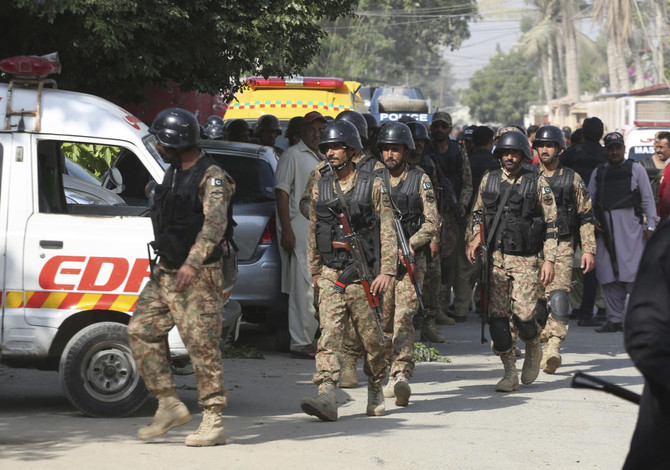
Pakistani security personnel arrive at the Chinese consulate in Karachi. (AP)
2 / 3
Pakistani security personnel arrive at the Chinese consulate in Karachi. (AP)
3 / 3
Paramilitary forces and policemen take cover behind a wall during an attack on the Chinese embassy on Friday, November 23, in Karachi. (Reuters)
Updated 23 November 2018
Follow

Pakistan PM, China condemn attack on Chinese consulate in Karachi

  • All the Chinese diplomats and staff at the consulate safe and were not harmed during the assault
  • Up to four gunmen tried to enter the consulate but were intercepted by security guards at a checkpoint

KARACHI: Pakistan’s Prime Minister Imran Khan has “strongly condemned” the attack on the Chinese consulate in the country’s southern port city of Karachi, in which two police officers and all the three assailants were killed.
Khan issued a statement, saying he has ordered a probe into Friday’s attack. He described the assault as part of a conspiracy against Pakistan and China’s economic and strategic cooperation.
Pakistani separatists from the southwestern Baluchistan province claimed the consulate attack.
Khan vowed in his statement that such incidents would never be able to undermine Pakistan’s relations with China, which are “mightier than the Himalayas and deeper than the Arabian Sea.”
Khan lauded the Karachi police and the paramilitary ranger forces, saying they showed exceptional courage in defending the consulate and that the “nation salutes the martyrs.”

China has also condemned the attack on its consulate and urged its ally to ensure the security of Chinese citizens.

“China strongly condemns any violent attacks against diplomatic agencies and requests that Pakistan takes practical measures to ensure the safety of Chinese citizens and institutions in the country,” foreign ministry spokesman Geng Shuang said at a regular press briefing.

Senior police official Ameer Ahmad Sheikh said all the Chinese diplomats and staff at the consulate were safe and were not harmed during the assault or the shootout on Friday.
The Baluch Liberation Army, a separatist group based in the southwestern province of Baluchistan, claimed responsibility for the attack and released photos of the three attackers.
Karachi, the capital of southern Sindh province, has a militant presence.
Up to four gunmen tried to enter the consulate but were intercepted by security guards at a checkpoint, senior local police official Javaid Alam Odho said.
An exchange of fire resulted “killing two of our constables and critically wounding another,” he said.
He added that the attackers “ran away” but did not confirm if the attack was over, saying the area had been cordoned off and security forces were conducting a clearing operation.
“Police and Rangers have reached the site,” added senior police official Pir Muhammad Shah.
Pictures posted to social media purportedly of the attack showed smoke rising from the area.
Karachi, Pakistan’s largest city and a financial hub, was for years rife with political, sectarian and ethnic militancy.
A crackdown in the city by security forces in recent years has brought a lull in violence, but scattered attacks still take place.
China, one of Pakistan’s closest allies, has poured billions into the South Asian country in recent years as part of a massive infrastructure project that seeks to connect its western province Xinjiang with the Arabian Sea.


Portugal heads for presidential vote, fretting over storms and far-right

Updated 4 sec ago
Follow

Portugal heads for presidential vote, fretting over storms and far-right

LISBON: Portugal ended campaigning on Friday for a presidential election this weekend amidst a battering by storms and fretting about the political whirlwind created by outspoken far-right leader Andre Ventura.
Ventura is almost certain to be beaten by Socialist candidate Antonio José Seguro in Sunday’s election but the far-right score will be watched almost as much as the latest of a series of fierce gales that have swept in off the Atlantic since the start of the year.
Voting has been delayed by a week in some municipalities because of the storms, which have killed at least five people, triggered flooding and caused widespread damage.
A new storm is forecast for Saturday.
But Ventura’s call to postpone the whole vote was rejected.
Prime Minister Luis Montenegro said the storms had caused a “devastating crisis” but that the threats to voting could be overcome. The electoral law only allows for a postponement in individual localities.
- Government attacks -

Seguro and Ventura have drastically rewritten their election scripts and appearances to focus on the towns and villages worst hit by floods, where the storm has torn down buildings and pylons.
Ventura, whose Chega (Enough) party was only created in 2019 but is now the biggest single opposition party in parliament, has attacked the response to the storm given by Montenegro’s center-right minority government.
Seguro has cast off his stance as a unifying candidate and also criticized the government.
The 63-year-old former Socialist party leader said he was “shocked” by the state’s efforts to get the country back on its feet.
Seguro has the advantage in the divisions caused by the rise of Chega in recent years.
An opinion poll published by the Publico daily on Wednesday gave Seguro 67 percent of voter support and Ventura 33 percent.
Seguro led the first round of the presidential election in January with 31 percent of votes and he is now backed by a host of political figures from the far left to the mainstream right.
Montenegro, whose government relies on the goodwill of the Socialists and Chega to survive, has not publicly backed any candidate, however.
His own party’s candidate obtained only 11 percent in the first round and dropped out.
Ventura, 43, took 23 percent of the vote in the first round.
The Portuguese establishment and analysts will be closely watching Ventura’s final score on Sunday to see whether his support is “stagnating” or whether he is “conquerering a new public,” said Joao Cancela, political science professor at Lisbon’s Nova University.
But the weather could have the final word in the debate as the storms and Seguro’s predicted win may lower voter turnout.