Dozens of migrants refuse to leave container ship in Libya

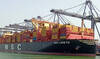
Migrants on board the container ship Nivin refuse to disembark in Misrata. 91 migrants, including a baby, were rescued by the ship’s crew last weekend after leaving Libya in a raft. (AP Photo)
Updated 14 November 2018
Follow

Dozens of migrants refuse to leave container ship in Libya

  • Loaded with cars, the ship Nivin was already bound for Misrata when it picked up 93 migrants in a foundering raft in the Mediterranean Sea late on Friday
  • The ship’s cargo of cars was peacefully unloaded, but the migrants remained unmoved

MISRATA: Dozens of migrants have barricaded themselves in a container ship in the Libyan port city of Misrata for the past five days, after being picked up at sea, and refuse to disembark, saying Libya is too dangerous for them.
Loaded with cars, the ship Nivin was already bound for Misrata when it picked up 93 migrants in a foundering raft in the Mediterranean Sea late on Friday and continued toward its destination. Two of the migrants agreed to leave with the Libyan coast guard, but the others refused, saying Libya was deadly for migrants and they wanted to go to Europe.
They have been in the Misrata port ever since, with the captain and crew taking refuge on the upper decks.
One of the migrants, a man from South Sudan reached by The Associated Press on the ship, vowed on Wednesday to reach Europe or die trying. He said six commercial ships passed his group before the Nivin finally stopped.
Libya’s coast guard had no immediate comment on the situation.
With just one rescue ship patrolling the Mediterranean, and European ports refusing to take in rescued migrants, commercial ships have become increasingly leery of picking up people in the sea. Repeatedly in recent months, they have found themselves caught in the middle between governments hostile to new migrants and an obligation under international maritime law to save
The man, who identified himself only by his name, Victor, fearing for his safety, said he himself had already been imprisoned repeatedly in Libya and that his own brother had died there. He had no intention of returning, he said.
“We don’t want to go out in Libya,” he told The Associated Press. “You can come and take my dead body outside.”
Julien Raickman, who is the head of the Doctors Without Borders mission in Libya, said Europe’s policy of refusing to take in rescued migrants has led to a spike in deaths. Now one in five who cross perish at sea, he said.
Raickman said the Libyan coast guard has given international organizations access to the migrants, who have food and some degree of medical care now, but no toilets or other sanitary facilities. The ship’s cargo of cars was peacefully unloaded, but the migrants remained unmoved.
“We’re afraid that this dispute will end in violence. The people who are on board are determined. They know that they went far and could face charges for taking control of a boat,” he said. “But these are people motivated by despair.”


Turkiye to forge on with tight economic policy, some fine-tuning, VP Yilmaz says

Updated 57 min 50 sec ago
Follow

Turkiye to forge on with tight economic policy, some fine-tuning, VP Yilmaz says

  • The central ‍bank forecasts inflation between 13-19 percent by end-2026

ISTANBUL: Turkiye is committed to carrying on its tight economic policies ​in order to cool inflation, and though it may fine-tune the program it will not change course, Vice President Cevdet Yilmaz said in comments embargoed to Friday.
“There is no plan to pause our program,” Yilmaz said at a briefing with reporters in Istanbul on Thursday. “All programs are dynamic, and adjustments can always be made.”
Yilmaz, who plays a key role overseeing economic policy at the presidency, said any such adjustments would aim to support production, investment and ‌exports while moderating consumption.
Turkiye ‌has pursued tight monetary and fiscal policies ‌for more ⁠than ​two years ‌in order to reduce price pressure, leading to high financing and borrowing costs that have weighed on businesses and households. Inflation has eased slowly but steadily over the last year but remains elevated at 31 percent annually.
Last month, Is Bank CEO Hakan Aran warned that focusing solely on one target — inflation — could create side effects, suggesting a “pause and restart” might be healthy once the program achieves certain targets.
Yılmaz said the ⁠government expects improvements in inflation in the first quarter, which should reflect to market expectations for year-end ‌inflation around 23 percent. The government projects inflation to dip ‍as far as 16 percent by year end, ‍within a 13-19 percent range, and falling to 9 percent in 2027. The central ‍bank forecasts inflation between 13-19 percent by end-2026.
Yilmaz noted inflation fell by nearly 45 points despite pressure from elevated food prices, hit by agricultural frost and drought.
The agricultural sector is expected to support growth and help ease price rises this year, which could ​help achieve official inflation targets, he said.
Yilmaz said the government wants to avoid a rapid drop in inflation that could hurt economic ⁠growth, jobs and social stability.
Turkiye’s economic program was established in 2023 after years of unorthodox easy money that aimed to stoke growth but that sent inflation soaring and the lira plunging. The program aims to dislodge high inflation expectations while boosting production and exports, in order to address long-standing current account deficits.
The central bank, having raised interest rates as high as 50 percent in 2024, eased policy through most of last year, bringing the key rate down to 38 percent.
Asked whether lower rates could trigger an exit from the lira currency, Yilmaz said: “What matters is real interest rates. Lowering rates as inflation falls does not affect real rates, so we do ‌not expect such an impact.”
He added that the government will strengthen mechanisms that selectively support companies while improving overall financial conditions.