

Israel defense minister Lieberman resigns over Gaza ceasefire

1 / 2
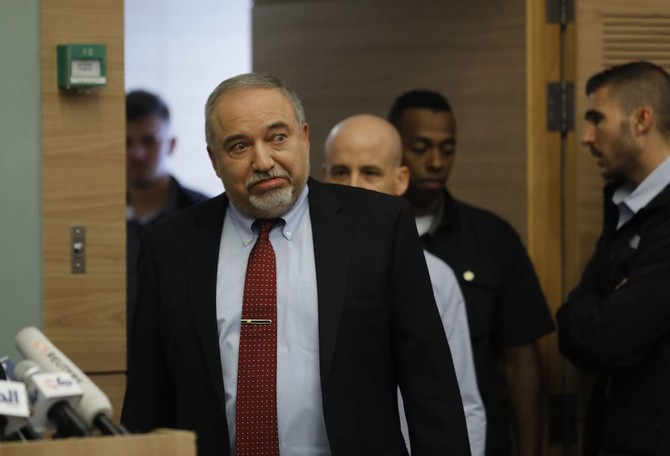
Israeli Defence Minister Avigdor Lieberman arrives at the Knesset in Jerusalem. (AFP)
2 / 2
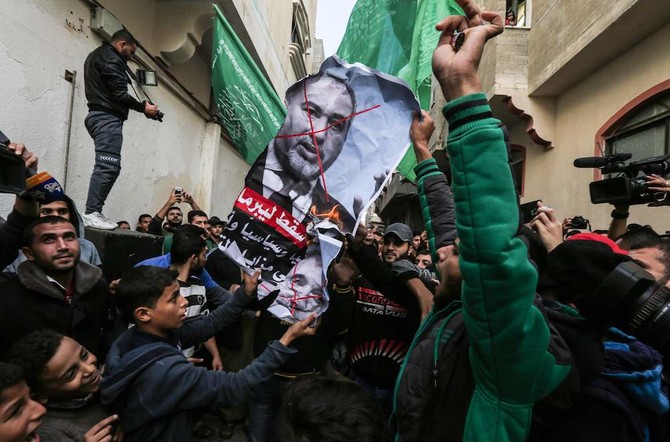
Palestinian demonstrators burn pictures of Israeli Defence Minister Avigdor Lieberman in front of the house of Hamas chief Ismail Haniya. (AFP)
Updated 14 November 2018
Follow

Israel defense minister Lieberman resigns over Gaza ceasefire

  • Benjamin Netanyahu defended Israel’s handling of Gaza as prudence
  • Lieberman describes Gaza cease-fire a 'capitulation to terror'

JERUSALEM: Israeli Defense Minister Avigdor Lieberman announced his resignation on Wednesday in protest at a Gaza cease-fire that he called a “capitulation to terror,” weakening Prime Minister Benjamin Netanyahu’s conservative coalition government.
“Were I to stay in office, I would not be able to look southern residents in the eye,” Lieberman told reporters, referring to Israelis subjected to a surge in Palestinian rocket attacks before Tuesday’s truce took hold.
Lieberman said his resignation, which will go into effect 48 hours after he submits a formal letter to Netanyahu, also withdraws his far-right Israel Beitenu party from the coalition.
That would leave Netanyahu with control of just 61 of the 120 seats in parliament a year before Israel’s next election.


Palestinian demonstrators burn pictures of Israeli Defence Minister Avigdor Lieberman in front of the house of Hamas chief Ismail Haniya. (AFP)

Political commentators had speculated that Netanyahu, who despite his approval ratings has been dogged by multiple corruption investigations, might bring forward the ballot.
They also saw in Lieberman’s decision to quit a bid to poach votes from Netanyahu and far-right cabinet rival Naftali Bennett of the Jewish Home party, ahead of an election.
A spokesman for Netanyahu’s right-wing Likud played down the option of an early poll, saying the prime minister would assume the defense post.
“There is no need to go to an election during what is a sensitive period for national security. This government can see out its days,” the spokesman, Jonatan Urich, said on Twitter.
The cracks in the coalition could soon widen, however.
In Jewish Home, which has eight lawmakers, there were calls for Bennett, now education minister, to succeed Lieberman as defense chief.
Bennett did not immediately comment. Losing him would reduce Netanyahu’s parliamentary control to 53 seats, making a snap election inevitable.
But as defense minister, he could be no less a thorn in Netanyahu’s side than Lieberman.
Lieberman and Bennett have spoken in favor of harsh Israeli military action against Gaza’s dominant Hamas Islamists, even as the government authorized a Qatari cash infusion to the impoverished enclave last week and limited itself to air strikes rather than a wider campaigns during this week’s fighting.
Netanyahu cast Israel’s handling of Gaza as prudence.
“Leadership also means standing up to criticism when you know things that are classified and which you cannot share with the public that you love,” he said in a speech. “Our enemies begged for a cease-fire, and they know well why.”
Hamas, which over the last decade has fought three wars against Israel that deepened Gaza’s economic hardships, saw victory in the Lieberman’s departure.
“Lieberman’s resignation is a recognition of the defeat before the growing force of the Palestinian resistance,” said Hamas spokesman Sami Abu Zuhri. “It also showed a state of weakness that has overcome the Israelis.”
Born in the former Soviet Union, Lieberman, who has also held the foreign affairs portfolio, established an electoral base among the votes of fellow Russian-speaking immigrants. He also counts among his supporters other Israeli Jews who share his suspicions of Israel’s Arab minority or oppose the religious authority and political clout of ultra-Orthodox rabbis.


Editorial: The threat of Yemen’s fragmentation is far reaching

President of Yemen’s Presidential Leadership Council Rashad Mohammed Al-Alimi. (SABA Net)
Updated 7 sec ago
Follow

Editorial: The threat of Yemen’s fragmentation is far reaching

  • The southern issue is a just cause — one that must be addressed in any future political settlement and not reduced to the ambitions of any single individual, including the likes of Aidarous Al-Zubaidi

RIYADH: As Yemen’s political landscape continues to shift at a dizzying pace, it is worth pausing to reflect on the official Saudi position — and the commentary of some of our leading Saudi columnists — regarding the recent unilateral moves by the Southern Transitional Council (STC) in the governorates of Hadramout and Al-Mahrah. These actions, taken without the consent of the Presidential Leadership Council (PLC) or coordination with the Arab Coalition, represent a dangerous gamble with the future of a fragile nation — one that Saudi Arabia, like its Arab neighbors, wishes only peace, stability, and prosperity.
There is no ambiguity in the Kingdom’s stance: it has worked tirelessly to preserve calm in Hadramout and Al-Mahrah, steering both regions away from military escalation and toward peaceful solutions. In a bid to contain the situation, Saudi Arabia, in coordination with its brothers and partners in the United Arab Emirates and the PLC, dispatched a joint team to negotiate with the STC. The goal was clear — facilitate the withdrawal of STC forces and hand over military sites to the National Shield Forces.
Yet despite Riyadh’s call for de-escalation and its appeal to the STC to prioritize national interest and social cohesion, the Council has persisted in its confrontational posture, seemingly indifferent to the grave consequences of its actions.
Observers in Riyadh will note that the Kingdom remains steadfast in its support for the PLC and Yemen’s internationally recognized government. Its commitment to Yemen’s stability is not rhetorical — it is political, economic, and developmental. Saudi Arabia’s vision is to shepherd Yemen from the shadows of conflict into an era of peace, prosperity, and regional integration. This is not merely a function of geography or shared borders; it is a reflection of the Kingdom’s religious, political, and economic responsibilities in the Arab and Islamic world.
From this vantage point, the newspaper firmly believes that the STC’s unilateral actions in Hadramout constitute a blatant violation of Yemen’s transitional framework. They undermine the legitimacy of the recognized government, threaten the fragile peace, and jeopardize the political process. Worse still, they echo the very tactics employed by the Houthi militias — an alarming parallel that should not be ignored.
It is therefore essential to reiterate the Kingdom’s position: the STC must withdraw its forces from Hadramout and Al-Mahrah, restoring the status quo ante. This is not a punitive demand, but a necessary step to safeguard national security and prevent further military flare-ups.
At the same time, Saudi Arabia has consistently affirmed that the southern issue is a just cause — one that must be addressed in any future political settlement. It is enshrined in the outcomes of Yemen’s National Dialogue and must be resolved inclusively, reflecting the aspirations of all southern Yemenis — not reduced to the ambitions of any single individual, including the likes of Aidarous Al-Zubaidi or other STC figures.
Ultimately, we urge the separatists to choose reason over recklessness. Partitioning Yemen will not bring peace — it will sow the seeds of future wars, embolden extremist actors, and pose a threat not only to Yemen’s internal cohesion but to regional and international stability. As Western and American policymakers know all too well: what happens in Yemen never stays in Yemen.