Deadline midnight: Iran on the brink of international isolation

1 / 4
A handout picture provided by the office of Iran's Supreme Leader Ayatollah Ali Khamenei on Nov. 3, 2018 shows a crowd cheering as he delivers a speech during a meeting with Iranian students in the capital Tehran. (AFP PHOTO / Handout by the khmanenei.ir site)
2 / 4
Motorcyclists wait for customers in front of the grand bazar in the Iranian capital Tehran on Nov. 3, 2018. As the deadline for US sanctions neared, Iran's supreme leader Ayatollah Ali Khamenei said on Saturday that President Donald Trump has "disgraced" US prestige and would be the ultimate loser from renewing sanctions on the Islamic republic. (AFP / ATTA KENARE)
3 / 4
Iranians shop in the Tehran's grand bazar on Nov. 3, 2018. As the deadline for US sanctions neared, Iran's supreme leader Ayatollah Ali Khamenei said on Saturday that President Donald Trump has "disgraced" US prestige and would be the ultimate loser from renewing sanctions on the Islamic republic. (AFP / ATTA KENARE)
4 / 4
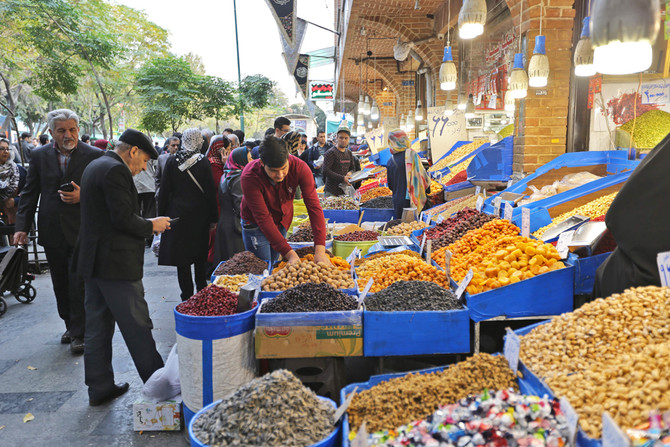
Iranians shop at a market street in the capital Tehran on November 3, 2018. As the deadline for US sanctions neared, Iran's supreme leader Ayatollah Ali Khamenei said on Saturday that President Donald Trump has "disgraced" US prestige and would be the ultimate loser from renewing sanctions on the Islamic republic. (AFP / ATTA KENARE)
Updated 04 November 2018
Follow

Deadline midnight: Iran on the brink of international isolation

  • US sanctions will decimate Tehran’s oil export trade and deny its banks access to global finance
  • “I will stand against you,” Iran's international terror campaign architect tells Trump

JEDDAH: When the clocks strike midnight on the US east coast on Sunday, Iran will become the world’s economic pariah state.

US President Donald Trump will reintroduce tough sanctions on Iran’s vital oil sales and banking sectors to try to force Tehran into negotiations to scrap its nuclear and ballistic missile programs and end its regional meddling.

Most international sanctions were lifted in 2016 in a deal Iran signed with world powers the year before to curb its uranium enrichment program, widely seen as a disguised effort to develop a nuclear bomb.

But Trump denounced the deal as flawed in Iran’s favor, and withdrew in May. His decision was welcomed throughout the Middle East.

Iran’s “aggressive policies” were “largely responsible” for the reimposition of US sanctions, the UAE Minister of State for Foreign Affairs, Anwar Gargash, said on Saturday.

In Iran, the sanctions were greeted with boastful defiance. “The world opposes every decision made by Trump,” Supreme Leader Ayatollah Ali Khamenei said. “America’s goal has been to re-establish the domination it had before 1979 but it has failed.”

Gen. Qassem Soleimani, commander of the Quds Force, which runs the foreign operations of the Islamic Revolutionary Guard Corps, responded to a Game of Thrones-inspired tweet by Trump on Friday that warned: “Sanctions are Coming.”

“I will stand against you,” Soleimani said on Instagram.

Iran has been trying for six months with the EU to create a financial mechanism to avoid the sanctions. Diplomats said the new EU mechanism to pay for Iranian exports should be legally in place by Nov. 4, but not operational until next year. In addition, no country has volunteered to host the entity, which is delaying the process.

A senior French diplomat said on Saturday there was no way any trade with the mechanism could be conducted before the end of 2018, and no other countries, including China, would be part of it.

The US has given eight countries — including India, Japan and possibly China —waivers to continue importing Iranian oil to avoid upsetting the global market.

Turkey said on Saturday it had received initial indications from Washington that it would be granted a waiver, but is awaiting clarification on Monday.

The sanctions are “aimed at depriving the Iranian regime of the revenues it uses to spread death and destruction around the world,” US Secretary of State Mike Pompeo said.

“Our ultimate aim is to compel Iran to permanently abandon its well-documented outlaw activities and behave as a normal country.”


Anti-Daesh coalitions issues joint statement after Riyadh meeting

Updated 11 sec ago
Follow

Anti-Daesh coalitions issues joint statement after Riyadh meeting

RIYADH: Saudi Arabia hosted a meeting of senior diplomatic and defense officials from the Small Group of the Global Coalition to Defeat Daesh in Riyadh on Monday.

Saudi Vice Foreign Minister Waleed Elkhereiji opened the meeting, which was co-chaired by US Special Envoy for Syria Ambassador Tom Barrack.

Participants expressed their appreciation to the Kingdom for hosting the meeting and for its continued role in supporting regional and international efforts to counter terrorism and promote stability.

Participants welcomed the comprehensive agreement between the Government of Syria and the Syrian Democratic Forces, including the permanent ceasefire and arrangements for the civil and military integration of northeast Syria. 

They noted the Government of Syria’s stated intention to assume national leadership of counter-Daesh efforts and expressed appreciation for the sacrifices made by the Syrian Democratic Forces in the fight against Daesh. 

Participants also thanked the Government of Iraq for its continued leadership in the Defeat Daesh campaign.
 
The participants reaffirmed their priorities, including the swift transfer and safeguarding of Daesh detainees, third-country repatriation, the dignified reintegration of families from Al-Hol and Roj camps to their communities of origin, and continued coordination with Damascus and Baghdad on the future of the Defeat Daesh campaign in Syria and Iraq.

Participants welcomed the Syrian government as the 90th member of the D-Daesh Coalition. Coalition members underscored their readiness to work closely with the Syrian government and encouraged members to provide direct support to Syrian and Iraqi efforts.

Coalition defense officials highlighted the close coordination between diplomatic and military lines of effort. 

Participants received briefings on the current Defeat Daesh campaign, including ongoing detainee transfer operations. 

Officials commended Iraq’s efforts to securely detain Daesh fighters and welcomed Syria’s assumption of responsibility for detention facilities and displacement camps housing Daesh fighters and their family members. 

Participants reiterated the need for countries to take responsibility for and repatriate their nationals from Iraq and Syria.

Coalition members thanked Iraq for its leadership and recognized that the transfer of detainees into Iraqi custody is essential to regional security. 

They reaffirmed their shared commitment to defeating Daesh in Iraq and Syria and pledged continued support to both governments in securing Daesh-affiliated detainees.