DUBAI: When a group of Iranian students stormed the US Embassy in Tehran 39 years ago this Sunday, taking more than 60 Americans hostage, it marked the start of a long and precipitous decline in relations between then two countries.
Now, almost four decades later, the anniversary of the embassy takeover coincides with a fresh round of economic sanctions to be imposed on the Islamic republic. The sanctions follow the US withdrawal from the 2015 international agreement on Iran’s nuclear program, and will hit Iran’s shipping, finance and energy sectors.
In 1979, the American hostages were seized by Iranian students demanding the extradition of Iran’s ruler, Shah Mohammed Reza Pahlavi, who was in the US receiving treatment for cancer (he had fled from Iran to Egypt in January). The issue escalated rapidly after the storming of the embassy. The following day Iran ended military treaties with the US and the Soviet Union, which allowed for military intervention. Then, on Nov. 6, Ayatollah Khomeini took power.
“The hostage crisis was the first time the American public acquired a negative view of Iran,” Mark Katz, professor of government and politics at the Schar School of Policy and Government at George Mason University, said this week.
“Of course, many Iranians had long had a negative view of the US, stemming from the 1953 Mossadegh episode (the overthrow of Iran’s prime minister) and the subsequent US support for the shah. I well remember how Iranian students frequently demonstrated against the shah’s regime and US support for it during the 1970s.”
Matters worsened when US president Jimmy Carter sent former attorney general Ramsey Clark and Senate Intelligence Committee staff director William Miller to Iran on Nov. 7 to negotiate the release of the hostages, and Khomeini refused to meet with them. One week later, Iranian assets in US banks were frozen — the first of many restrictions on the Islamic republic.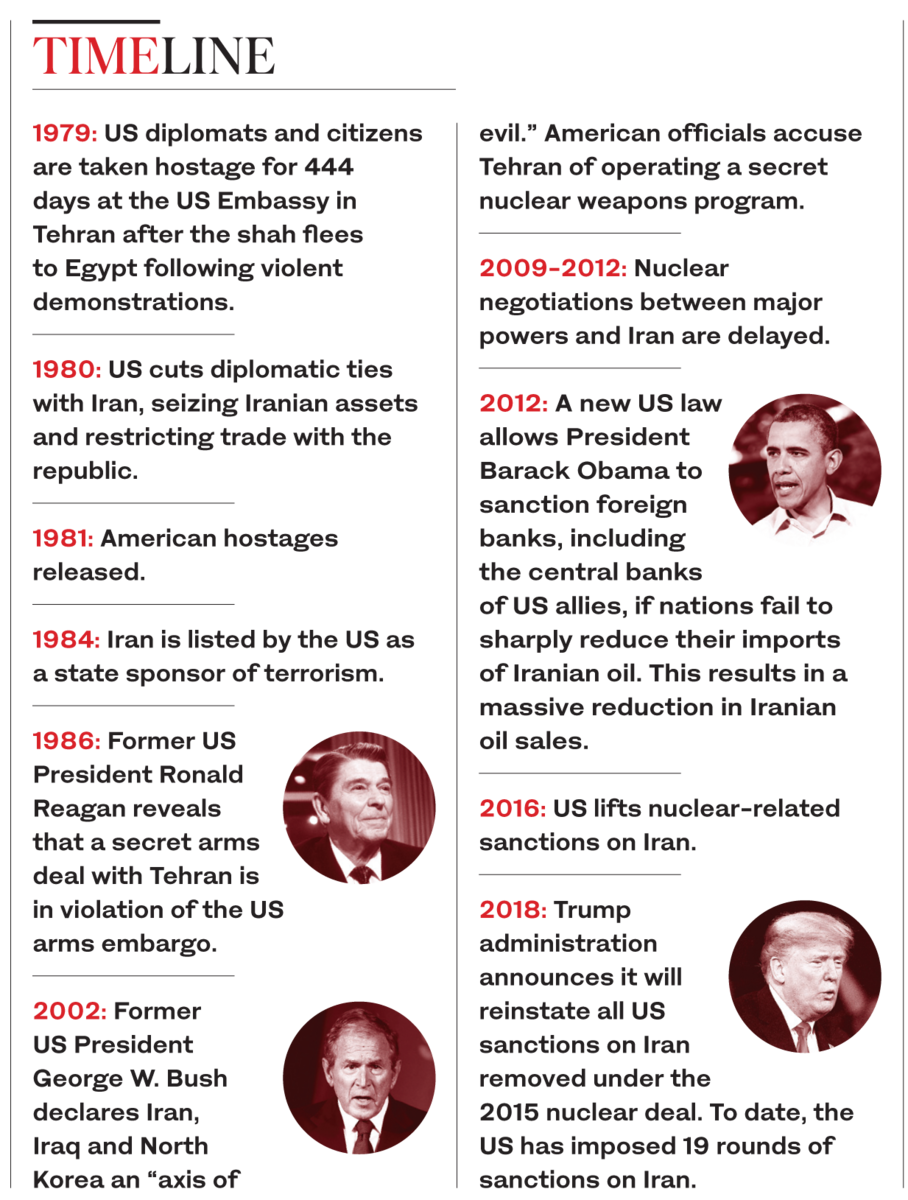
“The hostage crisis had a profound effect on American views of Iran,” Katz said. “Before the Iranian revolution, Iran was seen as an ally; afterwards it was seen as unremittingly hostile and even irrational. This was partly because most Americans had no notion of Iranian grievances against the US.”
On Nov. 19 and 20, women and African-American hostages were freed, leaving 53 Americans captive in the embassy. Although the United Nations had passed a resolution in early December 1979 calling for Iran to release the hostages, President Carter cut diplomatic ties with Iran in April 1980, imposing more sanctions and ordering all Iranian diplomats to leave the US.
“The hostage-taking marked the moment American-Iranian relations began deteriorating,” said Riad Kahwaji, founder and CEO of the Institute for Near East and Gulf Military Analysis in Dubai. “But relations were not always the way they are today. When the shah was in power, relations were extremely good between both countries — Iran was more or less Washington’s main strategic ally in the region.”
Kahwaji said Iran had a status that was equivalent, if not higher, than Israel with respect to the US. “The weapons given to the shah were even more advanced than those given to Israel,” he said. “So it was a high-level strategic relationship. At that time, Iran was openly and publicly, with US knowledge and indirect support, starting its own nuclear program as well.”
The hostage-taking came as a major shock. “The revolution was a blunder on the part of American intelligence, which didn’t expect it to happen,” Kahwaji said. “So the revolution and the subsequent hostage-taking was a major setback in relations between the two countries.”
On Jan. 20, 1981, 444 days after the storming of the embassy, the US hostages were released and flown to Wiesbaden air base in Germany. The release was negotiated after the US and Iran signed an agreement to free Iranian assets.
Today, as Iran prepares to face a new set of sanctions imposed by the US, experts look back on the events of 1979 as among the most significant and far-reaching in the region.
“Iran was the number one ally to Israel in the region and it became the number one enemy,” Kahwaji said. “So, with the revolution, Iran shifted 180 degrees and all of its previous allies became its main enemies, and vice versa.”
New alliances emerged in the region. “Subsequently, with the Iran-Iraq war, we had Iran on the side of everything that opposed the US and the West, and it still is today,” he said. “The whole political landscape in the Middle East changed.”
On Friday, US Secretary of State Mike Pompeo said the new sanctions would deprive Iran of the revenues “that it uses to spread death and destruction around the world. Our ultimate aim is to compel Iran to permanently abandon its well-documented outlaw activities and behave as a normal country.”
He said the sanctions were a part of a US government effort to change the behavior of the Iranian regime.
“On Nov. 5, the US will reimpose sanctions that were lifted as part of the nuclear deal on Iran’s energy, ship-building, shipping and banking sectors,” he said.
“These sanctions hit at the core areas of Iran’s economy. They are necessary to spur changes we seek on the part of the regime and our actions today are targeted at the regime, not the people of Iran, who have suffered grievously under it.”