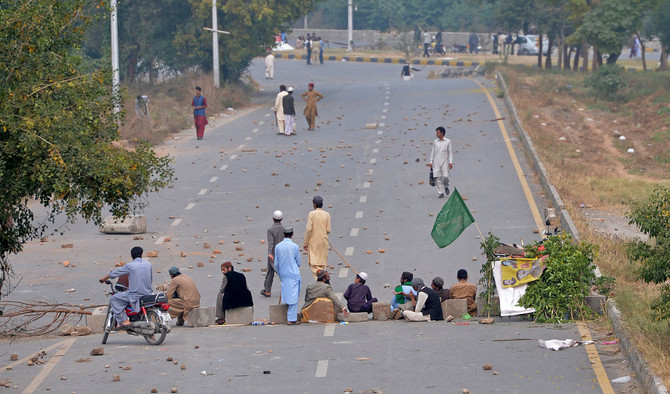
KARACHI: Islamist protesters blocked roads in Pakistan's major cities for a second day on Thursday, opposing a Supreme Court decision the previous day to acquit a Christian woman on death row for blasphemy allegations, media said.
Knots of protesters from an ultra-Islamist party blocked roughly 10 key roads in the southern city of Karachi and others in eastern Lahore, Geo TV and other channels said. Private schools in both cities were shut, as well as in the capital.
Groups of about 200 protesters from the Tehreek-e-Labaik (TLP) party sat under large tents, listening to speeches on two blocked roads in Karachi, a Reuters witness said.
In one speech, a TLP speaker exhorted supporters to light new fires if the police managed to douse burning tyres and other objects they had already set ablaze.
The demonstrators were protesting against the court's decision to free Aasia Bibi, a mother of four, who had been living on death row since 2010, as the first woman sentenced to death by hanging under Pakistan's tough blasphemy laws.
Bibi was accused of making derogatory remarks about Islam after neighbors objected to her drinking water from their glass because she was not Muslim.
But a three-judge panel set up to hear the appeal, headed by Chief Justice Saqib Nisar, ruled the evidence was insufficient.
The case has divided Pakistan, where two politicians who sought to help Bibi were assassinated, and outraged Christians worldwide, with Pope Francis saying he personally prayed for Bibi.
In a televised national broadcast late on Wednesday, Prime Minister Imran Khan warned the protesters the government would act against any prolonged blockade.
"We will not allow any damages. We will not allow traffic to be blocked," Khan said. "I appeal to you, do not push the state to the extent that it is forced to take action."
Khan's broadcast followed comments by a senior leader of the Islamist TLP group, calling for Chief Justice Nisar and the other two judges to be killed.
"They all three deserve to be killed," TLP co-founder Muhammad Afzal Qadri told a protest in Lahore. "Either their security, their driver, or their cook should kill them."
He also called for the ouster of Khan's new government and urged army officers to rise up against powerful military chief General Qamar Javed Bajwa.
Hafiz Saeed, an influential Islamist whom the US accuses of being the mastermind of attacks in Mumbai in 2008 that killed 166, has called for protests after Friday afternoon prayers.
Another Islamist group, the Milli Yakjehti Council, is also meeting on Thursday to discuss Bibi's case and may launch protests.
The whereabouts of Bibi and her family are unclear, and speculation is growing that she will leave Pakistan with her family, who have been in hiding for much of the past eight years.


Protests continue in Pakistan on second day after Aasia Bibi's acquittal


Protests continue in Pakistan on second day after Aasia Bibi's acquittal
- Bibi was accused of making derogatory remarks about Islam after neighbors objected to her drinking water from their glass because she was not Muslim
- Prime Minister Imran Khan warned the protesters the government would act against any prolonged blockade


Pakistan’s interior minister says Islamabad to emulate Shanghai model for next urban development phase
- Islamabad has seen rapid road and transport expansion in recent years, including new flyovers and underpasses
- Mohsin Naqvi is currently visiting China to study technology-driven urban planning, city management frameworks
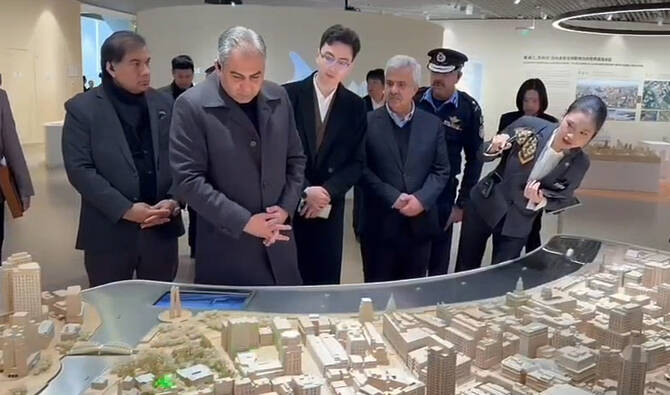
KARACHI: Pakistan’s Interior Minister Mohsin Naqvi said on Tuesday Islamabad would be developed along the lines of Shanghai’s integrated urban planning model, as he studied the Chinese city’s technology-driven approach during an official visit to China.
Naqvi’s comments come as Pakistan’s federal capital has undergone rapid changes to its road and transport infrastructure in recent years, marked by the construction of new flyovers, underpasses and the expansion of a state-run metro bus system, aimed at easing congestion and improving mobility.
“Shanghai is a leading example of rapid urban development and its progress is worthy of emulation for cities around the world,” Naqvi said during a visit to Shanghai’s Urban Planning Headquarters, according to an official statement released by his office.
“Islamabad is also intended to be developed on the lines of Shanghai,” he continued, adding that “immediate measures will be undertaken to benefit from Shanghai’s fast-paced development” in the Pakistani capital.
Naqvi was briefed on Shanghai’s master planning framework, which integrates land use, transport, public services and civic management through a centralized digital system.
The interior minister has been closely associated with infrastructure-led governance in Pakistan’s capital, where successive administrations have pushed ahead with road expansions, signal-free corridors and mass transit projects to accommodate population growth and rising traffic.
Naqvi is currently in China to examine urban management and governance models, including modern policing and city-wide coordination systems, as Pakistan seeks to upgrade public administration in major urban centers.