Aasia Bibi to finally walk free

Pakistani police officers stand guard outside the Supreme Court in Islamabad on Wednesday. Pakistan’s top court on Wednesday overturned a death sentence for blasphemy handed down to a Christian woman, acquitting her of all charges and ordering her immediate release. (AP)
Updated 31 October 2018
Follow

Aasia Bibi to finally walk free

  • Pakistan Supreme Court acquits Christian woman on death row after eight years in jail
  • Case had gained international attention after she was convicted for blasphemy

ISLAMABAD: Pakistan’s top court on Wednesday overturned a death sentence for blasphemy handed down to a Christian woman, acquitting her of all charges and ordering her immediate release.
The ruling brings to an end a long-delayed, landmark decision involving Aasia Bibi, 51, after she was convicted by the Lahore High Court (LHC) in 2010, making her the first woman to be sentenced to death under Pakistan’s blasphemy law.
She had been in jail ever since.
The apex court announced the verdict on a 2014 appeal filed by Bibi challenging the LHC’s decision. Chief Justice Saqib Nisar, while reading out the judgment, ordered for Bibi’s immediate release if she was not wanted in any other case. “The judgment of the high court and that of the trial court is reversed. Her conviction is set aside and she is to be relieved forthwith if not required in other charges,” the ruling said.
Earlier, a special three-judge bench — comprising and headed by Chief Justice Saqib Nisar, Justice Asif Saeed Khosa and Justice Mazhar Alam Khan Miankhel — reserved its verdict on October 8 after hearing the final appeal against Bibi’s execution.
The appeal had challenged the LHC’s October 2014 verdict which upheld a trial court’s decision in November 2010 sentencing Bibi to death for committing blasphemy.
Bibi was accused of making “defamatory and sarcastic” comments about Prophet Muhammad (PBUH) in 2009 during an argument with three Muslim women, while working in a field, in Sheikhupura.
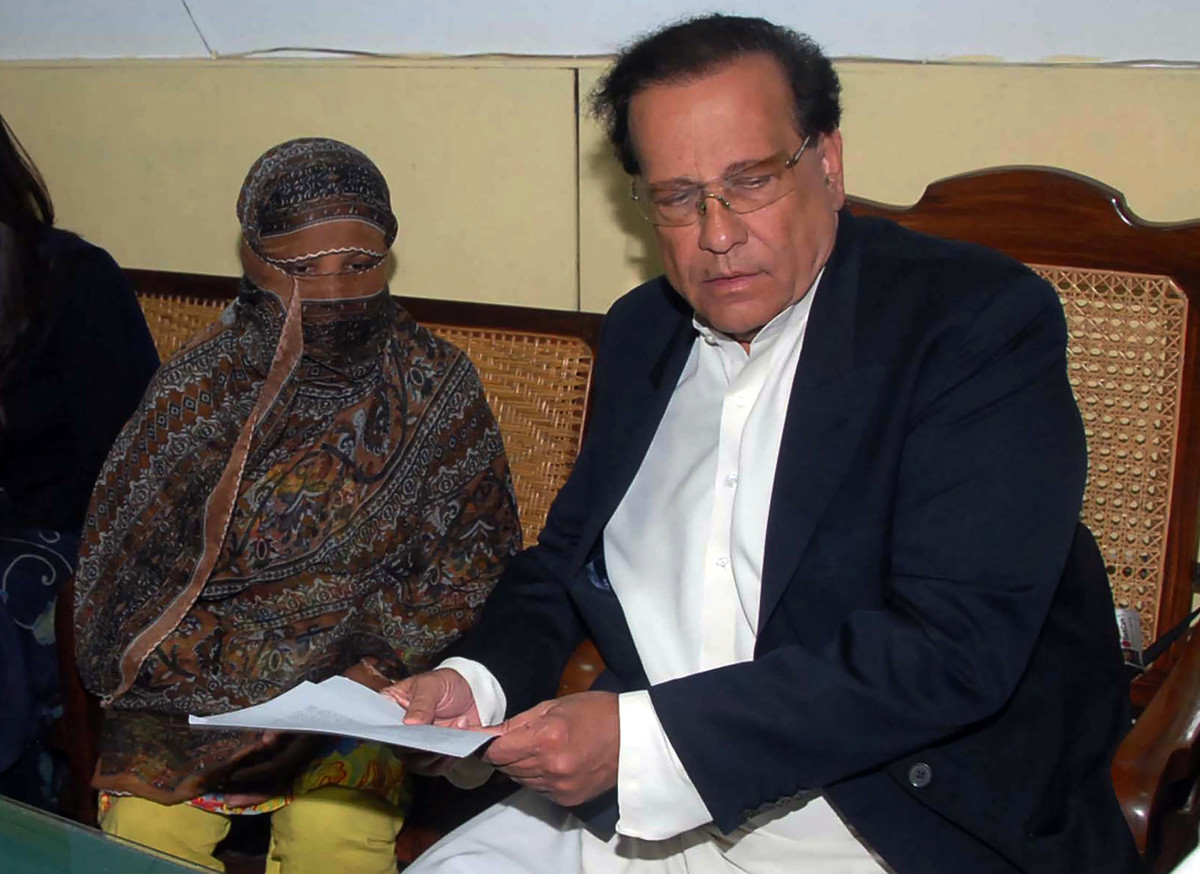


This file photo shows Aasia Bibi, left, with the slain Governor of Punjab Salman Taseer at the Central Jail in Sheikhupura on Nov. 20, 2010. (AFP)

According to details of the case, she had been asked to fetch water to which the Muslim women objected saying that as a non-Muslim she was unfit to touch the water bowl. The women later complained to a local prayer leader, accusing Bibi of blasphemy.
During the last hearing, Bibi’s lawyer, Saiful Mulook, had told the bench that the incident had taken place on June 14, 2009 and a case was registered on June 19 by the prayer leader or imam in Katanwala village. The imam alleged that Bibi had confessed to committing blasphemy, the lawyer said.
The counsel further informed the bench that the imam himself was not a witness to the incident. “From your statements we have gathered that the imam himself did not witness the incident as it happened and no blasphemous words were said in his presence,” Justice Khosa said, to which Justice Nisar added: “As per the prayer leader’s statement, a panchayat [village court] was held in a house and 1,000 people had gathered for it.”
The Supreme Court, after reserving the verdict, restrained both electronic and print media from discussing or commenting on the matter until the final judgment was passed.
Islamabad was placed on high alert prior to the announcement of the verdict after a far-right group’s leader, Tehrik-e-Labaik’s Khadim Rizvi, called for protests in case Bibi was released. Additional police and paramilitary rangers were deployed in several areas of the capital to guard the Diplomatic Enclave and other sensitive buildings.
Bibi’s case outraged Christians worldwide and had been a source of division within Pakistan. The incident gained international spotlight after the-then Punjab governor Salman Taseer intervened and called for an amendment in blasphemy laws. The governor was later killed in broad daylight in Islamabad by one of his own bodyguards. His assassin, Mumtaz Qadri, was executed in 2016 after the apex court found him guilty of murder and his appeal for clemency was rejected by the president.
Pakistan’s blasphemy law (295-C) carries the mandatory death penalty and activists claim that it is often used to target non-Muslim minorities in the country.

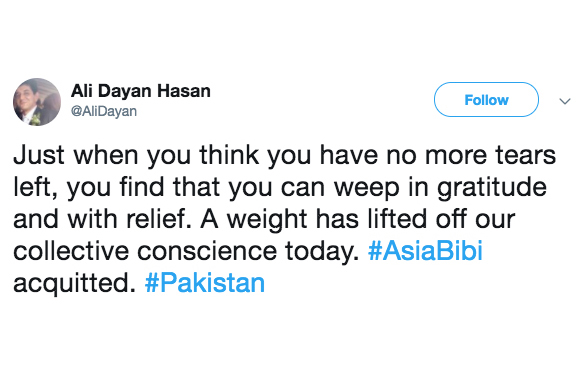
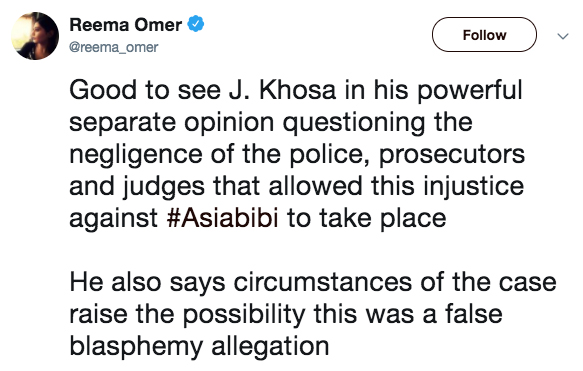
REACTIONS

Pakistan, global crypto exchange discuss modernizing digital payments, creating job prospects 

Updated 05 December 2025
Follow

Pakistan, global crypto exchange discuss modernizing digital payments, creating job prospects 

  • Pakistani officials, Binance team discuss coordination between Islamabad, local banks and global exchanges
  • Pakistan has attempted to tap into growing crypto market to curb illicit transactions, improve oversight

ISLAMABAD: Pakistan’s finance officials and the team of a global cryptocurrency exchange on Friday held discussions aimed at modernizing the country’s digital payments system and building local talent pipelines to meet rising demand for blockchain and Web3 skills, the finance ministry said.

The development took place during a high-level meeting between Finance Minister Muhammad Aurangzeb, Pakistan Virtual Assets Regulatory Authority (PVARA) Chairman Bilal bin Saqib, domestic bank presidents and a Binance team led by Global CEO Richard Teng. The meeting was held to advance work on Pakistan’s National Digital Asset Framework, a regulatory setup to govern Pakistan’s digital assets.

Pakistan has been moving to regulate its fast-growing crypto and digital assets market by bringing virtual asset service providers (VASPs) under a formal licensing regime. Officials say the push is aimed at curbing illicit transactions, improving oversight, and encouraging innovation in blockchain-based financial services.

“Participants reviewed opportunities to modernize Pakistan’s digital payments landscape, noting that blockchain-based systems could significantly reduce costs from the country’s $38 billion annual remittance flows,” the finance ministry said in a statement. 

“Discussions also emphasized building local talent pipelines to meet rising global demand for blockchain and Web3 skills, creating high-value employment prospects for Pakistani youth.”

Blockchain is a type of digital database that is shared, transparent and tamper-resistant. Instead of being stored on one computer, the data is kept on a distributed network of computers, making it very hard to alter or hack.

Web3 refers to the next generation of the Internet built using blockchain, focusing on giving users more control over their data, identity and digital assets rather than big tech companies controlling it.

Participants of the meeting also discussed sovereign debt tokenization, which is the process of converting a country’s debt such as government bonds, into digital tokens on a blockchain, the ministry said. 

Aurangzeb called for close coordination between the government, domestic banks and global exchanges to modernize Pakistan’s payment landscape.

Participants of the meeting also discussed considering a “time-bound amnesty” to encourage users to move assets onto regulated platforms, stressing the need for stronger verifications and a risk-mitigation system.

Pakistan has attempted in recent months to tap into the country’s growing crypto market, crack down on money laundering and terror financing, and promote responsible innovation — a move analysts say could bring an estimated $25 billion in virtual assets into the tax net.

In September, Islamabad invited international crypto exchanges and other VASPs to apply for licenses to operate in the country, a step aimed at formalizing and regulating its fast-growing digital market.