
DUBAI: History was made on Monday as the first satellite to be fully engineered and developed by Emiratis was successfully launched into space from an island south of Japan’s mainland, marking a meteoric milestone for space programmes in the Arab world.
The eyes of the world were watching as KhalifaSat — the most sophisticated satellite built by the UAE, which was tested and manufactured entirely by Emirati engineers — was loaded onto a Mitsubishi Heavy Industries H-2A rocket and launched live on Monday at 8:08am UAE time from the Tanegashima Space Center in Japan. The launch is among a raft of space programs that will be led by the UAE and countries across the wider Gulf region in the coming years.
Dr Ahmed Murad, dean of the college of science at United Arab Emirates University, told Arab News that the launch of KhalifaSat is a monumental step for the Arab world’s ambitious space programs, adding that it will spur further diversification of the country’s economy and inspire innovation across the GCC.
“This launch is a very significant achievement for the country as one of the main strategic pillars in the UAE National Strategy of Innovation,” he said, referring to the aim to make the UAE one of the most innovative nations in the world by 2021. “Also, this launch will make the UAE the ‘hub’ of space science. The country has achieved their ambitious plan by entering the industry sector of space science, which will build a knowledge-based economy.
“The country is building this sector through the policy, governance, financial resources and building national capacity. I am sure and confident that the UAE will lead the Arab region in the space science sector as all requirements are available and built in-country.”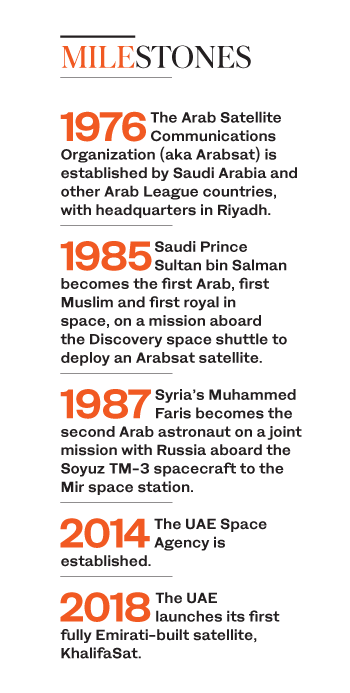
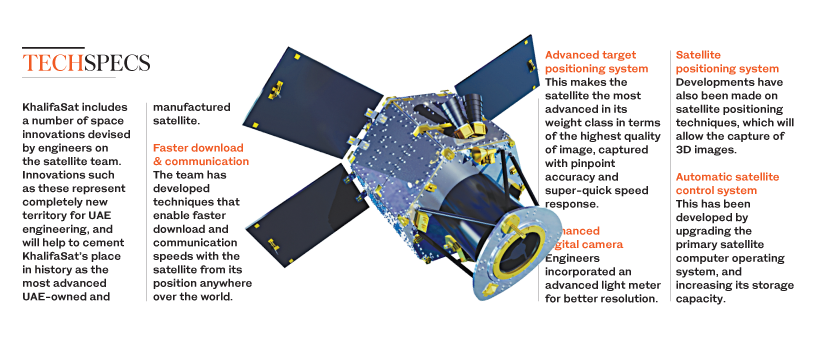
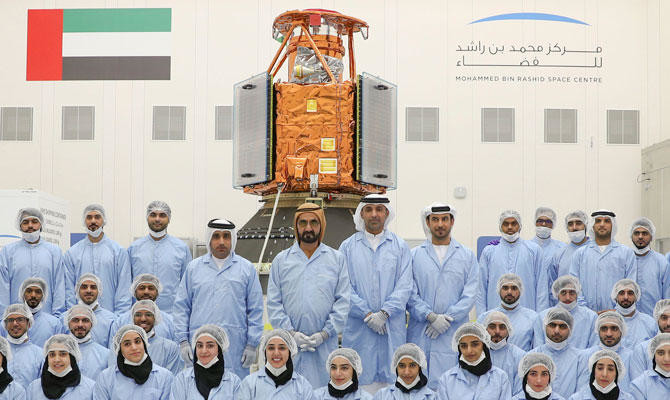
Designed and built at the space technology laboratories at the Mohammed bin Rashid Space Center (MBRSC) in Dubai, KhalifaSat, which bears the name of the UAE president, will deliver high-quality images of Earth, assisting governmental and private organizations all over the world with environmental monitoring, disaster relief and urban planning.
The successful launch drew praise from the UAE’s leaders, with Sheikh Hamdan bin Mohammed, the crown prince of Dubai, tweeting his praise to the KhalifaSat team shortly after takeoff. “Congratulations to the leaders and people of the UAE on the successful launch of ‘KhalifaSat,’ a satellite built completely by Emirati engineers — a true reflection of the aspirations of our youth and our nation,” he said. “(I am) proud of the talented Emirati personnel at the Mohammed bin Rashid Space Centre (MBRSC). They are the heroes behind this important project that carries the name of our president. Taking a picture of our founding father to outer space adds a wonderful note to our celebrations for the Year of Zayed.”
Sheikh Hamdan also referenced future ambitious plans under the UAE’s space program, including the Emirates Mars Mission, which will, in July 2020, see the launch of the Arab world’s first “Hope” spacecraft that aims to land on the planet in 2021 to coincide with the 50th anniversary of the UAE’s founding, and the UAE’s first astronaut training program, which aims to send two emiratis into space in April 2019.
“The Hope Mars Mission and the UAE astronaut program are two great initiatives that are part of our efforts to follow in the footsteps of Zayed to serve humanity and bring happiness to people,” he said.
The UAE Space Agency also tweeted: “The launch of the UAE’s first Emirati-made satellite
#KhalifaSat has been successful. The highly advanced imaging satellite will now begin to orbit the Earth from pole to pole, at a distance of 613 km with its state-of-the-art positioning, controlling systems and digital cameras.”
Circulating on social media was a picture of Hamad Obaid Al-Mansoori, chairman of Mohammed bin Rashid Space Centre, hugging Abdulla Harmoul, KhalifaSat’s launch manager, after the launch. Ahead of the historical day, Amer Al-Sayegh, the KhalifaSat project manager, said the project helped create a key partnerships between the UAE and Japan.
“It’s not only the technical work that we are doing with our Japanese colleagues, it is the bonding of two teams and two cultures working together for the same vision,” he said. “The UAE now has a highly qualified team equipped with knowledge, expertise and strong teamwork for the new missions for the UAE.”
A team of MBRSC engineers had travelled to Tanegashima Space Center to monitor the launch of KhalifaSat, one of the world’s most technologically advanced satellites, with five patents to its name. The spectacle was broadcast live on Dubai TV and streamed live on many channels, including Dubai TV and YouTube, and online viewers watched as, about 10 minutes after blast-off, the satellite disappeared from sight, and on-site engineers announced the flight path was “proceeding as expected.”
It was the latest in a long history of Arab satellites in space, which began when the Arab Satellite Communications Organization (Arabsat) sent the first Arab satellite into space in February 1985: Arabsat-1A was performed by a French Ariane rocket and was used to provide communication services to the Arab states.
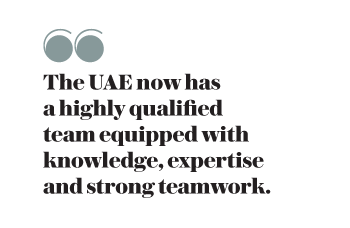 Founded in 1976 by the 21 member states of the Arab League, Arabsat is largely funded by Saudi Arabia and operates from its headquarters in Riyadh and two satellite control stations in Riyadh and Tunis. The launch of its sixth generation satellite — ArabSat-6A with a Falcon Heavy rocket — is planned for January 2019.
Last year, King Salman signed an agreement with Russian President Vladimir Putin, committing both countries to space exploration cooperation, while also in 2017, the Kingdom, together with five other Arab countries — Lebanon, Jordan, Morocco, Algeria and Bahrain — converged for talks related to space, with Sudan, Oman and Kuwait later joining the group.
Farther afield, Space Generation (Kuwait) aims to gather the youth of Kuwait to express their thoughts and ideas about establishing a space program in the country, while in Jordan, the Regional Center for Space Science and Technology Education, based in Amman, is the regional centre for the United Nations Office for Outer Space Affairs (UNOOSA). It aims to assist participating countries in developing and enhancing the knowledge and skills of their citizens in relevant aspects of space science and technology to effectively contribute to national development and space programs.
It reflects a general will across the GCC — as economies gradually shift away from oil — for more investment in space science, including technology such as satellites and exploration involving missions to the Moon and Mars.
“By launching KhalfiaSat, the country will participate with other satellites to provide new insights about the inner and outer space, which will help to push the research agenda in the region,” Dr Murad said.