

UN Security Council condemns Islamabad mosque bombing claimed by Daesh

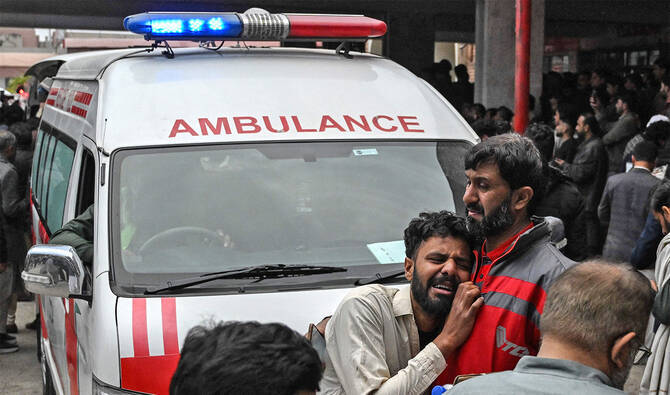
People mourn the death of their relatives following a suicide bombing at a Shiite mosque, outside a hospital in Islamabad on February 6, 2026. (AFP/File)
Short Url
Updated 13 February 2026
Follow

UN Security Council condemns Islamabad mosque bombing claimed by Daesh

  • The Council urges accountability, calls for cooperation with Pakistan
  • A suicide bomber targeted the mosque during prayers, killing 32 people

ISLAMABAD: The United Nations Security Council said on Friday it condemned a suicide bombing at a mosque on the outskirts of Islamabad that killed at least 32 people, calling the attack “heinous and cowardly” and urging accountability for those responsible.

The blast targeted the Qasr-e-Khadijatul Kubra mosque and imambargah in the Tarlai Kallan area during Friday prayers on Feb. 6, when mosques across the country were packed with worshippers. Daesh claimed responsibility, saying one of its militants detonated an explosive vest inside the congregation.

In a press statement issued by Council President James Kariuki of the United Kingdom, members of the 15-nation body expressed “deepest sympathy and condolences” to the families of the victims and to the government and people of Pakistan.

“The members of the Security Council condemned in the strongest terms the heinous and cowardly suicide bombing terrorist attack,” the statement said, reaffirming that “terrorism in all its forms and manifestations constitutes one of the most serious threats to international peace and security.”

The Council underlined the need to hold “perpetrators, organizers, financiers and sponsors” accountable and urged all states to cooperate actively with the Pakistan government in accordance with international law and relevant UN resolutions.

Pakistan, which is currently serving as a non-permanent member of the Security Council for the 2025–2026 term, has faced intense militant violence in recent years, including attacks claimed by Tehreek-e-Taliban Pakistan, Balochistan Liberation Army and Daesh affiliates.

The administration in Islamabad said the day after the attack that a police officer was killed and four suspects were arrested in overnight raids in the northwestern cities of Peshawar and Nowshera.

Among those detained was an Afghan national alleged to have worked for Daesh and to have masterminded the bombing, authorities said.

The Security Council reiterated that acts of such militant violence were criminal and unjustifiable regardless of motivation and reaffirmed the need for states to combat threats to international peace and security in line with the UN Charter and international law.

Earlier this week, Pakistani religious scholars also condemned the bombing at a meeting presided over by Religious Affairs Minister Sardar Muhammad Yousuf, saying the attack was contrary to Islamic teachings.


Pakistan, Saudi Arabia discuss regional situation, upcoming engagements

Updated 14 February 2026
Follow

Pakistan, Saudi Arabia discuss regional situation, upcoming engagements

  • Ishaq Dar and Prince Faisal bin Farhan agree to stay in contact amid Middle East tensions
  • The two officials speak ahead of Trump’s Feb. 19 Board of Peace meeting in Washington, DC

ISLAMABAD: Pakistan’s Deputy Prime Minister and Foreign Minister Ishaq Dar discussed regional developments and upcoming international engagements with Saudi Foreign Minister Prince Faisal bin Farhan in a phone call on Saturday, according to the foreign office in Islamabad.

The conversation took place against the backdrop of deepening strategic ties between Islamabad and Riyadh. In September last year, the two countries signed a bilateral defense agreement that formalized decades of military cooperation and included a commitment to view aggression against one as an attack on both countries.

“Deputy Prime Minister/Foreign Minister Mohammad Ishaq Dar held a telephonic conversation today with the Foreign Minister of Saudi Arabia, Faisal bin Farhan Al Saud,” Pakistan’s foreign ministry said in a statement.

“The two leaders discussed the evolving regional situation, forthcoming international engagements, and agreed to remain in close contact,” it added.

The two officials spoke at a time of heightened tensions in the Middle East, with the conflict in Gaza far from resolution amid ongoing ceasefire violations by Israel.

The region has also been on edge as the United States pursues nuclear negotiations with Iran, prompting regional states to call for diplomacy rather than new military flare-ups.

Both Pakistan and Saudi Arabia are participants in US President Donald Trump’s Board of Peace, which is scheduled to meet on Feb. 19 in Washington.

Islamabad and Riyadh have consistently coordinated positions over regional and global issues.

The foreign ministry did not provide further details of the discussion.