

Floods wreak havoc in Morocco’s farmlands after severe drought

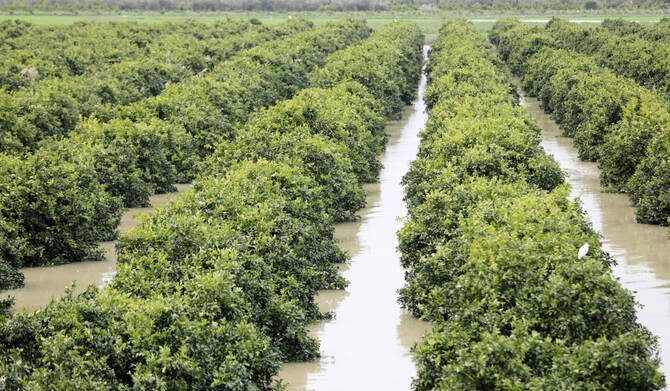
An orchard of citrus trees stand in flood water in the Sidi Kacem region, in northwestern Morocco on February 5, 2026. (AFP)
Short Url
Updated 14 February 2026
Follow

Floods wreak havoc in Morocco’s farmlands after severe drought

  • Morocco, where agriculture employs about a third of the working-age population, has seen seven consecutive years of drought
  • We have no grain left to feed our livestock, and they are our main source of income

KENITRA, Morocco: In the Moroccan village of Ouled Salama, 63-year-old farmer Mohamed Reouani waded through his crops, now submerged by floodwaters after days of heavy downpours.
Farmers in the North African kingdom have endured severe drought for the past few years.
But floods have now swamped more than 100,000 hectares of land, wiping out key crops and forcing farmers in the country’s northwest to flee with their livestock.
“I have about four or five hectares” of crops, Reouani said. “All of it is gone now.”
“Still, praise be to God for this blessing,” he added while looking around at the water.
Morocco, where agriculture employs about a third of the working-age population, has seen seven consecutive years of drought.
As of December, its dams were only around 30 percent full on average, and farmers have largely relied on rainwater for irrigation.
Now their average filling rate stands at nearly 70 percent after they received about 8.8 billion cubic meters of water in the last month — compared to just 9 billion over the previous two years combined.
Many like Reouani had at first rejoiced at the downpours.
But the rain eventually swelled into a heavy storm that displaced over 180,000 people as of Wednesday and killed four so far.
In his village, the water level climbed nearly 2 meters, Reouani said. Some homes still stand isolated by floodwater.
Elsewhere, residents were seen stranded on rooftops before being rescued in small boats.
Others were taken away by helicopter as roads were cut off by flooding.
Authorities have set up camps of small tents, including near the city of Kenitra, to shelter evacuees and their livestock.
“We have no grain left” to feed the animals, one evacuee, Ibrahim Bernous, 32, said at a camp. “The water took everything.”
Bernous, like many, now depends on animal feed distributed by the authorities, according to Mustapha Ait Bella, an official at the Agriculture Ministry.
At the camps, displaced families make do with little as they wait to return home.
“The problem is what happens after we return,” said Chergui Al-Alja, 42. 
“We have no grain left to feed our livestock, and they are our main source of income.”
On Thursday, the government announced a relief plan totaling about $330 million to aid the hardest-hit regions.
A tenth of that sum was earmarked for farmers and livestock breeders.

Rachid Benali, head of the Moroccan Confederation of Agriculture and Rural Development, said farming was “among the sectors most affected by the floods.”

But he said “a more accurate damage assessment was pending once the waters receded.”
Benali added that sugar beet, citrus, and vegetable farms had also been devastated by flooding.
Agriculture accounts for about 12 percent of Morocco’s overall economy.
The International Monetary Fund anticipates that the massive rainfall will help the economy grow by nearly five percent.
Authorities are betting on expanded irrigation and seawater desalination to help the sector withstand increasingly volatile climate swings.
While Morocco is no stranger to extreme weather events, scientists say that climate change driven by human activity has made phenomena such as droughts and floods more frequent and intense.
Last December, flash floods killed 37 people in Safi, in Morocco’s deadliest weather-related disaster in the past decade.
Neighboring Algeria and Tunisia have also experienced severe weather and deadly flooding in recent weeks.
Further north, Portugal and Spain have faced fresh storms and torrential rain.


A look at Ramadan and how Muslims observe the holy month

Updated 4 sec ago
Follow

A look at Ramadan and how Muslims observe the holy month

  • Ramadan is the ninth month of the Islamic lunar calendar; the month cycles through the seasons
  • Ramadan is followed by the Islamic holiday of Eid Al-Fitr
CAIRO: Observant Muslims the world over will soon be united in a ritual of daily fasting from dawn to sunset as the Islamic holy month of Ramadan starts. For Muslims, it’s a time for increased worship, religious reflection and charity. Socially, it often brings families and friends together in festive gatherings around meals to break their fast.
Ramadan is followed by the Islamic holiday of Eid Al-Fitr.
First day of Ramadan expected around Feb. 18-19
Ramadan is the ninth month of the Islamic lunar calendar; the month cycles through the seasons.
The start of the month traditionally depends on the sighting of the crescent moon. This year, the first day of Ramadan is expected to be on or around Feb. 18 or 19. The actual start date may vary among countries and Muslim communities due to declarations by multiple Islamic authorities around the globe on whether the crescent had been sighted or different methodologies used to determine the beginning of the month.
This year, the start of Ramadan is expected around the same time as Ash Wednesday, a solemn day of fasting and reflection that signals the start of Lent, the most penitential season of the church calendar for Catholics and many other Christians.
Fasting is one of the pillars of Islam
Fasting is one of the Five Pillars of Islam, along with the profession of faith, prayer, almsgiving and pilgrimage.
Muslims see various meanings and lessons in observing the fast.
It’s regarded as an act of worship to attain piety and one of submission to God. The devout see benefits, including practicing self-restraint, cultivating gratitude and empathizing with people who are poor and hungry.
The daily fast in Ramadan includes abstaining from all food and drink — not even a sip of water is allowed — from dawn to sunset, before breaking the fast in a meal known as “iftar” in Arabic.
Muslims typically stream into mosques for congregational prayers and dedicate more time to religious contemplation and the reading of the Qur’an, the Muslim holy book.
Charity is a hallmark of Ramadan. Among other ways of giving, many seek to provide iftar for those in need, distributing Ramadan boxes filled with pantry staples, handing out warm meals alongside such things as dates and juice or helping hold free communal meals.
Muslims eat a predawn meal, called “suhoor,” to hydrate and nurture their bodies ahead of the daily fast.
Exemptions from fasting
There are certain exemptions, such as for those who are unable to because of illness or travel. Those unable to fast due to being temporarily ill or traveling need to make up for the missed days of fasting later.
Cultural and social traditions associated with Ramadan
Muslims are ethnically and racially diverse and not all Ramadan traditions are rooted in religion. Some customs may transcend borders, while others can differ across cultures.
Many social rituals center on gathering and socializing after the daily fast. Some Muslims decorate their homes, put out Ramadan-themed tableware and centerpieces or throng to markets and Ramadan bazaars.
In Egypt, Ramadan is typically a festive time. Colorful lanterns, in different shapes and sizes, dangle from children’s hands and adorn homes. Ramadan songs may be played to welcome the month.
Ramadan’s soundscape in Egypt has traditionally included the predawn banging on drums by a “mesaharati” who roams neighborhoods, calling out to the faithful, sometimes by name, to wake them up for the suhoor meal.
New TV shows and communal meals
A lineup of new television series is another social fixture of the month in some countries, and advertisers compete for viewers’ attention.
In various regions, some Muslims worry that the month is getting commercialized, and say an emphasis on decorations, TV shows, outings or lavish iftar banquets can detract from Ramadan’s religious essence. Others say that a balance can be struck and that, in moderation, such rituals are part of the month’s festive spirit.
In Indonesia, Ramadan rituals vary across regions, reflecting the diversity of cultures. In deeply conservative Aceh province, animals are slaughtered during Meugang festivities, the meat cooked and shared with family, friends, poor people and orphans.
Hundreds of residents in Tangerang, a city outside the capital, Jakarta, flock to the Cisadane River to wash their hair with rice straw shampoo and welcome the fasting month with a symbolic spiritual cleansing.
Across the island of Sumatra, after evening prayers, many boys and girls parade through the streets, carrying torches and playing Islamic songs.
In the United States, where Muslims make up a racially and ethnically diverse minority, gathering at mosques and Islamic centers when possible for iftar meals and prayers provides many Muslim families with a sense of community. Some Muslims also organize or attend interfaith iftar meals.