

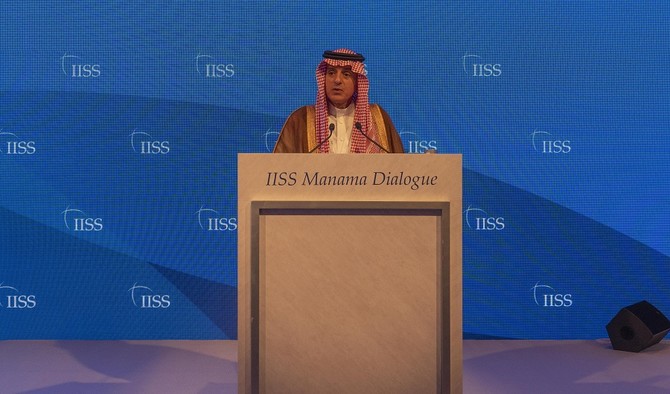
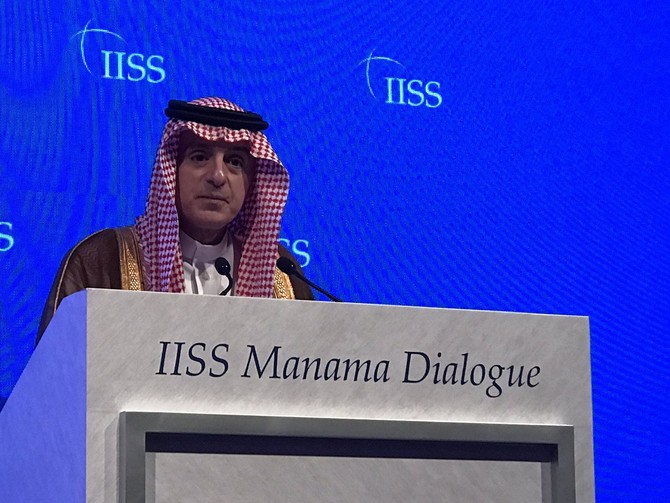


MANAMA: Saudi Foreign Minister Adel Al-Jubeir on Saturday denied media reports that Saudi Arabia intended to shift its alliance away from the United States and the West.
“The Kingdom of Saudi Arabia has a strategic relationship with the United States that goes back to the 1930s, it was enshrined by a meeting with the late King Abdulaziz and late Franklin Roosevelt,” Al-Jubeir said.
“That relationship is ironclad. Saudi Arabia has been an ally of the Western countries since the beginning of the third Saudi state … it’s not going to change.
“Friends come and go but interests remain, this is how we look at our relationship with the West in general and the United States in particular.”
Al-Jubeir’s comments came in response to a question by Arab News on the first day of the annual Manama Dialogue organized by the International Institute for Strategic Studies (IISS). The foreign minister also praised the current US administration’s Middle East strategy, especially in relation to containing Iran.
President Donald Trump had been protecting US allies since he took office, a foreign policy that was both “rational and realistic,” Al-Jubeir said.
FM @AdelAljubeir at the #IISSMD18 on the case of Jamal Khashoggi: We will investigate, we will share the results of the investigation, we will hold people to account and those responsible will be punished, and we will put in place mechanism to make sure that doesn’t happen again pic.twitter.com/JL6RLoCfjH
— Foreign Ministry (@KSAmofaEN) October 27, 2018
“He has defeated Daesh in Syria because he wasn’t hesitant about deploying force. He has defeated Daesh in Iraq, when it took years for the Obama administration to make any progress. He has put Iran on notice that business as usual cannot continue, and imposed sanctions against Iran.”
Addressing the murder this month in Istanbul of the Saudi journalist Jamal Khashoggi, and the continuing investigation, Al-Jubeir said the Saudi government was committed to finding all the facts, and was working closely with the Turkish government to do so.
“We know a mistake was committed, we know that people exceeded their authority, and we are investigating them,” he said.
Eighteen Saudis have been arrested in connection with Khashoggi’s death, and Turkey’s request for their extradition will not be granted, Al-Jubeir said. “The individuals are Saudi nationals, they are detained in Saudi Arabia, the investigation is in Saudi Arabia and they will be prosecuted in Saudi Arabia.
FM @AdelAljubeir on the issue of extradition the detainees in the case of Jamal Khashoggi #IISSMD18: They are detained in Saudi Arabia, their investigation is in Saudi Arabia, and they will be prosecuted in Saudi Arabia pic.twitter.com/noxNBM8div
— Foreign Ministry (@KSAmofaEN) October 27, 2018
“Unfortunately there has been hysteria in the media about Saudi Arabia’s guilt before the investigation is completed. Wait for the results of the investigation and then make a determination if the investigation is serious or not, but not from the get-go.”
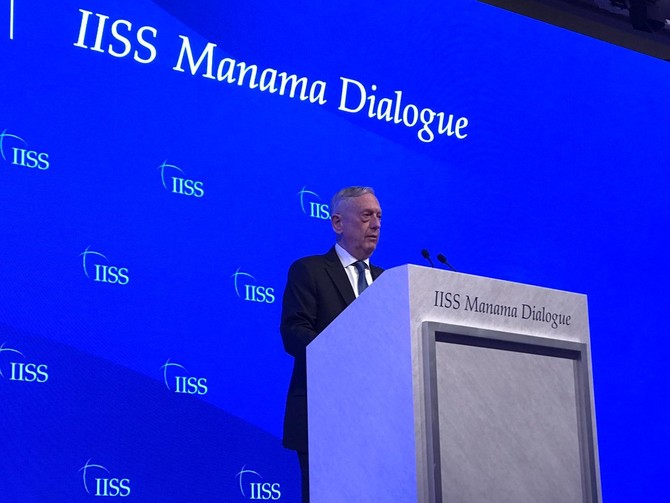
Earlier, US Defense Secretary James Mattis said Khashoggi’s murder inside a diplomatic mission “must concern us all.” If any nation failed to adhere to international norms and the rule of law, it “undermines regional stability at a time when it is needed most,” he said, but he also stressed the strength of Saudi-US relations: “We maintain our strong people-to-people partnership knowing that with our respect must come transparency and trust, as indicated by President Trump, Secretary Pompeo and European leaders alike.
“These two principles are vital to continued collaboration because we know that to remain committed, we’re going to have to continue transparency and security for all in this region.”


