Israeli police investigating Palestinian woman’s death in car

1 / 4
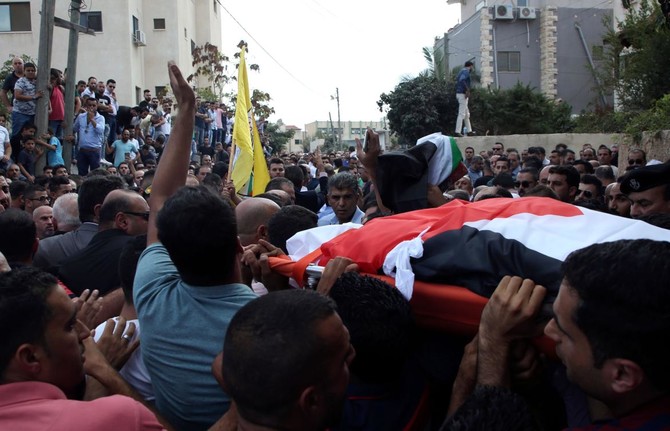
Palestinian carry the body of 48-year-old mother of eight, Aisha Rabi, who died of her wounds after the car she was traveling in with her husband was hit by stones, during her funeral in the West Bank village of Bidya, near Salfit, on October 13, 2018. (AFP)
2 / 4
Palestinian children watch the funeral procession of 48-year-old mother of eight, Aisha Rabi, who died of her wounds after the car she was traveling in with her husband was hit by stones, in the West Bank village of Bidya, near Salfit, on October 13, 2018. (AFP)
3 / 4
Palestinian carry the body of 48-year-old mother of eight, Aisha Rabi, who died of her wounds after the car she was traveling in with her husband was hit by stones, during her funeral in the West Bank village of Bidya, near Salfit, on October 13, 2018. (AFP)
4 / 4
Palestinian carry the body of 48-year-old mother of eight, Aisha Rabi, who died of her wounds after the car she was traveling in with her husband was hit by stones, during her funeral in the West Bank village of Bidya, near Salfit, on October 13, 2018. (AFP)
Updated 13 October 2018
Follow

Israeli police investigating Palestinian woman’s death in car

  • A source at the Nablus hospital where Aisha Al-Rawbi was brought said the 47-year-old was dead on arrival and that she had suffered a head injury.
  • Al-Rawbi's husband said he suspected Israeli settlers had pelted their car with rocks.

NABLUS: Israeli police said on Saturday they were investigating the death of a Palestinian woman in the occupied West Bank, after her husband said he suspected Israeli settlers had pelted their car with rocks.
Reuters was unable to independently verify the circumstances of the incident but footage of the car, which a Reuters cameraman said bore Palestinian license plates, showed what appeared to be a blood-stained broken brick at the foot of the passenger seat, which was covered in shattered glass and blood stains.
A source at the Nablus hospital where Aisha Al-Rawbi was brought said the 47-year-old was dead on arrival and that she had suffered a head injury. Her relatives said an autopsy was to be carried out at another hospital.
The woman’s husband, Aykube Al-Rawbi, 52, said he was driving by a settlement late on Friday after dark along a main road near the Palestinian city of Nablus and that he could not clearly see who pelted the car.
“The stones came from the side where the settlement is. I could hear the people speak Hebrew, but I didn’t see them,” said Al-Rawbi.
Israeli Police Spokesman Micky Rosenfeld said: “Police arrived in the area and have opened an investigation into the circumstances behind the incident reported.”
There was no immediate comment from Palestinian officials.
On Friday, Gaza health officials said Israeli forces killed seven Palestinians in protests along Gaza’s border. Israel said its troops had shot a group who broke through the fence with a bomb and attacked an army post.
On Sunday, a Palestinian gunman shot dead two Israelis and wounded a third in an industrial park next to an Israeli settlement in the West Bank, and on Thursday the Israeli military said a Palestinian had stabbed an Israeli soldier in the area.
Peace talks between Israel and the Palestinians broke down in 2014 and a bid by US President Donald Trump to restart them has shown little progress so far.
The Palestinians want to establish an independent state in the West Bank, Gaza and East Jerusalem — territories that Israel captured in the 1967 Middle East war.
Settlements Israel has built in the West Bank, where Palestinians have limited self-rule, are deemed illegal by most countries. Israel disputes this.


Lebanese finance minister denies any plans for a Kushner-run economic zone in the south

Updated 5 sec ago
Follow

Lebanese finance minister denies any plans for a Kushner-run economic zone in the south

  • Proposal was made by US Envoy Morgan Ortagus but was ‘killed on the spot’
  • Priority is to regain control of state in all aspects, Yassine Jaber tells Arab News

DAVOS: Lebanon’s finance minister dismissed any plans of turning Lebanon’s battered southern region into an economic zone, telling Arab News on the sidelines of the World Economic Forum’s meeting in Davos that the proposal had died “on the spot.”

Yassine Jaber explained that US Envoy to Lebanon Morgan Ortagus had proposed the idea for the region, which has faced daily airstrikes by Israel, and it was immediately dismissed.

Jaber’s comments, made to Arab News on the sidelines of the World Economic Forum in Davos, were in response to reports which appeared in Lebanese media in December which suggested that parts of southern Lebanon would be turned into an economic zone, managed by a plan proposed by Jared Kushner, US President Donald Trump’s son in law.

Meanwhile, Jaber also dismissed information which had surfaced in Davos over the past two days of a bilateral meeting between Lebanese ministers, US Middle East Envoy Steve Witkoff and Kushner.

Jaber said that the meeting on Tuesday was a gathering of “all Arab ministers of finance and foreign affairs, where they (Witkoff and Kushner) came in for a small while, and explained to the audience the idea about deciding the board of peace for Gaza.”

He stressed that it did not develop beyond that.

When asked about attracting investment and boosting the economy, Jaber said: “The reality now is that we need to reach the situation where there is stability that will allow the Lebanese army, so the (Israeli) aggression has to stop.”

Over the past few years, Lebanon has witnessed one catastrophe after another: one of the world’s worst economic meltdowns, the largest non-nuclear explosion in its capital’s port, a paralyzed parliament and a war with Israel.

A formal mechanism was put in place between Lebanon and Israel to maintain a ceasefire and the plan to disarm Hezbollah in areas below the Litani river.

But, the minister said, Israel’s next step is not always so predictable.

“They’re actually putting pressure on the whole region. So, a lot of effort is being put on that issue,” he added.

“There are still attacks in the south of the country also, so stability is a top necessity that will really succeed in pushing the economy forward and making the reforms beneficial,” he said.

Lawmakers had also enacted reforms to overhaul the banking sector, curb the cash economy and abolish bank secrecy, alongside a bank resolution framework.

Jaber also stressed that the government had recently passed a “gap law” intended to help depositors recover funds and restore the banking system’s functionality.

“One of the priorities we have is really to deal with all the losses of the war, basically reconstruction … and we have started to get loans for reconstructing the destroyed infrastructure in the attacked areas.”

As Hezbollah was battered during the war, Lebanon had a political breakthrough as the army’s general, Joseph Aoun, was inaugurated as president. His chosen prime minister was the former president of the International Court of Justice, Nawaf Salam.

This year marks the first time a solid delegation from the country makes its way to Davos, with Salam being joined by Jaber, Economy and Trade Minister Amr Bisat, and Telecoms Minister Charles Al-Hage.

“Our priority is to really regain the role of the state in all aspects, and specifically in rebuilding the institutions,” Jaber said.