

Saudi Arabia, Pakistan discuss oil refinery project

Saudi adviser on energy Ahmad Hamed Al-Ghamdi, center, holds talks with Pakistan’s Minister of Power Omar Ayub Khan, right, in Islamabad. (Photo courtesy: PID)
Updated 02 October 2018
Follow

Saudi Arabia, Pakistan discuss oil refinery project

  • During the meeting with the Finance Minister Asad Umar, both sides discussed areas of mutual cooperation
  • Saudi Arabia has always supported Pakistan in the most difficult times, says Asad Umar

JEDDAH: The high-level Saudi delegation on a five-day visit to Islamabad held talks with Pakistani authorities on Monday in a cordial atmosphere as both sides discussed areas for potential investment, Pakistan’s Commerce Minister Abdul Razak Dawood told Arab News.
A multibillion-dollar oil refinery which Saudi Arabia has offered to set up in Pakistan’s port city of Gwadar was one of the items discussed.
“Today (Monday) meetings with the Saudi delegation started on a very positive note. Both sides reviewed the areas of mutual interest,” Dawood said.
The Saudi delegation, which arrived in Pakistan on Sunday — shortly after Pakistan’s newly elected Premier Imran Khan’s visit to the Kingdom — remained busy on Monday, meeting individually with Commerce Minister Abdul Razak Dawood, Minister of Petroleum Ghulam Sarwar Khan, Minister of Power Omar Ayub Khan, and Finance Minister Asad Umar. During the meeting with the finance minister, both sides discussed areas of mutual cooperation. “Saudi Arabia has always supported Pakistan in the most difficult times,” Umar said. “The Saudi delegation has expressed interest in an oil refinery, the power sector, setting up a desalination plant, wind projects, and solar power projects,” Dawood added. The visiting delegation is expected to sign memoranda of understanding in projects of mutual interest at the end of the five-day visit.
“The delegation is going to visit Gwadar on Tuesday to review the setting up of the oil refinery,” Dawood said. Saudi Arabia has also expressed interest in acquiring stakes in liquefied natural gas power plants in Punjab province. During the meeting with Federal Minister for Power Omar Ayub Khan, the visiting delegation, led by adviser on energy Ahmad Hamed Al-Ghamdi, discussed prospects of increasing cooperation in the power sector.
Ayub briefed the delegation about investment opportunities in the power sector and assured full security to the investors. “Pakistan is the best destination for foreign investment,” Khan told the delegation.
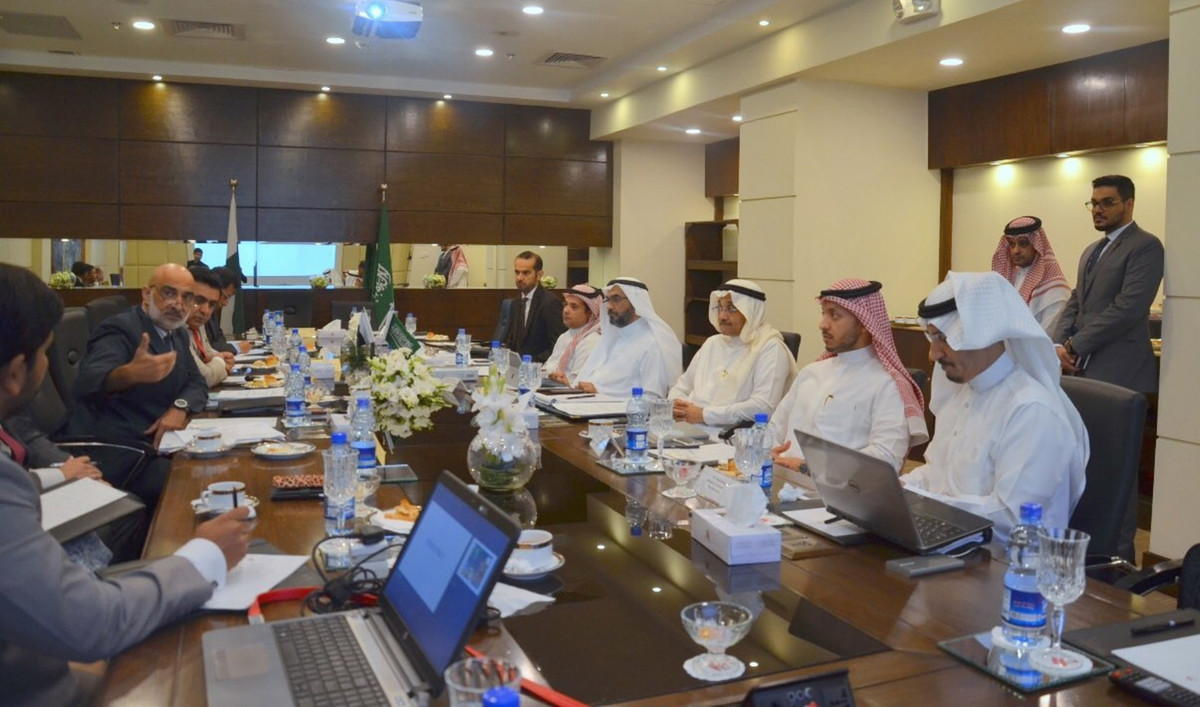


Pakistani officials are briefing visiting delegation of Saudi Arabia on the prospects of mutual investment. (AN photo)

Both sides also discussed the current volume of bilateral trade and explored ways to enhance trade volume from the current $3.4 billion, which is largely in favor of Saudi Arabia.
Pakistan imported $3.1 billion worth from the Kingdom while exporting only $316.7 million worth of goods during the 2017-18 fiscal year, the State Bank of Pakistan’s data shows.
During the meeting, Pakistan also formally sought the import of crude oil from the Kingdom on deferred payment for at least 90 days.
Last week, Pakistan’s Information Minister Fawad Chaudhry said that Pakistan and Saudi Arabia had signed three agreements to bring major investment into the country after the formal invitation of Pakistan to Saudi Arabia as a third partner in the China Pakistan Economic Corridor (CPEC) projects.
During his visit to the Kingdom in September, Umar had said that Prime Minister Khan discussed with the Saudi leadership measures for trade enhancement and investment. “These are measures which will help fill the external financing gap,” Umar noted.
He said Pakistan was constantly in touch with international commercial markets and banks for financing.
Foreign ministers of Saudi Arabia, other Muslim countries warn against Israel’s West Bank control measures

A woman takes clothes as members of a Palestinian Bedouin community leave following Israeli army order in Arabba town near Jenin
Updated 10 sec ago
Follow

Foreign ministers of Saudi Arabia, other Muslim countries warn against Israel’s West Bank control measures

  • Foreign ministers of Saudi Arabia, Jordan, UAE, Qatar, Indonesia, Pakistan, Egypt, and Turkiye strongly condemned the new Israeli measures
  • Measures will tighten control of the West Bank and pave the way for more settlements in the occupied Palestinian territory

RIYADH: The foreign ministers of Saudi Arabia and several other Muslim countries warned against the continuation of Israel’s expansionist policies and illegal measures in the occupied West Bank on Monday.

The foreign ministers of Saudi Arabia, Jordan, the United Arab Emirates, Qatar, Indonesia, Pakistan, Egypt, and Turkiye strongly condemned new Israeli measures to tighten control of the West Bank and pave the way for more settlements in the occupied Palestinian territory, the Saudi Press Agency reported.

Israel approved the measures, announced by Finance Minister Bezalel Smotrich and Defence Minister Israel Katz, on Sunday. They include allowing Jewish Israelis to buy West Bank land.

The Israeli measures also envisage transferring authority over building permits for settlements in parts of Palestinian cities, including Hebron, from the Palestinian Authority’s municipalities to Israel.

The foreign ministers reaffirmed that Israel has no sovereignty over occupied Palestinian territory and said such measures undermine ongoing efforts to achieve peace and stability in the region.

The ministers expressed their absolute rejection of these illegal measures, which constitute a flagrant violation of international law, undermine the two-state solution, and represent an attack on the inalienable right of the Palestinian people to establish their independent and sovereign state within June 1967 borders, with occupied East Jerusalem as its capital.

They said that the measures are null and void, and constitute a clear violation of UN Security Council resolutions, particularly Resolution 2334, which condemns all Israeli measures aimed at changing the demographic composition, character and status of the Palestinian territory occupied since 1967, including East Jerusalem.

The added that the measures also contradict a 2024 International Court of Justice advisory opinion, which concluded that Israel’s policies and practices in the occupied Palestinian territory and its continued presence therein are illegal.

The ministers reiterated their call for the international community to uphold its legal and moral responsibilities and compel Israel to halt its dangerous escalation in the occupied West Bank and inflammatory statements made by its officials.

They emphasized that fulfilling the legitimate rights of the Palestinian people to self-determination and the establishment of their state, based on the two-state solution and in accordance with international law and the Arab Peace Initiative, is the only way to achieve a just and comprehensive peace that guarantees security and stability in the region.