Saudi-Pakistani trust ‘very high,’ says Islamabad consul general in Jeddah

1 / 3
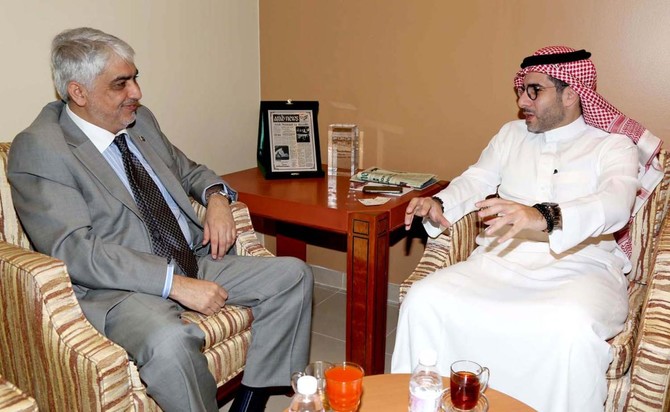
Arab News Editor in Chief Faisal J. Abbas received Pakistan Consul General in Jeddah Shehryar Akbar Khan at the Arab News HQ in Jeddah on Tuesday. (AN photo by Ghazi Mahdi)
2 / 3
Arab News Editor in Chief Faisal J. Abbas received Pakistan Consul General in Jeddah Shehryar Akbar Khan at the Arab News HQ in Jeddah on Tuesday. (AN photo by Ghazi Mahdi)
3 / 3
Arab News Editor in Chief Faisal J. Abbas received Pakistan Consul General in Jeddah Shehryar Akbar Khan at the Arab News HQ in Jeddah on Tuesday. (AN photo by Ghazi Mahdi)
Updated 20 February 2018
Follow

Saudi-Pakistani trust ‘very high,’ says Islamabad consul general in Jeddah

JEDDAH: The level of trust enjoyed by Saudi Arabia and Pakistan is “very high,” Pakistan’s consul general in Jeddah, Shehryar Akbar Khan, told Arab News Editor in Chief Faisal J. Abbas.
Khan visited the newspaper’s headquarters on Tuesday and congratulated Abbas on the successful launch of its Pakistan Edition.
“Heartiest congratulations on launching ArabNews.pk. We have many of the Pakistani diaspora here in Saudi Arabia who read Arab News on a daily basis, and they are now also turning to the PK edition,” Khan said.
“Likewise, there are many who have returned to Pakistan who are interested in keeping up with the news in and about Saudi Arabia. They have a good opportunity by going to the website.”
Referring to the Arab News interview with Pakistani Prime Minister Shahid Khaqan Abbasi, Khan said: “You had the interview on the front page, and that was highly appreciated by the Pakistani community.”

The fact that Arab News chose Pakistan as its first edition abroad “underlines and strengthens the bonds and ties that exist between Saudi Arabia and Pakistan,” he said.
“Our relationship at any level — whether people to people, government to government or military to military — is always the highest. Of that, there is no question,” he said.
“We are proud that ArabNews.pk has been launched. It is the first edition to be launched outside Saudi Arabia,” he added.
“Arab News is the leading English-language newspaper in Saudi Arabia, and I am sure it will find a great many readers in Pakistan.”
Khan said of his first meeting with Abbas: “I was very favorably impressed. We had a very open and candid discussion, and we wish him and his team the best of luck and success for their project in Pakistan.”
Talking about the launch of the Pakistan Edition, Abbas said: “You have the brand recognition. You have a bureau chief (Baker Atyani) who already knows the language. So the stars were aligned in our favor. The feedback is excellent.”
The Saudi-Pakistani relationship “has a very strong foundation. It is unshakable. We can agree or disagree about a particular point, but the underlying foundation remains,” he added.
“A country like Iran, or any other country, cannot alter this equation because we have layer upon layer — economic, political, religious — along with strategic cooperation between the two countries.”
Describing the mission of Arab News in going global, Abbas said: “We feel that there is a lot of change going on. This was my first visit to Islamabad, but it will definitely not be the last. I felt the people’s affection and their love for the Kingdom.”
But “their idea about Saudi Arabia is dated... It is 30 or 40 years old,” he said. “They are sometimes unaware of the changes that have taken place in the last 10 years, or even the changes that have occurred in the last two years alone, which are massive. Arab News wants to convey through our Pakistan Edition the changing face of Saudi Arabia.”
The consul general was accompanied by Press Consul M. Arshad Munir.



Pakistan finance chief calls for change to population-based revenue-sharing formula

Updated 6 sec ago
Follow

Pakistan finance chief calls for change to population-based revenue-sharing formula

  • Muhammad Aurangzeb criticizes current NFC formula, says it is holding back development
  • Minister says Pakistan to repay $1.3 billion debt in April as economic indicators improve

ISLAMABAD: Pakistan’s Finance Minister Muhammad Aurangzeb said on Saturday the country’s revenue-sharing formula between the federal and provincial governments “has to change,” arguing that allocating the bulk of funds on the basis of population was holding back long-term development.

The revenue-sharing is done under the National Finance Commission (NFC) Award that determines how federally collected taxes are divided between the center and the provinces. Under the current formula, much of the distribution weight is based on population, with smaller weightages assigned to factors such as poverty, revenue generation and inverse population density.

“Under the NFC award, 82 percent allocation is done on the basis of population,” Aurangzeb said while addressing the Federation of Pakistan Chambers of Commerce & Industry’s regional office in Lahore. “This has to change. This is one area which is going to hold us back from realizing the full potential of this country.”

Economists and policy analysts have long suggested broadening the NFC criteria to give greater weight to tax effort, human development indicators and environmental risk, though any change would require political consensus among provinces, making reform politically sensitive.

Aurangzeb also highlighted the economic achievements of the country in recent years, saying Pakistan’s import cover had improved from roughly two weeks just a few years ago to about 2.5 months currently, adding that the government had repaid a $500 million Eurobond last year.

“The next repayment is of $1.3 billion in April,” he continued, adding that “we will pay these obligations, which are the obligations of Pakistan, as we go forward.”

The minister also noted that unlike in 2022, when devastating floods forced Pakistan to seek international pledges at a Geneva conference, the government did not issue an international appeal during more recent flooding, arguing that fiscal buffers had strengthened.

“This time, the prime minister and the cabinet decided that we do not need to go for international appeal because we have the means,” he said.

He reiterated the government was pursuing export-led growth to avoid repeating past boom-and-bust cycles driven by import-led expansion that quickly depleted foreign exchange reserves and pushed Pakistan back into International Monetary Fund programs.