TEHRAN: Just one shop among the thousands in Tehran's sprawling Grand Bazaar can offer a tableau of the darkening mood descending across Iran as American sanctions again take hold.
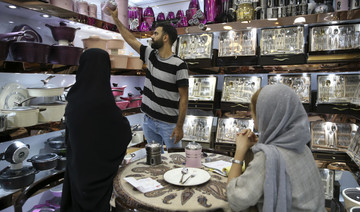
A salesman who wants to move to Europe for a better life shows off his pots and pans to a mother now struggling to pay for the gifts she wanted before her daughter's marriage amid the collapse of Iran's rial currency. Another salesman loudly blames internal politics and corruption for the country's woes. Muttered curses and even shouts against the government follow the journalists talking to them.
While only a small moment in a nation of 80 million people, it shows the dangers ahead for the government of the relatively moderate President Hassan Rouhani. His signature nuclear deal with world powers now has become a noose around his neck that hard-liners gleefully tighten. Meanwhile, the sporadic and leaderless protests the nation has seen over its worsening economy threaten to roar back to life at any time.
That has many expecting the worst is yet to come.
"It has become more difficult, but we need to lower our expectations," said Kiana Ismaili, 26, shopping ahead of her wedding.
For centuries, Iran's bazaar has been the beating heart of both its economic and political life. While some now go to the Western-style mega-malls of Tehran's tony northern suburbs, the Grand Bazaar's narrow alleys, cramped stalls and wandering musicians still draw crowds of thousands.
Strikes in Iran's bazaar also have served as political bellwethers.
Bazaar families opposed the Iranian Shah Mohammad Reza Pahlavi and supported the 1979 Islamic Revolution that saw him replaced by the Shiite theocracy and elected officials. More recently in June, protesters swarmed Tehran's Grand Bazaar and forced shopkeepers to close their stalls, apparently in anger over the rial dropping to 90,000 to the U.S. dollar on the black market despite government attempts to control the currency rate.
The rial in the meantime has dropped as much as 150,000 to $1 with many anticipating further drops as the U.S. restores punishing sanctions on Iran's crucial oil industry in early November. The Trump administration denies it is seeking to overthrow Iran's government through the economic pressure, though Iranian officials say the link between the two is clear.
Fear over the economy has brought many to the Grand Bazaar in recent days to buy what they can before their savings further dwindle away.
"People are buying more because they think they won't be able to buy stuff with current prices anymore. They are worried about price fluctuations," said Omid Farhadi, a 25-year-old sales clerk at the kitchenware shop Zomorrod, or "Emerald" in Farsi.
"You have no price stability in this country. You go to bed and overnight a car that was worth 100 million rials is now worth 140 million."
As shoppers looked over his pots and pans, Farhadi said he hoped to immigrate soon to the Netherlands. He said other young Iranians with the financial means want to leave the country as well, while those without, longingly look at life in Europe.
Farhadi largely blamed Iran's poor relations with the rest of the world for the faltering economy.
That's spearheaded by President Donald Trump's decision to pull America out of the 2015 Iran nuclear deal, which saw Iran agree to limit its enrichment of uranium in exchange for the lifting of economic sanctions. While the United Nations repeatedly has said Iran complies with the accord, Trump said he wanted a stricter deal that also constrained Iran's ballistic missile program and its foreign policy while permanently limiting its atomic program.
While Iranians remain angry at Trump over adding them to his travel ban and pulling out of the deal, many feel even angrier at their own government. That's due to a steady stream of corruption cases and allegations of mismanagement by officials.
Farhadi's colleague at the shop made a point to tell visiting Associated Press journalists he believed Iran's main problem lay with Rouhani's administration. The government's management of Iran's economy, already hobbled by high unemployment, growing inflation and debt-laden banks, also faces widespread criticsm.
"Ninety percent of our problems are because of the infighting," said salesman Alireza Alihosseini. "I don't know why but the government and the supreme leader have differences. Only 10 to 5 percent is because of America."
The mother of Ismaili, the young woman shopping ahead of her wedding, then came up and asked to talk as well. She spoke carefully about how Iran has faced sanctions and international pressure in the nearly 40 years since the 1979 Islamic Revolution, calling the recent pressure nothing new.
Men listening to her speak then started muttering, some cursing her loudly for her comments. A man in the market, who requested anonymity for fear of reprisals for his criticism of the government, put his blame squarely on those in charge of the country.
"For someone like me, a young man, if I'm hungry and I don't have a job I'll turn into a thief. I'll turn into a vampire," he warned.
Elsewhere in the market, some even defended Trump, like Mahdirashid Mohammadzadeh, whose small stall in the jewelry section of the bazaar has seen customers eagerly buying gold as a hedge against the falling rial.
"Once we made peace with Obama, we were never so cheap," he said.
Asked what caused the economic woes, Mohammadzadeh blamed Iran's costly foreign intervention in Syria.
"This is the people's money," he said. "We have done nothing wrong to deserve this, but they are sending all our money to Syria."

Unease, anger in Tehran's Grand Bazaar, Iran's beating heart
- Strikes in bazaar serve as political bellwether
- Shoppers worried about declining value of rial
Vision 2030 propelling Saudi Arabia’s global reputation
- Bold initiatives are positioning the Kingdom as a regional trailblazer in sustainability
RIYADH: Saudi Arabia’s Vision 2030 program, aimed at revolutionizing the Kingdom’s economic and social landscape, has propelled the nation’s global reputation on a large scale, experts told Arab News.
Launched in 2016, the program is a comprehensive guide to position Saudi Arabia as a powerhouse of business, tourism and non-oil activities, both regionally and globally.
Speaking to Arab News, Thomas Kuruvilla, managing partner of Arthur D. Little Middle East & India, said that Saudi Arabia’s Vision 2030 is the cornerstone of the Kingdom’s transformation driving diversification, investment in non-oil sectors, and reshaping its global reputation.
“Vision 2030 is not an end point but a launchpad. The foundations being laid today from renewable energy, automotive, and tourism to digital infrastructure and advanced industries are designed to endure and evolve well beyond 2030. The Kingdom’s leadership has already signaled that future frameworks will build on this momentum, ensuring that transformation continues into the decades ahead,” said Kuruvilla.
He added: “Vision 2030 has firmly established Saudi Arabia as a reforming nation on the world stage. Saudi Arabia is creating an economic and social model that looks past 2030, one that aims to deliver sustainable growth, global competitiveness, and opportunity for generations to come.”
Elie Farhat, chief of external affairs for Georgetown University’s McDonough School of Business espoused similar views and said Saudi Arabia has actively courted foreign investment, tourism, and partnerships with global universities and businesses.
“Saudi Arabia has become a market and society that is perceived as both investable and engaging. International organizations are setting up regional headquarters in Riyadh, universities are establishing partnerships, and businesses now openly discuss Saudi Arabia as a gateway to the future of the Middle East,” said Farhat.
In October, Saudi Arabia’s Investment Minister Khalid Al-Falih, while speaking at the Fortune Global Forum Conference in Riyadh, said the Vision 2030 program is progressing steadily, with 85 percent of the targets outlined in the initiative completed or on track by the end of 2024.
Al-Falih also added that the number of international firms licensed to establish their regional headquarters in Riyadh has reached 675.
The regional HQ program offers a 30-year corporate tax exemption, withholding tax relief, and regulatory support, reflecting efforts to position the Kingdom as a regional business hub and attract multinational corporations to the capital.
Some of the noted firms that have established regional bases in Riyadh include Northern Trust, IHG Hotels & Resorts, PwC, and Deloitte. Laura Hernandez Gonzalez, managing director of Globant for the Middle East and North Africa, said Vision 2030 has turned diversification from an aspiration into a reality, adding that programs like the regional HQ initiative and the transformation of Riyadh into a true financial hub are convincing multinationals to set up real operations, not just representative offices.
“From the technology side, the Kingdom’s commitment to AI, cloud, and sovereign digital infrastructure is equally important. It signals not only ambition, but the capacity to build future-ready capabilities at scale,” said Gonzalez.
She added: “This is how the Kingdom is changing global perceptions: from an energy powerhouse to a hub of innovation, capital and talent.”
Earlier in December, Rachid Boulaouine, Middle East and Saudi Arabia director at Business France, told Al-Eqtisadiah that French companies operating in Saudi Arabia are expected to increase by 30 percent to 40 percent as more small and medium-sized enterprises move to establish a presence in the Kingdom.
The changing global image
Kuruvilla said that Saudi Arabia’s pivot toward renewable energy and sustainability is not just symbolic, but it represents a decisive strategic shift in the Kingdom’s development model.
Bolstering renewable energy capacity is critical for Saudi Arabia as it aims to generate 130 gigawatts of clean energy by 2030 and achieve net-zero emissions by 2060.
Kuruvilla said that flagship projects such as Neom — a futuristic city designed to run entirely on renewable energy — and the world’s largest green hydrogen plant highlight Saudi Arabia’s determination to lead in climate innovation.

This is how the Kingdom is changing global perceptions: from an energy powerhouse to a hub of innovation, capital and talent.
Laura Hernandez Gonzalez, managing director of Globant for the Middle East and North Africa
“These initiatives are positioning the Kingdom as a regional trailblazer in sustainability and earning recognition as a nation “at the forefront of the clean-energy revolution,” with few global peers matching its scale and ambition,” said the Arthur D. Little official.
He added: “Such bold moves are strengthening Saudi Arabia’s standing among international partners that prioritize climate action, demonstrating alignment with global sustainability imperatives rather than resistance.”
According to Farhat, it is the young generation in Saudi Arabia guided by Vision who are playing a crucial role in elevating the Kingdom’s global reputation.
“Saudis — particularly younger generations — have opened up to the world with a readiness to learn, build, and lead for 2030. The world, in turn, has opened up to Saudi Arabia, seeing it as a dynamic partner to invest in,” said Farhat.
Saudi Arabia’s tourism growth
Gonzalez said that the global narrative about Saudi Arabia has shifted decisively, with international travelers increasingly considering the Kingdom as a favorite destination.
She added that the growth in tourism numbers is one of the clearest proof points that Vision 2030 is delivering, also indicating the Kingdom’s growing appeal among the international public.
“Ranking among the top three globally for growth in international tourist arrivals, surpassing 100 million visits in 2023, and contributing over 10 percent of the gross domestic product in 2025 are extraordinary achievements in such a short period,” said Gonzalez.
She added: “Today, when I speak with investors, partners, or peers, Saudi Arabia is framed around opportunity, innovation, and delivery.”
Kuruvilla said that the growth in tourism has signaled to the world that Saudi Arabia is no longer just an oil-rich nation, but a fast-emerging must-visit destination.
HIGHLIGHT
The regional HQ program offers a 30-year corporate tax exemption, withholding tax relief, and regulatory support, reflecting efforts to position the Kingdom as a regional business hub and attract multinational corporations to the capital.
The Arthur D. Little official added that media coverage has reinforced this narrative, with tourism and entertainment mentions up 60 percent in 2024, underscoring the Kingdom’s growing appeal to global travelers.
“International surveys echo this sentiment: a recent multi-country poll found 59 percent of respondents were interested in visiting Saudi Arabia — a figure unimaginable only a decade ago,” said Kuruvilla.
Saudi Arabia passed its 2030 target of 100 million visitors in 2023, and the following year it welcomed 115.9 million tourists.
Having already reached its goal, the Kingdom raised its target to 150 million annual visitors by 2030.
In November, the Saudi Conventions and Exhibitions General Authority announced record growth in the Kingdom’s business events infrastructure, reporting a 32 percent year-on-year increase in capacity across 923 accredited venues.
The authority added that this expansion reflects significant investment aligned with Vision 2030’s tourism and event sector priorities, driving a 320 percent increase in exhibition space since 2018 to a total of 300,520 sq. meters.
Sports and technology
According to Kuruvilla, Saudi Arabia is cultivating an image as a global hub for business, technology, and innovation by hosting high-profile international events like the Future Investment Initiative, the LEAP tech conference, and the World Defense Show.
He said that these events draw thousands of investors, entrepreneurs, and industry leaders to the Kingdom, showcasing opportunities beyond oil.
“The cumulative effect of these marquee gatherings and the establishment of such innovation-driving entities is a narrative that Saudi Arabia is open for business and eager to lead in future industries – a notable departure from its old image of insularity,” said Kuruvilla.
He added: “These gatherings are translating into tangible partnerships and long-term investment opportunities, solidifying Saudi Arabia’s reputation as a hub for innovation and global business exchange.”
According to Gonzalez, events like FII and LEAP in Saudi Arabia prove the Kingdom’s execution capacity, as well as showing the nation’s capability to “convene the world, compress partnership cycles, and set the agenda on innovation, defense, and finance.”
Highlighting the importance of sporting events, Kuruvilla told Arab News that sports have become a cornerstone of Saudi Arabia’s effort to bolster its global reputation.
“From hosting Formula 1 races and high-profile boxing matches to purchasing stakes in English Premier League football clubs, the Kingdom has invested heavily in sports as an avenue for soft power. The pinnacle of this strategy is Saudi Arabia securing the rights to host the 2034 FIFA World Cup — a coup that instantly thrusts the country into the international spotlight,” said Kuruvilla.
Adding to this momentum, Saudi Arabia has also positioned itself at the forefront of digital sports by hosting the Esports World Cup in Riyadh in 2024 and 2025, with record-breaking prize pools and participation from the world’s top gaming titles.
“By associating with beloved sports and athletes, Saudi Arabia is effectively rebranding itself, especially to younger global audiences, as a vibrant and welcoming destination. Superstars like Cristiano Ronaldo playing for Saudi clubs – and posting about life in the Kingdom – further humanize Saudi Arabia’s image abroad,” added the Arthur D. Little official.


