- Trade Development Authority plans displays in foreign consulates and embassies to attract buyers
- Demand high among Asian women, with Middle East, Afghanistan, Sri Lanka and Bangladesh potential markets
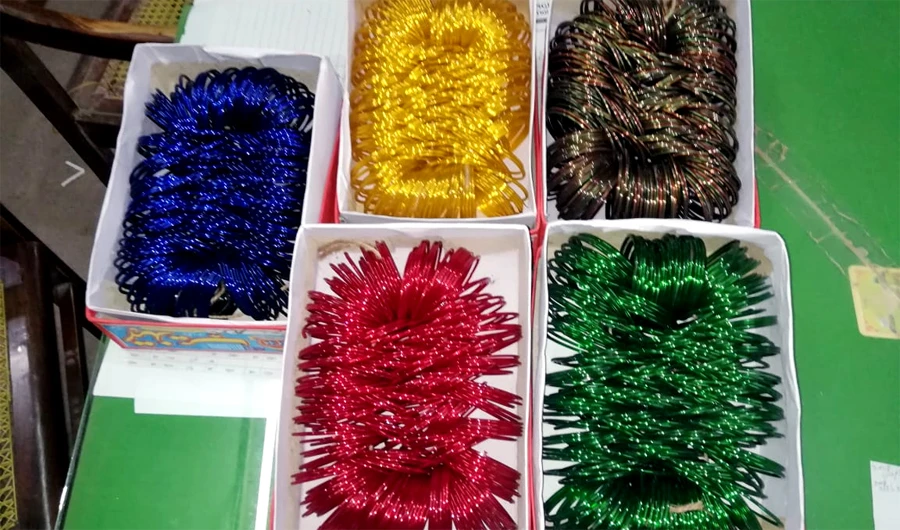
KARACHI: Pakistan is pushing its glass bangles manufacturers into the export market to tap into the growing demand in the Middle East, Afghanistan, Sri Lanka, Bangladesh, and other countries with many Asians residents, according to officials.
Hyderabad is the main hub of glass bangles manufacturing, with its products supplied throughout the country. About 25 units, 10 of which are automated, are operational in the city. The bangles produced in the city are mainly consumed within Pakistan, with relatively few formal exports.
Considered a vital fashion ornament for Pakistani and Asian women, demand for glass bangles exists wherever a large number of Asian women live, including Canada, the US and some European countries.
“We are planning to exports bangles from Pakistan by giving incentives to the manufacturers, including allocating special pavilions in domestic and international exhibitions, which are attended by thousands of foreign visitors, and training the workers for new designs and utilizations of colours,” Ashiq Hussain Khoso, Deputy Director of the Trade Development Authority of Pakistan (TDAP), told Arab News.
“TDAP has planned displays of glass bangles in foreign consulates and embassies to attract foreign buyers and visitors as part of promotional activity.”
The quality of products currently being manufactured needs to be enhanced, with more focus on innovation and new designs. “Pakistani manufacturers use around 40 colors while making bangles, whereas some 6,500 colors are being used worldwide in a wide range of glass products,” Khoso added.
Exports from Pakistan are negligible for a variety of reasons, including a lack of awareness among the manufacturers.
“I have been associated with the bangle manufacturing business for the last 52 years but no serious efforts were made to explore international markets. The nature of the product, which is very delicate, easily broken, has discouraged many aspiring exporters,” said Zamir Uddin, the 70-year old Chairman of Bangle Union Hyderabad.
The industry is providing job opportunities to nearly half of the city’s population. “For making a single bangle, 25 individuals are involved in the process”, Uddin added.
“The industry now needs automation to a large extent,” Hasan Jamal Siddiqui, an active member of the Glass Bangles Manufacturers’ Association, told Arab News. “The innovative products, new designs and quality are major concerns. We want to talk to institutions where such ideas are discussed and people are being imparted training.”
India is the leading manufacturer of glass bangles in the region and it has adopted automation and come up with a greater variety of designs. “The Indian city of Firozabad has become the main hub of glass bangle-making activities and they have also captured our market in Afghanistan,” said Siddiqui.
Currently no institute is specifically providing courses related to designing or manufacturing bangles. “We can offer courses if there is feasibility, otherwise we can keep it limited to workshops, depending on the requirements and methodology of the manufacturing and design of bangles and career openings,” Nameem Bukhari, Head of the Department of Textile Designing at the Asian Institute of Fashion Designing, Iqra University, told Arab News.
The bangle manufacturing sector employs large numbers of women, who suffer due to the seasonal nature of the work. “The employers need to improve the working environment and come up with more innovative ideas. The export of products will also boost the demand for the commodity in this age of consumers’ right,” said Zehra Khan, General Secretary of the Home-based Women Workers’ Federation of Pakistan.