23 injured after Saudi Arabian forces intercept Houthi missile fired toward Najran

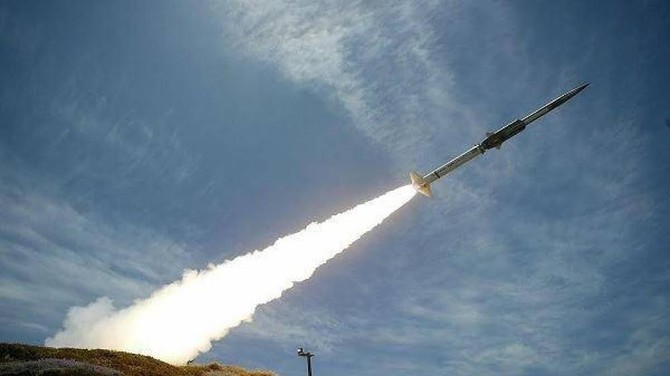
Saudi Arabia's air defense forces intercepted a missile fired by Houthi militia on Wednesday toward Najran. (Screenshot)
Updated 06 September 2018
Follow

23 injured after Saudi Arabian forces intercept Houthi missile fired toward Najran

JEDDAH: Saudi Arabia’s air defense forces on Wednesday intercepted a ballistic missile fired by Houthi militias, which injured 23 people according to an Arab coalition statement.

The missile, the latest in a series of similar attacks, was heading toward Najran, the Saudi Press Agency reported.

Arab coalition spokesman Col. Turki Al-Maliki said that 23 people were injured by "falling scattered fragments" as a result of the incident but none of the injuries were serious.

Al-Maliki added that the launching of missiles by the Iranian-backed Houthi militia proves the Iranian regime’s continued involvement in supporting the terrorist group in clear and explicit defiance of UN resolution 2216 and resolution 2231.

He noted the Houthi attacks are aimed at threatening the Kingdom’s security, as well as regional and international security and the firing of ballistic missiles at populated towns and villages is in contradiction of international humanitarian law.

The total number of ballistic missiles launched by the Iranian-backed Houthi militia toward Saudi Arabia so far has reached 187 rockets.


Saudi Arabia targets 50 wildlife breeding programs within 5 years

Updated 5 sec ago
Follow

Saudi Arabia targets 50 wildlife breeding programs within 5 years

  • Strategy follows surging interest in protecting prized native species

RIYADH: Saudi Arabia’s top wildlife protection body has launched a plan to operate 50 breeding programs by 2030 and improve environmental balance, its CEO has said.

Mohammed Ali Qurban, head of the National Center for Wildlife, said the number of programs has already surged from seven to 21 in recent years, amid renewed interest in the protection of valued native species.

The breeding programs are based on precise scientific principles, starting with the selection of suitable species at research centers, followed by veterinary care and specialized nutrition programs, he added.

At the final stage, protected species are rehabilitated for release and monitored using the latest tracking and data analysis technologies.

The relocation of more than 10,000 animals in Saudi Arabia is “an important step in restoring ecosystems and enhancing environmental balance in the Kingdom,” Qurban said.

Veterinary scientists at work at the National Center for Wildlife's laboratory. (Supplied)

“Releasing wildlife into the wild contributes to forming new populations capable of self-reproduction; these releases support the genetic diversity of wild populations and enhance their ability to resist disease and adapt to environmental changes,” he added.

Releases have so far included more than 80 priority species, most notably reem antelopes, Arabian oryx, idmi gazelles, mountain ibex, houbara bustards, ostriches and sandgrouses. The animals were released within their historical and ecological ranges.

Qurban said that the plans take into account the carrying capacity of natural habitats and the importance of safe ecological corridors that connect protected areas to facilitate species movement and population sustainability.

Release sites are spread across more than 60 diverse environmental locations, including natural reserves, royal reserves and national parks, as well as strategic sites within the Kingdom’s giga-projects, ensuring the dispersal of animals across their targeted geographical ranges.

The efforts are part of a national integrated framework to support the goals of the Saudi Green Initiative, Vision 2030 and the National Environment Strategy, aiming to achieve thriving and sustainable wildlife and ecosystems, Qurban said.