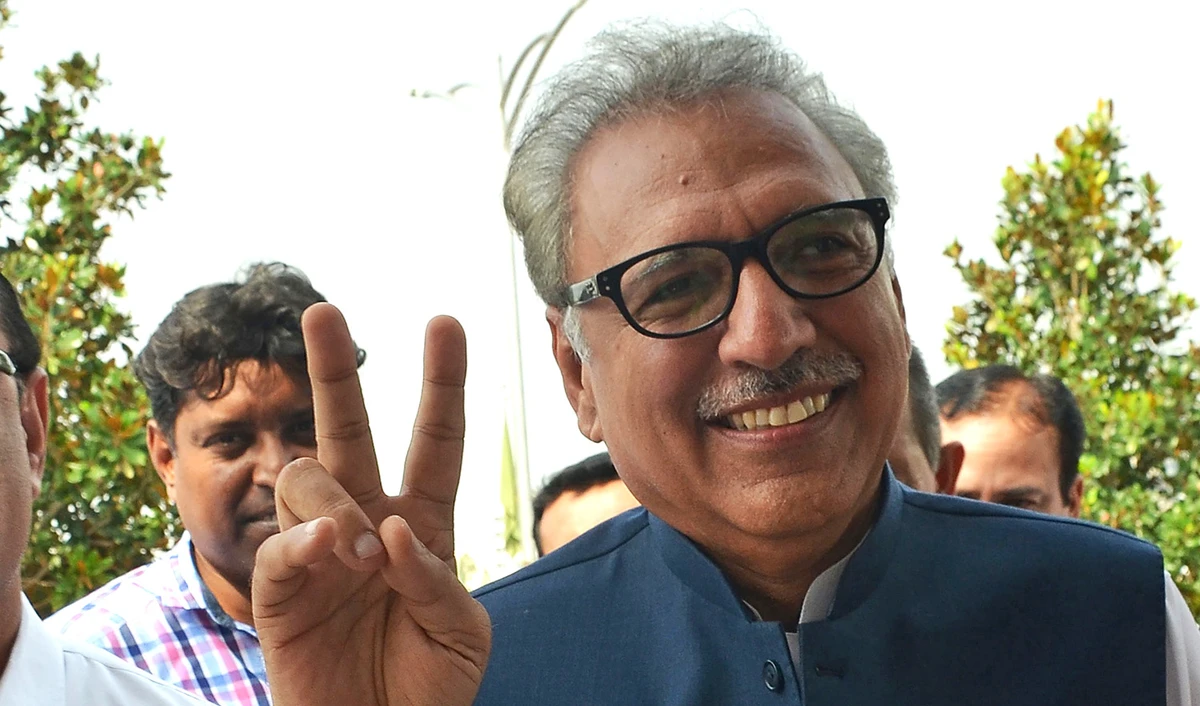
- Victorious candidate faced two other contenders, Aitzaz Ahsan and Maulana Fazlur Rehman
- Alvi received 352 votes from 706 in electoral college’s secret ballot
ISLAMABAD: Dr. Arif Alvi, the Pakistan ruling coalition candidate, was chosen as the republic’s 13th president on Tuesday, five days before incumbent President Mamnoon Hussain’s term expires.
Alvi was elected in a secret ballot carried out by the country’s electoral college consisting of the Senate, National Assembly and four provincial assemblies.
“I am the president of the entire nation and all parties from today, not just the president nominated by the PTI (Pakistan Tehreek-e-Insaf),” the president-elect said. “Each party has an equal right on me.”
Alvi is expected to take the oath of office on Sept. 9.
Speaking to the media after the announcement, Alvi thanked Prime Minister Imran Khan for trusting him to take up the “big responsibility.”
The Election Commission of Pakistan will announce the official results on Wednesday. However, a preliminary vote count showed a “clear majority” in favor of the PTI co-founder and parliamentarian who is believed to have received 352 of the 706 votes cast.
Alvi’s victory was tipped ahead of the presidential election by political observers following signs of a rift between Pakistan People’s Party (PPP) and the joint opposition.
The party of jailed former Prime Minister Nawaz Sharif backed Maulana Fazlur Rehman while the PPP went ahead with lawyer Aitzaz Ahsan as its candidate. This failure to reach a consensus and nominate a single candidate weakened any power the opposition alliance may have had.
“Alvi’s election shows that PTI and its allies stand united and on the same page, while the opposition has not yet recovered from its electoral defeat,” said political analyst Umar Kareem.
Lt. Gen. (retd.) Talat Masood dubbed the Sindh-based PPP as “the opposition within the opposition.”
Speaking to Arab News, he said that the “PPP’s move (to elect a separate candidate) while masquerading as the opposition crippled the prospects of the alliance having their candidate elected.”
TV anchor and analyst Ahmed Qureshi said: “Alvi’s triumph confirms PTI’s political dominance in Pakistan established after the 2018 electoral win.
“It confirms that the opposition, especially Nawaz Sharif’s PML-N (Pakistan Muslim League-Nawaz) has lost the ability to rock the boat for PTI. And, lastly, it means that an educated, middle-class Pakistani citizen can rise to the top in Pakistan after decades of rule by feudal politicians,” said Qureshi.
PPP had pitched senior Supreme Court advocate and veteran lawmaker Aitzaz Ahsan, a well-respected politician, as its nominee. He reportedly received a collective 132 votes, leading only in the Sindh Assembly against Alvi and Rehman.
Maulana Fazlur Rehman, president of the five religious party alliance and chief of his own party Jamiat Ulema-e-Islam-Fazl, who has been elected several times as a member of Pakistan’s National Assembly since the late 1980s, failed to secure over 160 votes.
Ahsan was ineligible to vote as he is not a member of Senate, while Rehman could not vote because he is neither a member of Parliament nor the Provincial Assembly.
Islamabad-based strategic and political analyst Yasir Mehmood said: “This reaffirms a monumental victory for the PTI, a party that has defeated the dynastic and the status quo — two parties that dominated politics in Pakistan (PPP and PML-N).
“The opposition should put aside their differences, respect and accept the institutional strength of the Parliament to ensure the smooth functioning of democratic norms,” Mehmood told Arab News.
Analysts believe that Alvi is likely to take a proactive approach in his new role, a post that is largely ceremonial.