

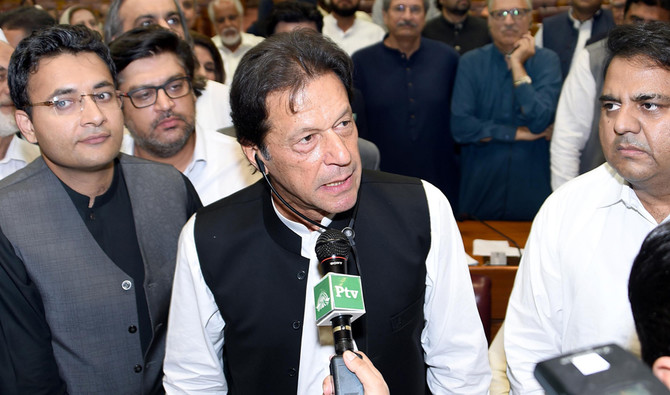
Imran Khan elected prime minister of Pakistan

Pakistan's newly appointed Prime Minister Imran Khan addresses lawmakers after being elected by National Assembly members in Islamabad on August 17, 2018. (AFP / Handout photo)
Updated 17 August 2018
Follow

Imran Khan elected prime minister of Pakistan

  • Khan received 176 votes in the 342-seat National Assembly; Shehbaz Sharif of Pakistan Muslim League-Nawaz (PMLN), garnered 96 votes
  • Pakistan People’s Party with 54 seats backed out of supporting opposition's candidate Shabaz sharif , weakening the position of the PML-N, which has 81 seats

ISLAMABAD: Members of Pakistan’s freshly elected national assembly voted in favor of Imran Khan to take the country’s most powerful position as its new Prime Minister crushing his opponent Shahbaz Sharif on Friday.

Khan, chief of Pakistan Tehreek-e-Insaaf (PTI) received an impressive 176 votes in the 342 seat lower house of parliament. His rival Sharif, younger brother of imprisoned ex-Premier Nawaz Sharif and president of Pakistan Muslim League – Nawaz (PML-N) received 96 votes.

The result announcement by the speaker of the house rattled lawmakers of PML-N sparking a loud protest against Khan’s victory as unacceptable repeatedly chanting “Prime Minister Nawaz Sharif” who was judicially ousted from the premiership last year and is serving time in prison on corruption charges.

Meanwhile PTI lawmakers rejoiced and congratulated Khan who remained calm amid the strong protest by his rivals which continued despite requests by the speaker Asad Qaiser for silence forcing him to temporarily suspend the assembly session.

Amid unrest, the new Prime Minister addressed the national assembly members following resumption of the session by the speaker.

------

READ MORE: EXCLUSIVE: Pakistan PM contender Imran Khan pledges stronger ties with Saudi Arabia

------

"I did not climb on any dictator's shoulders; I reached this place after struggling for 22 years. Only one leader struggled more than me, and that was my hero, Jinnah. Twice every month I will answer to the people during the question-answer session in the assembly", said Khan and vowed to bring promised change the country desires.

"We have to have strict accountability in this country; the people who looted this country, I promise that I will work against them" and “the money that was laundered, I will bring it back — the money that should have gone towards health, education, and water, went into people's pockets" Khan pledged in continuation of his anti-corruption campaign.

He briefly centered his attention towards the protesting opposition and reminded them of their failure to address his concerns when he raised his voice against election rigging during the PML-N government following 2013 general elections.

Khan told the PML-N leadership that his government would cooperate with them if they chose to take rigging allegations to court and would provide food, water, and containers if they opted to stage demonstrations against his ruling coalition.  

The PTI won the July 25 election with 116 seats in the National Assembly, the lower house of Parliament.

The party took in independent candidates and formed an alliance with other political parties, putting it above the threshold required for a majority in the assembly, said PTI spokesman Fawad Chaudhry.

Candidates backed by the PTI and its coalition partners won the key positions of the speaker and deputy speaker of the house on Wednesday, dealing another blow to the 11-party opposition alliance

The Pakistan People’s Party (PPP), with 54 seats backed out of supporting Sharif’s candidacy, weakening the position of the PML-N, which has 81 seats.

In response Sharif also reminded the new premier of his earlier commitment. "You had said that if rigging in 2013 elections would be proven, Nawaz Sharif's government should resign. We will not let you run from this. We will hold you accountable for stealing votes" firmly said Sharif and continued his diatribe over systematic election rigging hurling accusations.

The first time member of the national assembly, Bilawal Bhutto, the young Chairman of PPP maintained posture and decorum during the session. He challenged Khan on his words to the nation and said, "our prime minister-elect has promised a 100-day roadmap. I want to see how he creates 10 million jobs, ends poverty" and asked the new premier “what his plan will be to deal with the economic crisis" which the new government is likely to seek a bailout package from the International Monetary Fund, a door Khan had vowed not to knock for help regardless.


US Justice Department official eyes cases against Cuba leaders as Trump floats ‘friendly takeover’

Updated 07 March 2026
Follow

US Justice Department official eyes cases against Cuba leaders as Trump floats ‘friendly takeover’

  • “Working group” formed to build cases against people connected to the Cuban government
  • Trump’s has increasingly displayed aggressive stance against Cuba’s communist leadership

MIAMI: The top Justice Department prosecutor in Miami is considering criminal investigations of Cuban government officials, according to people familiar with the matter. The inquiry comes as President Donald Trump has raised the possibility of a “friendly takeover” of the communist-run island.
Jason Reding Quiñones, the US attorney for the Southern District of Florida, has created a “working group” that includes federal prosecutors and officials from the Drug Enforcement Administration and other agencies to try to build cases against people connected to the Cuban government and its Communist Party, according to one of the people. They spoke on the condition of anonymity because they were not authorized to publicly discuss the effort.
It was not immediately clear which Cuban officials the office is targeting or what criminal charges prosecutors may be looking to bring.
The Justice Department said in a statement Friday that “federal prosecutors from across the country work every day to pursue justice, which includes efforts to combat transnational crime.”
The effort is taking place against the backdrop of Trump’s increasingly aggressive stance against Cuba’s communist leadership.
Emboldened by the US capture of Cuba’s close ally, Venezuelan President Nicolás Maduro, Trump last month said his administration was in high-level talks with officials in Havana to pursue “a friendly takeover” of the country. He repeated those claims this week, saying his attention would turn back to Cuba once the war with Iran winds down.
“They want to make a deal so bad,” Trump said of Cuba’s leadership.
While Cuba has faded from Washington’s radar as a major national security threat in recent decades, it remains a priority in the US Attorney’s office in Miami, whose political, economic and cultural life is dominated by Cuban-American exiles.
The FBI field office has a dedicated Cuba group that in 2024 was instrumental in the arrest of former US Ambassador Victor Manuel Rocha on charges of serving as a secret agent of Cuba stretching back to the 1970s.
In recent weeks, several Miami Republicans, in addition to Florida Sen. Rick Scott, have called on the Trump administration to reopen its criminal investigation into the 1996 shootdown of four planes operated by anti-communist exiles.
In a letter to Trump on Feb. 13, lawmakers including Reps. Maria Elvira Salazar and Carlos Gimenez highlighted decades-old news reports indicating that former President Raúl Castro — the head of Cuba’s military at the time — gave the order to shoot down the unarmed Cessna aircraft.
“We believe unequivocally that Raúl Castro is responsible for this heinous crime,” lawmakers wrote. “It is time for him to be brought to justice.”
While no indictment against Castro has been announced, Florida’s attorney general said this week that he would open a state-level investigation into the crime.
The Trump administration has also accused Cuba of not cooperating with American counterterrorism efforts, adding it alongside North Korea and Iran to a select few nations the US considers state sponsors of terrorism.
The designation stems from Cuba’s harboring of US fugitives and its refusal to extradite several Colombian rebel leaders while they were engaged in peace talks with the South American nation.