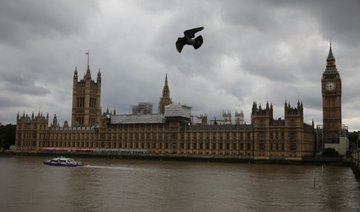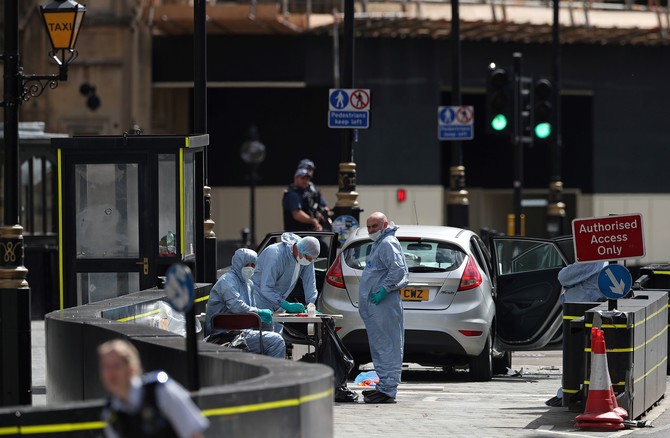
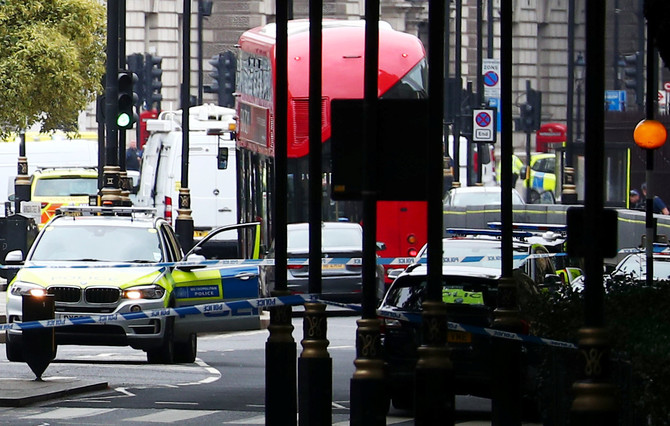

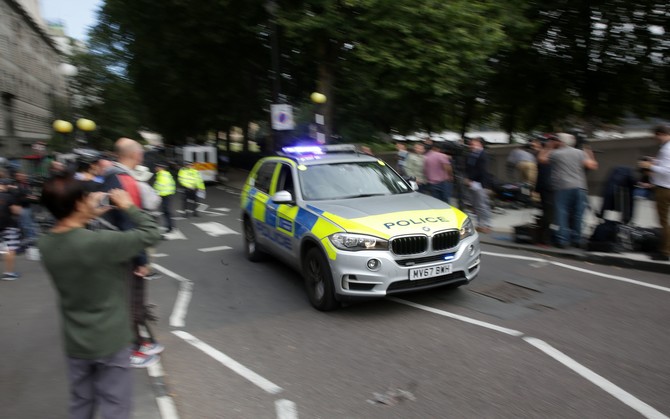

LONDON: British counter-terrorism police carried out three searches in central England on Tuesday evening as part of an investigation after a car slammed into barriers outside the Houses of Parliament in London on morning.
Police say the driver, a 29-year-old UK national, has been arrested on suspicion of “preparing a terrorist act.”
Three people were hurt in the incident.
The suspect is being questioned at a south London police station, having previously refused to cooperate with officers immediately after his arrest.
Rooftop camera shows moment car crashes into barriers outside Parliamenthttps://t.co/CprbiGZgrg #Westminster pic.twitter.com/0noYclQNaR
— BBC Breaking News (@BBCBreaking) August 14, 2018
The Metropolitan Police said a silver Fiesta, which was privately owned, travelled from Birmingham to London late on Monday night. It was then driven around the Westminster and Whitehall area from approximately 6am until the crash at 7:37am.
Police say there have been no other arrests in connection with this investigation.
Britain's government decided to keep its threat level for terrorism at severe after the incident. The decision not to elevate the threat level followed a meeting of the government's emergency COBRA committee on Tuesday.
Assistant Commissioner Neil Basu of the Metropolitan Police confirmed in a statement that no other suspects have been identified and police believe there is no further threat to Londoners.
Prime Minister Theresa May said her thoughts were with those injured, and she urged the country to come together and carry on as normal, even as she urged the public to "remain vigilant.”
British authorities say they have foiled 13 extremist plots and four far-right plots since March 2017, and currently have 676 live counterterrorism investigations.
The Metropolitan Police said cordons that had sealed off much of London's Westminster government district had been lifted, after forensics officers in coveralls finished collecting evidence from the car.
While we are keeping an open mind, the Met's Counter-Terrorism Command is leading the investigation into the #Westminster incident.
— Metropolitan Police (@metpoliceuk) August 14, 2018
Chris Phillips, a former senior police officer with expertise in counter-terrorism, told Arab News: “The worry is that we start seeing these types of attack as being normal. Because that blinds us to the myriad of other types of attack open to terrorists.
“This appears to be a copy cat-type incident. But there might be more to it, time will tell. It certainly appears to be a poor attempt, thank goodness.
He added: “(These types of attacks are) impossible to predict, impossible to stop completely but it is possible to make iconic sites more difficult to attack.”
And Adrian James, reader in police studies at Liverpool Centre for Advanced Policing Studies, Liverpool John Moores University, warned that potential acts of terror do not require “sophisticated means” in urban areas.
Speaking to Arab News, James said: “We need to be cautious about attributing motive but certainly eye-witness reports suggest that this was a deliberate act. Previous terrorist attacks have utilised vehicles in a similar way.
“If indeed it is an act of terrorism, as much as anything it demonstrates that in an urban environment a motivated offender can easily find the means to achieve their purpose. One doesn’t necessarily need sophisticated means to achieve it.
“Intelligence is key to preventing these attacks but the police have only finite resources and in a truly democratic society there are limits to the extent to which police intelligence gathering activities are considered legitimate. Intelligence ‘failure’ though always regrettable is inevitable."
US President Donald Trump tweeted about the incident on Tuesday, saying: “Another terrorist attack in London. These animals are crazy and must be dealt with through toughness and strength!”
Our statement in response to the incident in #Westminster. We have treated two people at the scene for injuries that are not believed to be serious and have taken them to hospital. pic.twitter.com/ySXAgmYqfF
— London Ambulance (@Ldn_Ambulance) August 14, 2018
Another terrorist attack in London...These animals are crazy and must be dealt with through toughness and strength!
— Donald J. Trump (@realDonaldTrump) August 14, 2018