Protesters demonstrate outside UK Parliament over visit of Qatari emir

1 / 6
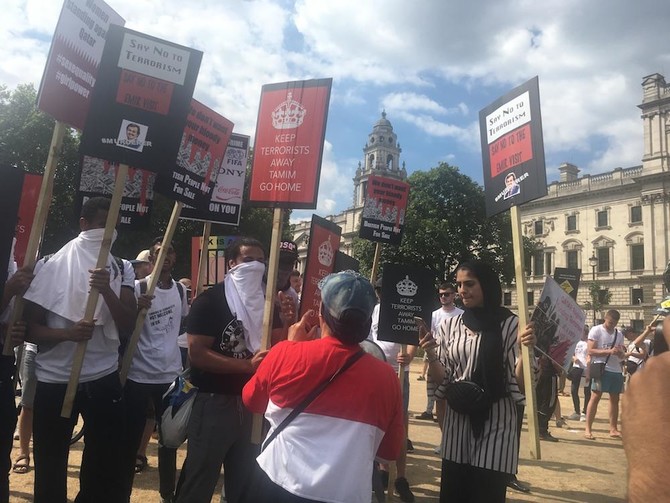
Scores of protesters took to the streets outside the UK’s parliament building in London on Monday to voice their objections to the visit of Qatar’s Emir Tamim bin Hamad Al-Thani. (AN Photo/Anna Pukas)
2 / 6
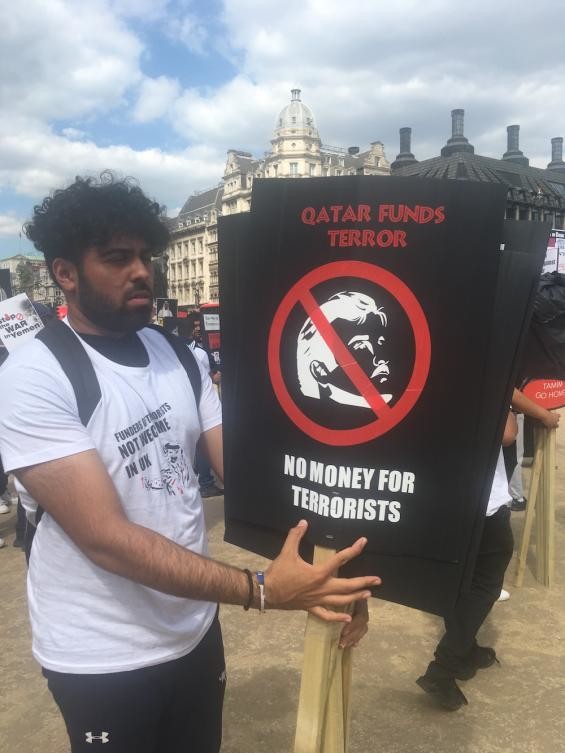
Scores of protesters took to the streets outside the UK’s parliament building in London on Monday to voice their objections to the visit of Qatar’s Emir Tamim bin Hamad Al-Thani. (AN Photo/Anna Pukas)
3 / 6
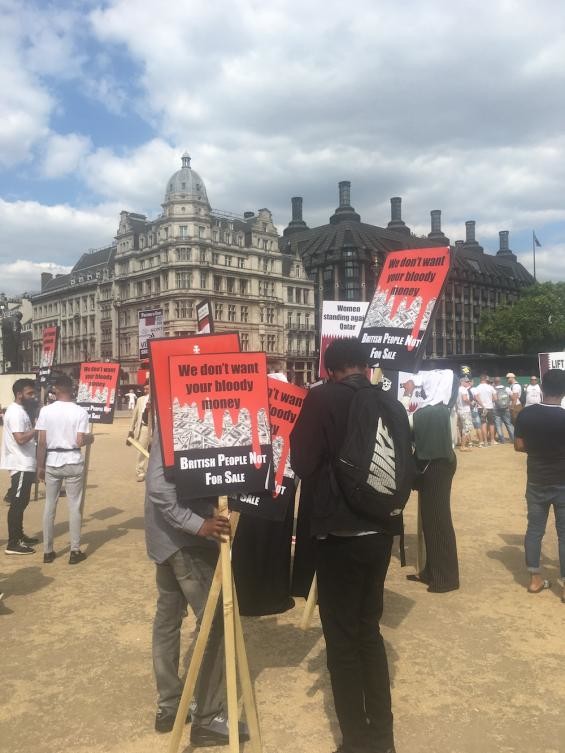
Scores of protesters took to the streets outside the UK’s parliament building in London on Monday to voice their objections to the visit of Qatar’s Emir Tamim bin Hamad Al-Thani. (AN Photo/Anna Pukas)
4 / 6
Scores of protesters took to the streets outside the UK’s parliament building in London on Monday to voice their objections to the visit of Qatar’s Emir Tamim bin Hamad Al-Thani. (AN Photo/Anna Pukas)
5 / 6
Scores of protesters took to the streets outside the UK’s parliament building in London on Monday to voice their objections to the visit of Qatar’s Emir Tamim bin Hamad Al-Thani. (AN Photo/Anna Pukas)
6 / 6
Scores of protesters took to the streets outside the UK’s parliament building in London on Monday to voice their objections to the visit of Qatar’s Emir Tamim bin Hamad Al-Thani. (AN Photo/Anna Pukas)
Updated 24 July 2018
Follow

Protesters demonstrate outside UK Parliament over visit of Qatari emir

  • Scores of protesters took to the streets outside the UK’s parliament building in London on Monday
  • The demonstrations come after several recent stories have drawn Londoners’ attention to Qatar’s actions

He may be the honored guest of the British prime minister but the protesters who gathered outside Parliament in London on Monday felt differently.

A crowd of around 100 took up positions opposite Big Ben in Westminster to voice angry opposition to the presence in Britain of Sheikh Tamim bin Hamad Al-Thani, emir of Qatar and a man derided by the protesters as “leader of a country without a conscience.”

“One, two, three four, we don’t want Tamim no more,” they chanted, followed by “five, six, seven, eight, Qatar is a terror state. The chants were led by two women — Egyptian-born Magda Sakr, a freelance PR consultant, and 20-year-old university student Belle Yassin, who organized two coach-loads of demonstrators from Birmingham, about 125 miles north west of London.“He is not welcome here,” said Sakr. “He should go now.”

The emir is in London to discuss trade relations. He was due to meet the Lord Mayor, Charles Bowman, and Baroness Fairhead, minister of state for trade and export promotion, in the morning before going on to the Houses of Parliament, although no one seemed sure of his movements.

The first protesters on the scene were a dozen young men in white T-shirts, bearing placards with the slogan “we don’t want your bloody money” — a protest against the treatment of migrant workers in Qatar. Surprisingly — and somewhat inexplicably — they were all Russian and spoke little English, but shared a common cause with the British Arab protesters who eventually joined them.

“We want Qatar to respect people from all countries who work there and not to treat them like slaves,” said one of the men, who gave his name only as Pavel.

After an hour, there was a cheer from the gathering with the arrival of Khalid Al-Hail, leader of the Qatar National Democratic Party, and the man everyone said was behind the anti-Tamim protest. Blue-suited and urbane, Al-Hail said it was time for Qatar to admit its links with terrorists and stop giving in to them.

“I hope the Qatar leadership will confess to sponsoring terrorism and admit the human rights abuses that they have allowed to happen,” he said. 

Al-Hail referred to a ransom of more than $1 billion paid by Qatar for the release of a hunting party kidnapped in southern Iraq, money that was allegedly used to fund terror.

“Why didn't they talk to the Iraqi government instead of handing over money? What will they say to the families of those who will be killed because of what that money enables terrorists to do? The Qatari government is damaging Qatar’s reputation internationally,” Al-Hail said.

“But the trouble is, if I have an issue I cannot go to the emir. Opposition is a healthy way to fix corrupt things but the leadership believes opposition is unhealthy.”

The boycott imposed on Qatar by the Anti-Terror Quartet was justified, Al-Hail added.

“They are protecting their interests as is the right of every country. It is Qatar that is unwilling to compromise.”

Mariam Omar, 20, had traveled by coach from Birmingham with her friends Samsam Jama, 20, Naima Ali, 19, and Rama Ahemd, 20. They proudly brandished placards calling for equality for women in Qatar.

“We don’t want the emir here because he associates himself with terrorists and (Daesh) and tarnishes Muslims. He is a war criminal,” said Omar. She was especially happy that the two main cheerleaders of the protest were women.

Most of the protesters were young, in their twenties. But Hekmat Ahmed, 68, an Egyptian who came to Britain in 1991, said infirmity — she uses a zimmer frame — would not keep her away.

“Qatar has done bad things to my country,” she said. Making a thumbs-down gesture, she added, “Qatar is very bad. They are friends with all terrorist groups. I don’t want Tamim here. He is not welcome.”

Meanwhile, 200 meters away from Parliament Square, a smaller group of pro-Doha protesters had gathered with placards and Qatari flags.

At one point, the two opposing groups tired of shouting at the Houses of Parliament and turned to face each other. Yet they stuck to high-decibel sloganeering rather than turning to violence. Two police officers arrived on the scene and stood between the groups but found they had no need to call for reinforcements. 

When Tamim’s father, Sheikh Hamad bin Khalifa, visited the UK in 2010, he was accorded all the accoutrements of a top-level state visit. 

That visit passed without incident or much comment. But this visit by Hamad’s son and successor, Tamim, is a different matter.

It comes more than a year after the Anti-Terror Quartet imposed a boycott on Doha, sealing Qatar’s only land border and severing all diplomatic and trade relations.

As for whether the emir was aware of the protests, no one was sure. 


Greenland prepares next generation for mining future

Updated 8 sec ago
Follow

Greenland prepares next generation for mining future

SISIMIUT: At the Greenland School of Minerals and Petroleum, a dozen students in hi-viz vests and helmets are out for the day learning to operate bulldozers, dump trucks, excavators and other equipment.
The Greenlandic government is counting on this generation to help fulfill its dream of a lucrative mining future for the vast Arctic territory coveted by US President Donald Trump.
Founded in 2008, the school, based in El-Sisimiut in the southwest of the island, offers students from across Greenland a three-year post-secondary vocational training.
Apart from their practical classes, the students, aged 18 to 35, also learn the basics of geology, rock mechanics, maths and English.
Teacher Kim Heilmann keeps a watchful eye on his students as they learn to maneuver the heavy equipment.
“I want them to know it’s possible to mine in Greenland if you do it the right way,” he told AFP.
“But mostly the challenge is to make them motivated about mining,” he added.
The remote location of Greenland’s two operational mines, and the ensuing isolation, puts many people off, the school’s director Emilie Olsen Skjelsager said.
A Danish autonomous territory, Greenland gained control over its raw materials and minerals in 2009.
The local government relies heavily on Danish subsidies to complement its revenues from fishing, and is hoping that mining and tourism will bring it financial independence in the future so that it can someday cut ties with Denmark.
“The school was created because there is hope for more activities in mining, but also to have more skilled workers in Greenland for heavy machine operating and drilling and blasting, and exploration services,” Olsen Skjelsager said.
By the end of their studies, some of the students — “a small number, maybe up to five” — will go on to work in the mines.
The rest will work on construction sites.

- Lack of skills -

Greenland is home to 57,000 people, and has historically relied on foreign workers to develop mining projects due to a lack of local know-how.
“We have some good people that can go out mining and blasting and drilling and all that kind of stuff,” explained Deputy Minister of Minerals Resources, Jorgen T Hammeken-Holm.
“But if you have a production facility close to the mining facility, then you need some technical skills in these processing facilities,” he said.
“There is a lack of educated people to do that.”
Going forward, geologists, engineers and economists will be needed, especially as Greenland’s traditional livelihoods of hunting and fishing are expected to gradually die out as professions.
The students’ tuition is paid by the Greenland government, which also gives them a monthly stipend of around 5,000 kroner ($800).
Inside the school, a glass case displays some of the minerals that lie — or are believed to lie — under Greenland, including cryolite, anorthosite and eudialyte, which contains rare earth elements essential to the green and digital transitions.
“New mine sites have been searched (for) all over Greenland,” said Angerla Berthelsen, a 30-year-old student who hopes to find a job in the mining sector one day.
There are “lots of possibilities” in Greenland, he said, sounding an optimistic note.

- Doubts over deposits -

But questions remain about Greenland’s actual resources, with the existence and size of the deposits still to be confirmed.
According to the Geological Survey of Denmark and Greenland (GEUS), Greenland is home to 24 of the 34 critical raw materials identified by the EU as essential for the green and digital transitions.
“A large variety of geological terrains exists, which have been formed by many different processes. As a result, Greenland has several types of metals, minerals and gemstones,” it says in a document on its website.
“However, only in a few cases have the occurrences been thoroughly quantified, which is a prerequisite for classifying them as actual deposits,” it stressed.
Deputy minister Hammeken-Holm said it was “more or less a guess” for now.
“Nobody knows actually.”
In addition, the island — with its harsh Arctic climate and no roads connecting its towns — currently doesn’t have the infrastructure needed for large-scale mining.
There are currently only two operational mines on the island — one gold mine in the south, and one for anorthosite, a rock containing titanium, on the west coast.