Reminder to Saudi citizens, expats: No Hajj without permit

Intensive security checks at the entry points to Makkah have reduced the number of illegal pilgrims without Hajj permits from entering the holy city. (SPA)
Updated 12 August 2018
Follow

Reminder to Saudi citizens, expats: No Hajj without permit

  • Government measure has successfully tackled the issue of illegal pilgrims
  • Having a large number of pilgrims without permits in the past have led to chaos and randomness, and the gathering of pilgrims on the sidewalks, roads and under bridges

JEDDAH: Hajj “permits” have always been one of the issues that pilgrims worry about, whether they are in Saudi Arabia or from any other country in the world.

In 2008, a campaign for organizing the pilgrims of the Kingdom was launched under the title “No Hajj Without Permission.” It aimed to reduce the number of pilgrims from Saudi Arabia who used to go to Hajj every year without permission by allowing them to perform Hajj once every five years to give a chance to other pilgrims.

Having a large number of pilgrims without permits led to chaos and randomness, and the gathering of pilgrims on the sidewalks, roads and under bridges. Over the past 10 years the campaign authorized individuals to reach the holy mosques easily, to pass through the checkpoints without violations, and to enjoy the services provided to pilgrims by the Kingdom.
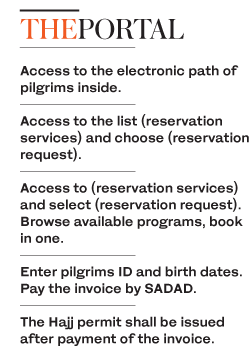
The Ministry of Interior has been working hard every year to make Hajj successful and easy by using technology to facilitate Hajj permits with a number of very creative applications.

The National Media Campaign for pilgrims’ awareness during Hajj tweeted on Aug. 9: “Make sure to have your Hajj permit to enjoy a legal Hajj that preserves your rights, allows you to select the suitable service and price and does not expose you to legal liability.”

The campaign also tweeted: “Failure to possess a permit for Hajj may result in you being turned back by the security authorities.”

Security forces tweeted in a video that according to the instructions issued for Hajj, “pilgrims won’t be allowed entry to the holy capital without the appropriate permission, as security checkpoints at all entrances to the city will apply procedures of investigation, verification and seizure of violators, referring them to the appropriate authorities to apply regulations against them.”

It was also clarified by a post on the security forces’ Twitter page that no one can access the holy capital from “citizens and residences” unless they have Hajj permits or proof that they are working in the city.

The Ministry of Interior provides electronic permits which enable the registration and definition of Hajj convoys in the system. This service allows registered convoys to receive Hajj permits electronically, and enables regulators to verify issued permits; in addition, the service allows permits to be issued for government convoys.

The service also allows the option of adding trips, and assigning passengers for each trip, according to the Absher website, in addition to the possibility of issuing permits for government campaigns.

This service allows Saudis and non-Saudis to apply for pilgrimage permission through the ministry portal without having to make a physical visit to the ministry.

The director-general of passports in the Makkah region, Abdul Rahman Al-Harbi, on Wednesday said that the number of electronic permits issued had reached 52,000.
The service is accessed from the “Muqeem” portal for companies and institutions or through the link https://portal.elm.sa by Absher.

@AljawazatKSA also tweeted. “Residents can cancel their Hajj permits.” 

Year after year, Hajj has witnessed many improvements in the system of projects and services provided by the Kingdom to the pilgrims, in particular the continuation of the project of expanding the Haram to accommodate a larger number of pilgrims and the completion of important projects that have contributed effectively to facilitate Hajj.

The number of pilgrims increases annually which is a good sign of a successful Hajj. In 2017 the number of pilgrims increased 32 percent from the previous year.

During last year’s Hajj, Saudi Arabia received more than 2.35 million pilgrims from around the world, according to official statistics. 

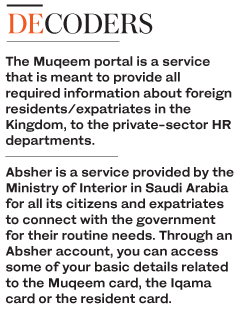
Decoder

What are Muqeem and Absher?

The Muqeem portal is a service that is meant to provide all required information about foreign residents/expatriates in the Kingdom, to the private-sector HR departments. Absher is a service provided by the Ministry of Interior in Saudi Arabia for all its citizens and expatriates to connect with the government for their routine needs. Through an Absher account, you can access some of your basic details related to the Muqeem card, the Iqama card or the resident card.


Threat to Kingdom’s security is ‘red line’ that will be ‘addressed and neutralized,’ Saudi envoy says

Updated 14 January 2026
Follow

Threat to Kingdom’s security is ‘red line’ that will be ‘addressed and neutralized,’ Saudi envoy says

  • Abdulaziz Alwasil tells UN Security Council the situation in southern Yemen is ‘a just cause with social and historic dimensions’ that can only be resolved through dialogue
  • Recent military activity in the south was unilateral, resulting in an escalation that harms the interests of Yemeni people and undermines efforts to address issues in the south, he said

NEW YORK CITY: Any attempt to threaten Saudi Arabia’s national security is a “red line” and will be met with decisive action, the Kingdom’s ambassador to the UN told the Security Council on Wednesday.

Speaking during a meeting of the council to discuss Yemen, Abdulaziz Alwasil said the situation in the south of the country is “a just cause with social and historic dimensions” that can only be resolved through dialogue.

“We stress that any attempt to threaten our national security is a red line, and we will not hesitate to take the necessary actions and steps to address it and neutralize it,” he added.

Alwasil reaffirmed Saudi Arabia’s support for Yemeni President Rashad Al-Alimi, the Presidential Leadership Council, and the Yemeni government in their efforts to achieve security, stability, development and peace while preserving national unity.

He said military activity by Southern Transitional Council forces in Hadramout and Al-Mahra on Dec. 2, 2025, was unilateral, did not have the approval of the Presidential Leadership Council, and was not carried out in coordination with the Coalition to Restore Legitimacy in Yemen.

It had resulted in an unjustified escalation that harmed the interests of the Yemeni people, undermined efforts to address the issues in the south, and ran counter to the coalition’s objectives, Alwasil added.

The Kingdom, working with its coalition partners, the Presidential Leadership Council and the Yemeni government, had moved to contain the situation by dispatching a military force to coordinate arrangements with the Southern Transitional Council in Aden, he said.

The aim was to ensure the return of the southern council’s forces to their previous positions outside of Hadramout and Al-Mahra, and the handover of camps to legitimate government forces and local authorities in line with agreed procedures, Alwasil added.

He expressed regret over the military operations that took place in Hadramout and Al-Mahra, close to Saudi Arabia’s southern border, which he said posed a direct threat to the Kingdom’s national security, as well as the security of Yemen and regional stability. Such steps were extremely dangerous, he added, and contradicted the principles on which the Coalition to Restore Legitimacy in Yemen had been founded.

Alwasil welcomed a prisoner and detainee exchange agreement signed in Muscat on Dec. 23, which he described as an important humanitarian measure to alleviate suffering and build confidence.

He praised Oman for hosting and sponsoring the consultations and supporting negotiations, and commended the efforts of UN’s special envoy for Yemen, Hans Grundberg, the International Committee of the Red Cross and all others that has played a part.

Regarding the political efforts to resolve the crisis, Alwasil said Saudi Arabia welcomed President Al-Alimi’s call for an inclusive conference in Riyadh to bring together all stakeholders to discuss just solutions to the situation in southern Yemen.

Preparations for the conference have begun, he added, in cooperation with the Yemeni government and southern representatives, reflecting the close ties between the two countries and their shared interests in stabilizing Yemen.

He urged all southern stakeholders to participate actively and constructively in the talks, to help find comprehensive and just solutions that meet the legitimate aspirations of the people of southern Yemen.

Alwasil called on all Yemeni forces and stakeholders to cooperate and intensify their efforts to reach a lasting political settlement that would ensure security and stability.

He described the southern issue as “a just cause with social and historic dimensions,” adding that “the only way to address it is through dialogue that leads to a comprehensive political solution” based on nationally and internationally agreed terms of reference.