Afghans bury victims of mosque attack as toll rises to 35

1 / 4
Afghan Shiite mourners carry a coffin during a burial ceremony for the 35 victims of a suicide attack in a Shiite mosque in Gardez of Paktia province on August 4, 2018. (AFP)
2 / 4
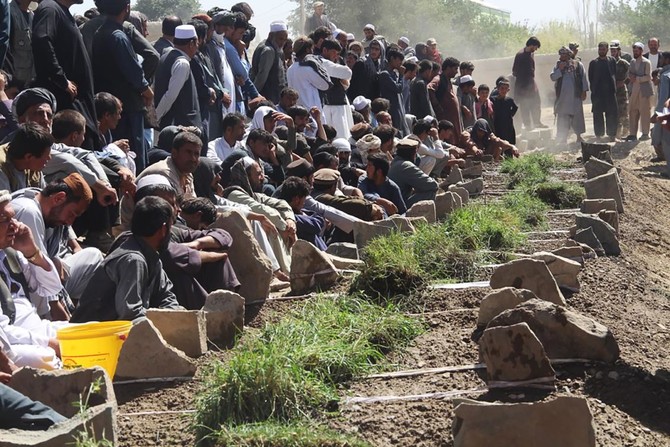
Afghan Shiite mourners and relatives attend a burial ceremony for the 35 victims of a suicide attack in a Shiite mosque in Gardez of Paktia province on August 4, 2018. (AFP)
3 / 4
Afghan Shiite mourners and relatives attend a burial ceremony for the 35 victims of a suicide attack in a Shiite mosque in Gardez of Paktia province on August 4, 2018. (AFP)
4 / 4
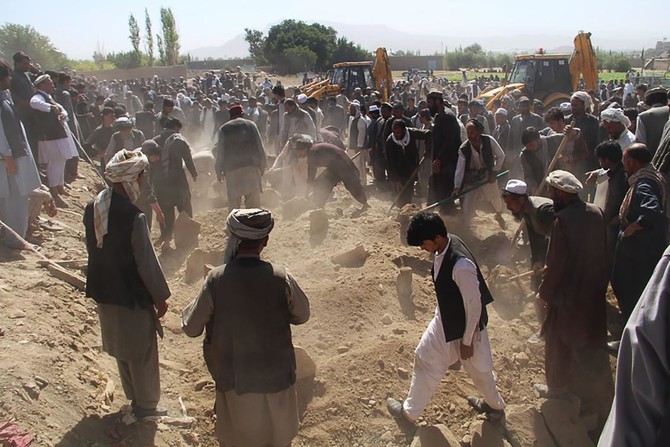
Afghan Shiite mourners cover the grave with soil after funeral prayers of 35 victims of a suicide attack in a Shiite mosque in Gardez of Paktia province on August 4, 2018. (AFP)
Updated 04 August 2018
Follow

Afghans bury victims of mosque attack as toll rises to 35

  • Hundreds of mourners Saturday buried the victims of a twin suicide attack on a Shiite mosque in eastern Afghanistan.
  • Two suicide bombers dressed as women struck a Shiite mosque in Gardez, capital of Paktia province, Friday as it was crowded with worshippers for weekly prayers.

KHOST, Afghanistan: Hundreds of mourners Saturday buried the victims of a twin suicide attack on a Shiite mosque in eastern Afghanistan, as the death toll rose to 35, officials said.
Two suicide bombers dressed as women struck a Shiite mosque in Gardez, capital of Paktia province, Friday as it was crowded with worshippers for weekly prayers.
The burqa-clad attackers shot at the mosque’s security guards before opening fire on worshippers then detonating their explosives.
“The death toll from Friday’s mosque attack in Gardez has jumped to 35 with 94 wounded,” Paktia governor Shamim Khan Katawazi told AFP.
Provincial police chief Raz Mohammad Mandozai confirmed the toll.
Officials had earlier said 29 people were killed and more than 80 wounded.
“Today, we held funeral ceremony and buried all the martyred of Friday’s attack,” a weeping Sayed Moharram, who lost his 16-year old son, told AFP from a graveyard on the outskirts of Gardez where hundreds of people attended the ceremony.
“It is very difficult for me to accept my son is no more with me,” he said.
Hajji Sultan, 70, who also attended, accused the government of “negligence” in providing security for the Shiite minority.
“The enemies of Afghanistan want to create division by carrying out attacks on Shiite people, but they cannot win, it will further increase hatred toward the enemies,” he said.
There was no immediate claim of responsibility for the attack.
The Taliban denied involvement but in recent years Daesh has carried out attacks on Shiites in Afghanistan.
The attack comes as urban areas across Afghanistan have been rocked by a surge in violence in recent months, with both Daesh and Taliban insurgents targeting security forces and government installations.
The Taliban have not claimed a major attack in a city for weeks as they come under increased pressure to agree to peace talks with the Afghan government.
But Daesh has carried out multiple attacks in the eastern city of Jalalabad and the capital Kabul in recent months, targeting everything from government ministries to a midwife training center.
Last month a Daesh suicide bomber blew himself up near Kabul international airport, killing 23 people including AFP driver Mohammad Akhtar.
The uptick in violence comes as US and Afghan forces intensify ground and air offensives against Daesh, and the Taliban step up their turf war with the group.
Earlier this week more than 150 Daesh fighters surrendered in northern Afghanistan — in a move that Afghan security forces and the Taliban hailed as the end of the extremist group in the north of the country.


Ethiopia’s prime minister accuses Eritrea of mass killings during Tigray war

Updated 03 February 2026
Follow

Ethiopia’s prime minister accuses Eritrea of mass killings during Tigray war

  • Landlocked Ethiopia says that Eritrea is arming rebel groups, while Eritrea says Ethiopia’s aspiration is to gain access to a seaport
  • Ethiopia lost sovereign access to the Red Sea when Eritrea seceded in 1993 after decades of guerrilla warfare

ADDIS ABABA: Ethiopia’s government Tuesday for the first time acknowledged the involvement of troops from neighboring Eritrea in the war in the Tigray region that ended in 2022, accusing them of mass killings, amid reports of renewed fighting in the region.
Ethiopian Prime Minister Abiy Ahmed, while addressing parliament Tuesday, accused Eritrean troops fighting alongside Ethiopian forces of mass killings in the war, during which more than 400,000 people are estimated to have died.
Eritrean and Ethiopian troops fought against regional forces in the northern Tigray region in a war that ended in 2022 with the signing of a peace agreement.
Eritrea’s Information Minister Yemane Gebremeskel told The Associated Press that Ahmed’s comments were “cheap and despicable lies” and did not merit a response.
Both nations have been accusing each other of provoking a potential civil war, with landlocked Ethiopia saying that Eritrea is arming and funding rebel groups, while Eritrea says Ethiopia’s aspiration is to gain access to a seaport.
“The rift did not begin with the Red Sea issue, as many people think,” Ahmed told parliamentarians. “It started in the first round of the war in Tigray, when the Eritrean army followed us into Shire and began demolishing houses, massacred our youth in Axum, looted factories in Adwa, and uprooted our factories.”
“The Red Sea and Ethiopia cannot remain separated forever,” he added.
Ethiopia lost sovereign access to the Red Sea when Eritrea seceded in 1993 after decades of guerrilla warfare.
Gebremeskel said the prime minister has only recently changed his tune in his push for access to the Red Sea.
Ahmed “and his top military brass were profusely showering praises and State Medals on the Eritrea army and its senior officers. … But when he later developed the delusional malaise of ‘sovereignty access to the sea’ and an agenda of war against Eritrea, he began to sing to a different chorus,” he said.
Eritrea and Ethiopia initially made peace after Abiy came to power in 2018, with Abiy winning a Nobel Peace Prize for his efforts toward reconciliation.
In June, Eritrea accused Ethiopia of having a “long-brewing war agenda” aimed at seizing its Red Sea ports. Ethiopia recently said that Eritrea was “actively preparing to wage war against it.”
Analysts say an alliance between Eritrea and regional forces in the troubled Tigray region may be forming, as fighting has been reported in recent weeks. Flights by the national carrier to the region were canceled last week over the renewed clashes.