1,500 migrants have died in Mediterranean in 2018: UN

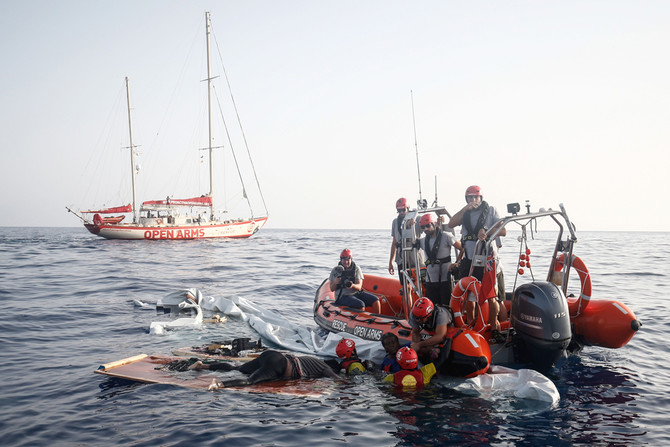
Members of the Spanish NGO Proactiva Open Arms' lift a woman out of the water as another lies dead on the remains of the sunken boat in the Mediterranean Sea about 85 miles off the Libyan coast on July 17, 2018. (AFP / PAU BARRENA)
Updated 28 July 2018
Follow

1,500 migrants have died in Mediterranean in 2018: UN

  • Spain, which has overtaken Italy as the preferred destination, has registered nearly 21,000 migrants so far this year
  • In all, about 55,000 migrants have reached European shores so far this year

GENEVA: For the fifth straight year, at least 1,500 migrants have perished in the Mediterranean, with the route between Libya and Italy being the deadliest, claiming the lives of one in 19, the UN migration agency said on Friday.

Spain, which has overtaken Italy as the preferred destination, has registered nearly 21,000 migrants so far this year, almost more than in the whole of last year, the International Organization for Migration (IOM) said.

In all, about 55,000 migrants have reached European shores so far this year, against more than double that number at this time last year, 111,753, it said.

Italy — whose new government has closed its ports to rescue vessels — has had about 18,130 migrants arriving by sea from Libya this year, with the rest going to Greece, Malta and Cyprus.

“Despite incredibly low numbers arriving to Italy, the per capita death or the rate of death per 1,000 people may be at its highest point since the emergency began,” IOM spokesman Joel Millman told a news briefing.

The IOM and the UN refugee agency UNHCR confirmed that they would host a meeting in Geneva on Monday to discuss a collective approach to disembarkation points aimed at making rescues at sea more manageable. They declined to say which government officials would attend the closed-door meeting.

On Tuesday, the European Commission presented a proposal for “regional disembarkation platforms” that would likely be located outside the EU to process migrants rescued at sea.


Prominent crossing

However, the plans remain vague and do not mention any potential host countries. EU diplomats say they could be set up in North Africa.

More than 600 African migrants forced their way through the heavily fortified border fence separating the Spanish North African enclave of Ceuta from Morocco on Thursday, using saws, shears and mallets to cut through the wire.

“What we can say is that the first indications that we are getting from the Spanish authorities is that it is the West African migrants that were most prominent crossing into Libya in the past couple of years who seem to be choosing Spain as their route now,” Millman said.

The death rate on the western Mediterranean route to Spain is about one in 70 migrants, he added.


Organizers say a new civilian-led aid flotilla with over 100 boats will sail to Gaza in March

Updated 2 sec ago
Follow

Organizers say a new civilian-led aid flotilla with over 100 boats will sail to Gaza in March

Campaigners described the upcoming mission as the biggest civilian-led mobilization against Israel’s actions in Gaza
They called on the international community to prevent Israeli forces from intercepting the operation

JOHANNESBURG: Organizers of an international flotilla of boats carrying humanitarian aid to Gaza on Thursday announced plans for another mission with more than 100 boats in March.
Campaigners, who organized a similar aid flotilla last year, described the upcoming mission as the biggest civilian-led mobilization against Israel’s actions in Gaza. They called on the international community to prevent Israeli forces from intercepting the operation.
The announcement was made at the Nelson Mandela Foundation in South Africa and speakers included Mandla Mandela, grandson of the late former South African president.
The United Nations said that hundreds of thousands of pallets of humanitarian supplies have been offloaded and collected at various crossings into Gaza since a fragile ceasefire was announced in October.
But Israel has suspended more than two dozen humanitarian organizations from operating in the Gaza Strip for failing to comply with new registration rules, and the territory’s population of over 2 million Palestinians still face a humanitarian crisis.
Mandela was part of the flotilla that embarked on a mission to Gaza last year and was detained along with other activists when their boat was intercepted by Israeli forces before they could reach Gaza shores.
According to organizers, more than 1,000 activists including medical doctors, war crimes investigators and engineers will form part of the new flotilla. It will be supported by a land convoy that is expected to attract thousands more activists across countries including Tunisia and Egypt.
The boats are expected to sail from Spain, Tunisia and Italy toward Gaza.
“This time around we expect hundreds and thousands to sign up and to mobilize entry through Egypt, through Lebanon, through Jordan and every other border that is feasible for us to get into occupied Palestine and to Gaza,” Mandela said. “We want to mobilize the entire global community to join forces with us.”
Activists said they were aware that they might be confronted by Israeli forces but that they were protected by international law.
“The International Court of Justice in the provisional ruling in the case opened by South Africa against the genocide state of Israel, states very clearly that Israel or any other nation are prohibited to hinder any type of humanitarian mission on the way to Gaza,” said Thiago Avila, a Brazilian activist who is part of the steering committee.
Mandela said they had chosen to host the briefing at the Nelson Mandela Foundation to highlight Nelson Mandela’s support for the Palestinian cause. They also welcomed the country’s decision to expel Israel’s deputy ambassador to South Africa.
Last year’s mission mobilized about 50 vessels and 500 activists. Organizers said Israeli vessels approached the boats while they sailed in international waters, spraying some with water canons.
An estimated 443 participants were detained, including Mandela, activist Greta Thunberg and European Parliament member Rima Hassan.