Young violinist hits a winning note in Riyadh

1 / 4
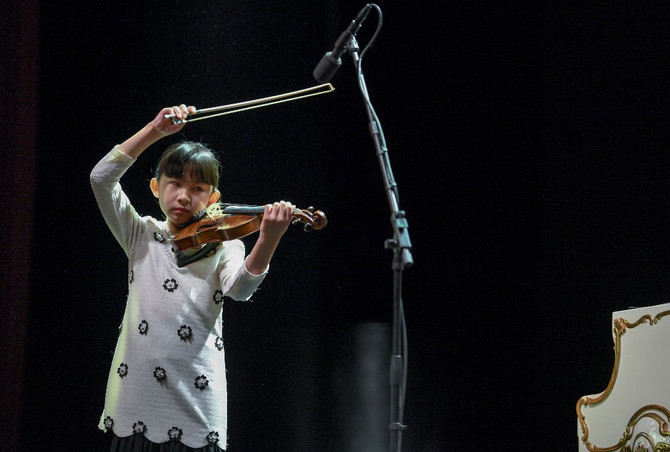
Chloe Chua performs, accompanied by world renowned pianist Gordon Back, at the King Fahad Cultural Center in Riyadh on July 21, 2018. (General Cultural Authority photo)
2 / 4
Chloe Chua performs to a spellbound audience at the King Fahad Cultural Center in Riyadh on July 21, 2018. (General Cultural Authority photo)
3 / 4
Eman Gusti, a 20-year-old Saudi pianist, performs during the concert of Chloe Chua at the King Fahad Cultural Center in Riyadh on July 21, 2018. (General Cultural Authority photo)
4 / 4
Saudi children get a photo op with Chloe Chua. (General Cultural Authority photo)
Updated 23 July 2018
Follow

Young violinist hits a winning note in Riyadh

  • Chloe Chua of Singapore is considered the world's foremost youngest pianist
  • Since the opening of its doors to global talent, people in Saudi Arabia have been enjoying electrifying performances of various world-class musicians and singers.

RIYADH: The cultural landscape of Saudi Arabia is changing at a rapid pace and it is fast becoming a hub of cultural activities. 
Since the opening of its doors to global talent, people in Saudi Arabia have been enjoying electrifying performances of various world-class musicians and singers.
The Saudi authorities are leaving no stone unturned to promote local talent and to make the Kingdom part of the global cultural revolution. 
On Saturday, the General Cultural Authority organized yet another unforgettable concert at the King Fahad Cultural Center, which saw the world’s youngest violinist, Chloe Chua from Singapore perform to a spellbound audience. The 11-year-old talented violinist has been a student at the Nanyang Academy of Fine Arts School of Young Talents (SYT) strings section since the age of four. 
She is studying with Yin Ke, string program leader of SYT and recently won the first prize in the Menuhin Competition Geneva 2018. She has been awarded prizes in numerous other competitions, coming first in the 24th Andrea Postacchini International Violin Competition (May 2017) and third in violin group A of the 2nd Zhuhai International Mozart Competition for Young Musicians. 
Chua was accompanied by the internationally distinguished pianist, Gordon Back. Back is an official accompanist at major international violin competitions such as the Queen Elizabeth competition, the Carl Flesch Competition (London), the International Tchaikovsky Competition (Moscow), the International Violin Competition of Indianapolis (US), and the Menuhin Competition (UK).

VIEW OUR PHOTO ALBUM: Chloe Chua's Concert in Riyadh

The pieces of music, which included Beethoven, Mozart and Johan Svendsen, were inspired by different stories and different musical rhythms and drew rapturous applause.
The program began with a 15-minute performance by Eman Gusti, a 20-year-old Saudi pianist who started playing at the age of nine. 
“No one on earth can imagine how I felt when I heard the audience applauded. It is such a great honor,” Gusti told Arab News.
She said she finally felt she had a place to express her passion and an umbrella (the General Culture Authority) to belong to. “Saudi women have a great space to express their enthusiasm in interactive situations and places. I am very happy to be part of this golden era.” 
After her segment, the main performance started with Chua and Back. “I am very happy to perform in Saudi Arabia,” Chua said afterward. “I chose these seven pieces because they are very good in terms of the music, rhythm and themes. I wanted to show that classical music can be a joy to everyone. I chose music because it makes everybody happy, and I can travel around the world to make the world happy.” 
Now Chua and Back are set to perform in Jeddah today. “I am very excited about seeing Jeddah and playing music in front of an audience there,” she said. 
It was the first time Back had played in Saudi Arabia. “It is a very wonderful experience,” he told Arab News.
When asked whether music can bring people from different countries and diverse cultures together, he said: “I think it can, because with music you do not need any language. It transcends languages. It can also unify people. 
“Hopefully I will come back to perform again here in Saudi Arabia,” he said.


Mini op-ed: Recognising a shift in how people relate to wellness, self-care

Updated 05 March 2026
Follow

Mini op-ed: Recognising a shift in how people relate to wellness, self-care

DUBAI: I have spent nearly a decade working in the beauty industry in Saudi Arabia and the UAE, and Ramadan always has a way of prompting change; in habits, in priorities, and in the routines people have been carrying without question. Speaking from my own corner of the industry, one of these habits is often hair removal.

Saudi Arabia’s beauty and personal care market was valued at about $7.56 billion in 2025 and is set to grow to an estimated $8.03 billion in 2026. Within that growth, personal care encompassing the daily (sometimes unglamorous) routines hold the largest share. But market size alone does not tell the full story. A study conducted at King Abdulaziz University Hospital, Jeddah, found that three quarters of Saudi women experienced complications from temporary hair removal methods, including skin irritation, in-grown hairs and hyperpigmentation. A separate 2025 study published in the Majmaah Journal of Health Sciences found that laser hair removal was both the most considered and most commonly undergone cosmetic procedure among Saudi respondents, yet dissatisfaction with cosmetic procedure outcomes was reported by nearly half of all participants. The numbers point to a gap not in demand, but in results. 

When I launched a specialized electrolysis practice in the UAE in 2016, it was with a clear gap in mind; safe, regulated, permanent hair removal for the region’s specific needs. The range of hair types here and the prevalence of conditions such as polycystic ovary syndrome, or PCOS, demanded a method that works across all of them.  Electrolysis is the only method recognized by the US Food and Drug Administration and American Marketing Association as achieving true permanent results, regardless of hair color or type. 

Despite this, awareness in Saudi Arabia remains limited. Part of this is familiarity, laser has dominated the conversation for years, and electrolysis, which requires more sessions and a licensed electrologist’s precision, has struggled to break through. Part of it is education. Many clients who come to us have never heard of electrolysis; they come because they have exhausted everything else. 

Right now, Saudi Arabia is in the middle of a genuine transformation in how people relate to wellness and self-care. The beauty market is maturing, consumers are asking harder questions of the brands they choose and Vision 2030 has not just shaped the economy, it has shaped how Saudis are showing up in their own lives. In that context, the idea of choosing permanence over repetition lands differently.
 
Mariela Marcantetti is a beauty industry entrepreneur based between Saudi Arabia and the UAE.