


LONDON: A century ago today, a boy was born who would grow up to change the world.
There was nothing auspicious about his beginnings, although there was perhaps a clue in the name he was given: Rolihlahla, which means “troublemaker” in his native Xhosa language.
And make trouble he most certainly did, though it was the right kind of trouble and at great cost to himself.
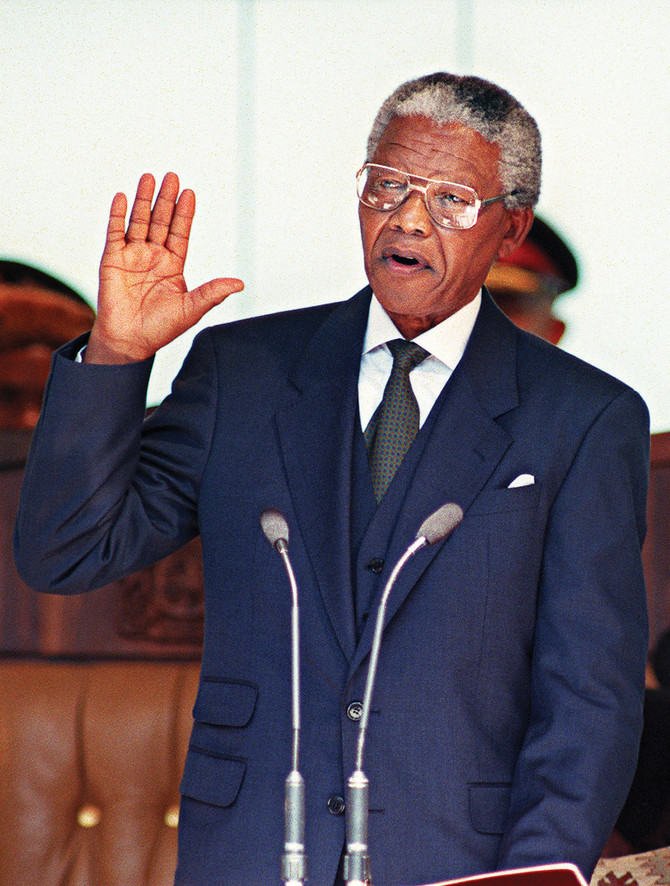
On May 10, 1994, Nelson Rolihlahla Mandela (he was given his English first name by a teacher) was sworn in as president of South Africa. He was the country’s first black head of state and the first to be elected in a fully representative democratic election. The hateful age of apartheid was finally over.
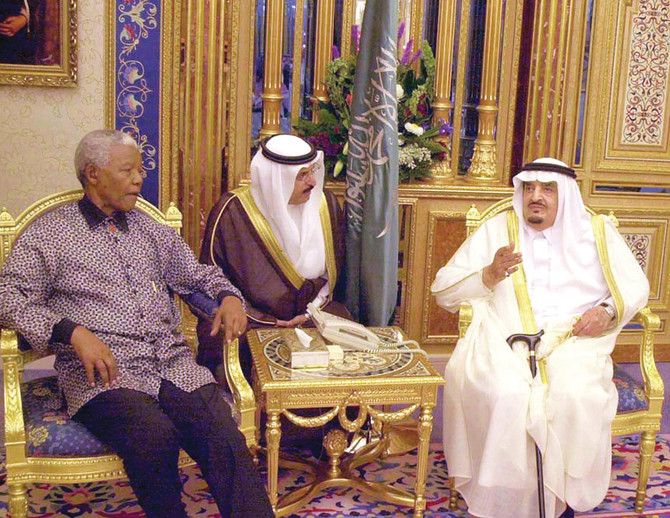
Nineteen days later, the South African government signed an agreement establishing diplomatic relations with Saudi Arabia and in October 1994 President Mandela visited the Kingdom.
It was one of his first trips abroad and the first of many as president to the Gulf, highlighting the importance he accorded to the region. A year after his election, in April 1995, Mandela went to Kuwait, Oman, Qatar, the UAE and Bahrain. The following year, he visited Egypt, Libya and Morocco.
In early 1962, Mandela had secretly left South Africa to travel around the continent building support for the armed struggle against apartheid. He received military training in Morocco and Ethiopia. As president, maintaining good relations with the Arab world was of prime importance, even if it made him unpopular with the West, whose attitude toward him had been ambivalent at best.
In response to Western concerns over his invitations to Muammar Qaddafi and Fidel Castro, he told Reuters in 1996: “Your (the West’s) enemies are not our enemies. We will not be persuaded to break with our friends because now the great powers in the West want to be our friends. We can be friendly to them without parting with our friends who were with us when we were all alone.”
After his release from prison in 1990, Mandela embarked on a tour of countries that had supported the African National Congress (ANC) during the years of struggle. Riyadh was among the cities he visited and it was there the future leader forged some of his strongest alliances.
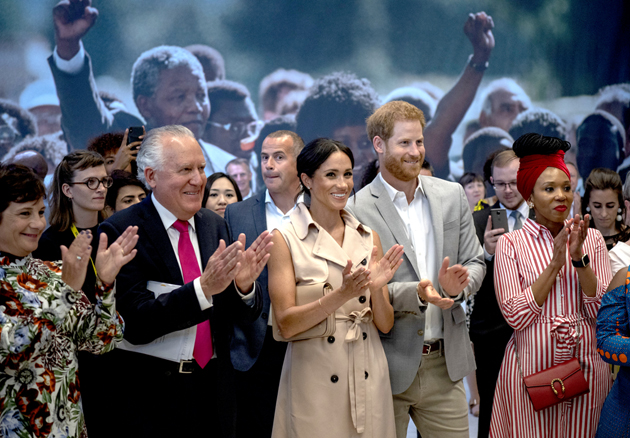
Britain’s Prince Harry and Meghan the Duchess of Sussex attend the launch of the Nelson Mandela Centenary Exhibition at the Queen Elizabeth Hall in London on Tuesday. (AP)
Tom Lodge, a former professor of political studies at the University of Witwatersrand and author of “Mandela: A Critical Life,” said: “Almost certainly there was more to the visits than to say ‘thank you.’ Mandela continued to raise funds for the ANC, though probably not on a state visit. South Africa in 1994 was short of capital and up to the 1990s it was buying oil in violation of sanctions, very expensively.
“At the time of Mandela’s presidency, he was ready to defend arms sales to various Middle Eastern countries as a reciprocal obligation for anti-apartheid support. He had a particular affection for the Moroccans because of the hospitality they showed him in 1962.”
Mandela was also keen to bring South Africa back into the international fold.
“The drive to strengthen and deepen relations with the Middle East was part of a more general thrust to build links with the international community, which had mostly cut ties with apartheid South Africa,” said Tony Trew, a former communications officer in the Office of the President, who contributed to a book on the Mandela presidency.
“Among other things, it meant shifting the balance of relations and dependencies to some extent from traditional partners of South Africa to others, in particular in Africa, the Middle East and Asia.”
Journalist Khaled Almaeena met Mandela several times, both in Riyadh and the South African capital Pretoria. Years of forced labor breaking rocks in the blinding sun on Robben Island had taken a toll on Mandela’s eyesight, and Almaeena recalls the president having his eyes checked at a Riyadh hospital.
At their first meeting, Almaeena’s knowledge of South African history, geography and sports so impressed Mandela that he jokingly asked: “Are you sure you are not an Afrikaner?”
Later, when Almaeena visited Pretoria with a group of Saudi business figures, he was touched by the warmth of Mandela’s greeting.
“As he shook my hand, he said with a gleam in his eye: ‘Here is a Springboks (the South African national rugby team) supporter.’ I felt overwhelmed.”
Mandela’s years in prison had made him reconsider his youthful espousal of communism, he told Almaeena.
“Mandela was frank. He was glad that the socialist system was over by the time he was released. It was a changed world. He was frugal and did not care for the trappings of office.”
As Mandela’s private secretary and personal assistant for 19 years, Zelda La Grange accompanied him on at least eight visits to Riyadh.
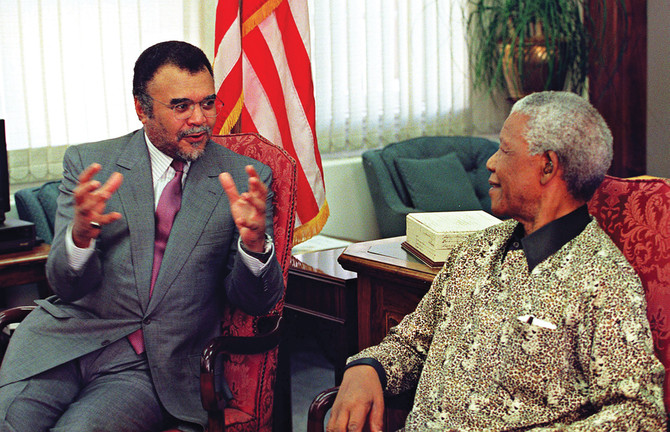
“He was friends with the royal family, with the late king (Fahd) and his successor (Abdullah), and also Prince Bandar bin Sultan (Saudi ambassador to the US from 1983 to 2005) and his immediate family,” she recalled.
“The royal family supported many of Mandela’s charitable causes over the years and always extended great hospitality. Mandela, as a result, fostered a close relationship with the Saudi people and always maintained that relationship.”
His visits were mainly to the king’s and the crown prince’s palaces, although he also liked to visit hospitals in Riyadh that employed South African staff, said La Grange.
However, her presence at Mandela’s side sometimes confused their Saudi hosts. Mandela addressed the blonde, Afrikaans-speaking La Grange as “granddaughter” and usually introduced her as such.
“I remember the king of Saudi Arabia just looking at me, clearly thinking: ‘But she’s white,’” said La Grange.
On one visit, Mandela expressed a desire to visit the holy sites of Makkah and Madinah. Arrangements were made for him, but La Grange was surprised to learn she was barred because she was not Muslim.
“But Madiba’s not Muslim either,” she exclaimed (using Mandela’s Xhosa name). The Saudis were “stunned,” as they were convinced Mandela was Muslim. La Grange reflected that had it not been for her outburst, Mandela might have become the first Christian allowed into Islam’s holiest place.
Prince Bandar bin Sultan, who after his ambassadorship served as secretary-general of the National Security Council, director-general of the Saudi Intelligence Agency and King Abdullah’s special envoy, became an especially close friend. He was one of the small number of guests present when Mandela married his third wife, Graca Machel, on his 80th birthday in July, 1998. When Mandela’s son, Makgatho, died in 2005, the prince went to Mandela’s home in Houghton, Johannesburg, to convey his condolences in person.
The prince publicly described Mandela as “not just the leader of Africa but of the whole world.”
Certainly, the relationship with Saudi Arabia had its practical aspects for both sides.
In a speech in September 1997 at a banquet in Cape Town in honor of Prince Sultan bin Abdulaziz, Mandela said: “The support that our liberation struggle enjoyed from Saudi Arabia, in particular, and the entire Arab world not only helped secure the defeat of apartheid but also gave us the chance to improve the lives of our people through our reconstruction and development program.
“As we rebuild our country, the bonds with those who stood by us during the struggle for freedom are being strengthened.”
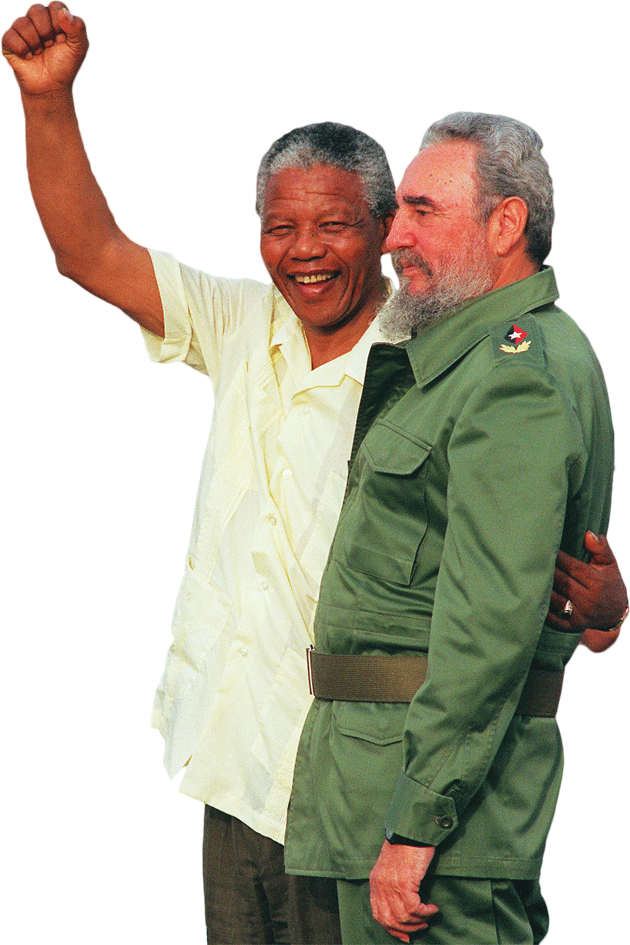
Nelson Mandela with Cuban president Fidel Castro in 1991. (AFP/Getty Images)
Until then, South Africa relied on Iran for most of its oil. In November of that year, Saudi Arabia signed an agreement to boost crude exports to South Africa and build an oil refinery. Rumors swirled that the deal was a guns-for-oil barter: South African anti-aircraft guns and ammunition in exchange for Saudi oil.
The plight of the Palestinians affected Mandela deeply, not least because he saw parallels with how black people lived under apartheid. “We know too well that our freedom will be incomplete without the freedom of the Palestinians,” he said.
He deplored what he called the “narrow, chauvinistic interest” of the Israeli government in stalling negotiations with the Palestinians, but he had no quarrel with the Jewish people. Many South African Jews had helped him in his early years and, according to some sources, Mandela advised Palestinian leader Yasser Arafat against unilaterally declaring a Palestinian state.
In 2000, Arafat asked Mandela — by then no longer president — to mediate in talks with Israel. Mandela declined, but pledged instead to do what he could to get the peace talks started again.
Mandela’s influence was crucial in reaching an agreement between the US, UK and Libya over the prosecution of two Libyans accused of downing Pan Am flight 103 over Lockerbie, Scotland, in December, 1988. Mandela proposed that Abdelbaset Al-Megrahi and Lamin Khalifah Fhimah be tried in a third country. All parties agreed and the trial, governed by Scottish law, went ahead in Camp Zeist in the Netherlands
“It was, ultimately, as a result of Mandela’s intervention that the US, UK and Libya reached an agreement,” said Trew.
On Tuesday, the day before what would have been Mandela’s 100th birthday, the annual Mandela Day lecture in Johannesburg was given by former US president Barack Obama.
Like Mandela, he was the first black man to lead his nation. Like Mandela, he, too, is a Nobel Peace Prize laureate. Obama also spoke at Mandela’s funeral in December, 2013.
The lecture was billed as “renewing the Mandela legacy and promoting active citizenship in a changing world.”
It is a message still worth hearing and heeding.


