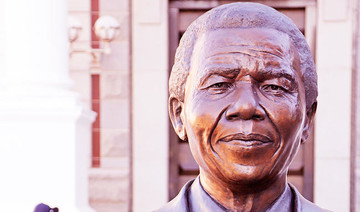
JOHANNESBURG: For rich corporate executives, fine food, expensive wine and five-star hotels come as standard.
But one discerning top boss with a spare $300,000 (€260,000) will give up creature comforts for a night in the cramped prison cell that was Nelson Mandela’s home for 18 years.
That is according to organizers of the annual CEO sleepout, an initiative which raises money for various charities.
South Africa’s first democratic, black president was kept on South Africa’s Robben Island prison off Cape Town for much of his 27-year incarceration.
A night in his iconic 8-foot by 7-foot (2.4 meters by 2.1 meters) concrete cell will now be auctioned for charity to mark the centenary of prisoner number 46664’s birthday.
“The suggestion was to auction the cell to raise money to fund the Prison-to-College Pipeline... educating incarcerated people in South Africa,” said Liane McGowan, spokeswoman for the CEO SleepOut South Africa adding that details of when the one night only fundraiser will take place, had not been finalized.
Online bidding started at $250,000 (€215,000) and has already attracted three bids, reaching $300,000 with the sale set to close on July 16.
The winner will spend one night in Mandela’s cell number seven, while up to 66 other bidders will sleep elsewhere in the island prison that is now a museum and World Heritage site.
The Museum’s management could not be reached for comment. The Nelson Mandela foundation said it was not a part of the initiative and could not be responsible for the usage of Mandela’s cell.
Sixty-seven was chosen as Mandela dedicated 67 years of his life to the fight against the racist apartheid system that governed South Africa until Mandela won the first democratic non-racial elections in 1994.
The initiative is part of the CEO SleepOut movement which auctions nights in unusual locations to wealthy business leaders to raise money for charitable causes.
The Robben Island event will raise funds for the Prison-to-College Pipeline (P2P), a scheme that began in New York to help prisoners access university-level education. The P2P initiative will be launched in South Africa on 18 July, Mandela’s birthday.
A similar event will be held on July 11 at the Liliesleaf Farm in northern Johannesburg which was used as a safe-house by several anti-apartheid fighters including Mandela.
The base was raided by apartheid security forces in 1963 and several anti-regime leaders faced the courts at the so-called “Rivonia Trial” which resulted in Mandela being jailed for life.
Executives have previously spent the night under the Mandela Bridge in central Johannesburg to raise awareness of poverty and homelessness.
The event was criticized online and in the media by some who accused it of mocking those forced to sleep rough.

A night in Nelson Mandela’s prison cell — yours for $300k
- One discerning top boss with a spare $300,000 will give up creature comforts for a night in the cramped prison cell that was Nelson Mandela’s home for 18 years
- South Africa’s first democratic black president was kept on South Africa’s Robben Island prison off Cape Town for much of his 27-year incarceration
Filipinos master disaster readiness, one roll of the dice at a time
- In a library in the Philippines, a dice rattles on the surface of a board before coming to a stop, putting one of its players straight into the path of a powerful typhoon
MANILA: In a library in the Philippines, a dice rattles on the surface of a board before coming to a stop, putting one of its players straight into the path of a powerful typhoon.
The teenagers huddled around the table leap into action, shouting instructions and acting out the correct strategies for just one of the potential catastrophes laid out in the board game called Master of Disaster.
With fewer than half of Filipinos estimated to have undertaken disaster drills or to own a first-aid kit, the game aims to boost lagging preparedness in a country ranked the most disaster-prone on earth for four years running.
“(It) features disasters we’ve been experiencing in real life for the past few months and years,” 17-year-old Ansherina Agasen told AFP, noting that flooding routinely upends life in her hometown of Valenzuela, north of Manila.
Sitting in the arc of intense seismic activity called the “Pacific Ring of Fire,” the Philippines endures daily earthquakes and is hit by an average of 20 typhoons each year.
In November, back-to-back typhoons drove flooding that killed nearly 300 people in the archipelago nation, while a 6.9-magnitude quake in late September toppled buildings and killed 79 people around the city of Cebu.
“We realized that a lot of loss of lives and destruction of property could have been avoided if people knew about basic concepts related to disaster preparedness,” Francis Macatulad, one of the game’s developers, told AFP of its inception.
The Asia Society for Social Improvement and Sustainable Transformation (ASSIST), where Macatulad heads business development, first dreamt up the game in 2013, after Super Typhoon Haiyan ravaged the central Philippines and left thousands dead.
Launched six years later, Master of Disaster has been updated this year to address more events exacerbated by human-driven climate change, such as landslides, drought and heatwaves.
More than 10,000 editions of the game, aimed at players as young as nine years old, have been distributed across the archipelago nation.
“The youth are very essential in creating this disaster resiliency mindset,” Macatulad said.
‘Keeps on getting worse’
While the Philippines has introduced disaster readiness training into its K-12 curriculum, Master of Disaster is providing a jolt of innovation, Bianca Canlas of the Department of Science and Technology (DOST) told AFP.
“It’s important that it’s tactile, something that can be touched and can be seen by the eyes of the youth so they can have engagement with each other,” she said of the game.
Players roll a dice to move their pawns across the board, with each landing spot corresponding to cards containing questions or instructions to act out disaster-specific responses.
When a player is unable to fulfil a task, another can “save” them and receive a “hero token” — tallied at the end to determine a winner.
At least 27,500 deaths and economic losses of $35 billion have been attributed to extreme weather events in the past two decades, according to the 2026 Climate Risk Index.
“It just keeps on getting worse,” Canlas said, noting the lives lost in recent months.
The government is now determining if it will throw its weight behind the distribution of the game, with the sessions in Valenzuela City serving as a pilot to assess whether players find it engaging and informative.
While conceding the evidence was so far anecdotal, ASSIST’s Macatulad said he believed the game was bringing a “significant” improvement in its players’ disaster preparedness knowledge.
“Disaster is not picky. It affects from north to south. So we would like to expand this further,” Macatulad said, adding that poor communities “most vulnerable to the effects of climate change” were the priority.
“Disasters can happen to anyone,” Agasen, the teen, told AFP as the game broke up.
“As a young person, I can share the knowledge I’ve gained... with my classmates at school, with people at home, and those I’ll meet in the future.”