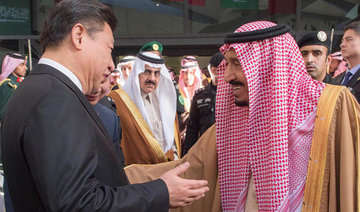
BEIJING: China will provide Arab states with $20 billion in loans for economic development, President Xi Jinping told top Arab officials Tuesday, as Beijing seeks to build its influence in the Middle East and Africa.
The money will be earmarked for “projects that will produce good employment opportunities and positive social impact in Arab States that have reconstruction needs,” said Xi, without providing further details.
It is part of a special Chinese program for “economic reconstruction” and “industrial revitalization,” Xi told participants at a China-Arab States forum in Beijing’s Great Hall of the People.
Beijing is also prepared to provide another one billion yuan to countries in the region to “build capacity for stability maintenance,” Xi said, using a term commonly associated with policing and surveillance.
Since taking office, Xi has overseen a concerted effort to expand Chinese influence in the Middle East and Africa, including the construction of the country’s first military base in Arab League state Djibouti.
China has already provided vast sums to Arab countries, with Djibouti alone owing some $1.3 billion, according to estimates from the US-based China Africa Research Initiative.
The financial largesse has raised concerns both at home and abroad over the vulnerability of poor nations to such massive debt.
Last year Sri Lanka was forced to hand over majority control of its Hambantota port to China after being unable to repay its loans.
At the heart of Xi’s vision is the “Belt and Road” initiative, a $1-trillion infrastructure program billed as a modern revival of the ancient Silk Road that once carried fabrics, spices and a wealth of other goods between Asia, Africa, the Middle East and Europe.
The Arab states’ position at the center of the ancient trade route makes them “natural partners” in China’s new undertaking, he said, adding he expected the summit would end with an agreement on cooperation on the initiative.
“Chinese and Arab peoples, though far apart in distance, are as close as family,” he said, describing a romanticized history of trade along the Silk Road.
The project, which has already financed ports, roads and railways across the globe, has spurred both interest and anxiety in many countries, with some seeing it as an example of Chinese expansionism.
“China welcomes opportunities to participate in the development of ports and the construction of railway networks in Arab states” as part of a “logistics network connecting Central Asia with East Africa and the Indian Ocean with the Mediterranean,” said Xi.

China pledges $20 billion in loans for Arab states
- Beijing is also prepared to provide another one billion yuan to countries in the region to “build capacity for stability maintenance”
- The Arab states’ position at the center of the ancient trade route makes them “natural partners” in China’s new undertaking
Saudi investment pipeline active as reforms advance, says Pakistan minister
ALULA: Pakistan’s Finance Minister Mohammed Aurangzeb described Saudi Arabia as a “longstanding partner” and emphasized the importance of sustainable, mutually beneficial cooperation, particularly in key economic sectors.
Speaking to Arab News on the sidelines of the AlUla Conference for Emerging Market Economies, Aurangzeb said the relationship between Pakistan and Saudi Arabia remains resilient despite global geopolitical tensions.
“The Kingdom has been a longstanding partner of Pakistan for the longest time, and we are very grateful for how we have been supported through thick and thin, through rough patches and, even now that we have achieved macroeconomic stability, I think we are now well positioned for growth.”
Aurangzeb said the partnership has facilitated investment across several sectors, including minerals and mining, information technology, agriculture, and tourism. He cited an active pipeline of Saudi investments, including Wafi’s entry into Pakistan’s downstream oil and gas sector.
“The Kingdom has been very public about their appetite for the country, and the sectors are minerals and mining, IT, agriculture, tourism; and there are already investments which have come in. For example, Wafi came in (in terms of downstream oil and gas stations). There’s a very active pipeline.”
He said private sector activity is driving growth in these areas, while government-to-government cooperation is focused mainly on infrastructure development.
Acknowledging longstanding investor concerns related to bureaucracy and delays, Aurangzeb said Pakistan has made progress over the past two years through structural reforms and fiscal discipline, alongside efforts to improve the business environment.
“The last two years we have worked very hard in terms of structural reforms, in terms of what I call getting the basic hygiene right, in terms of the fiscal situation, the current economic situation (…) in terms of all those areas of getting the basic hygiene in a good place.”
Aurangzeb highlighted mining and refining as key areas of engagement, including discussions around the Reko Diq project, while stressing that talks with Saudi investors extend beyond individual ventures.
“From my perspective, it’s not just about one mine, the discussions will continue with the Saudi investors on a number of these areas.”
He also pointed to growing cooperation in the IT sector, particularly in artificial intelligence, noting that several Pakistani tech firms are already in discussions with Saudi counterparts or have established offices in the Kingdom.
Referring to recent talks with Saudi Minister of Economy and Planning Faisal Alibrahim, Aurangzeb said Pakistan’s large freelance workforce presents opportunities for deeper collaboration, provided skills development keeps pace with demand.
“I was just with (Saudi) minister of economy and planning, and he was specifically referring to the Pakistani tech talent, and he is absolutely right. We have the third-largest freelancer population in the world, and what we need to do is to ensure that we upscale, rescale, upgrade them.”
Aurangzeb also cited opportunities to benefit from Saudi Arabia’s experience in the energy sector and noted continued cooperation in defense production.
Looking ahead, he said Pakistan aims to recalibrate its relationship with Saudi Arabia toward trade and investment rather than reliance on aid.
“Our prime minister has been very clear that we want to move this entire discussion as we go forward from aid and support to trade and investment.”