

Amman’s amazing citadel: A cluster of culture in the Jordanian capital

1 / 4
2 / 4
3 / 4
4 / 4
Updated 07 July 2018
Follow

Amman’s amazing citadel: A cluster of culture in the Jordanian capital

  • I might not like Amman’s choice of adhan orchestration, but the city’s citadel, smack in the middle of modern Amman and littered with ancient ruins, I do like. 
  • The Umayyad Monumental Gateway once led to a stunning palace from which Islam’s earliest dynasty ruled over Amman. The palace is in ruins now, but the impressive gateway offers a glimpse into the beginnings of Islam’s very first artistic movement.

LONDON: “Listen!” Mahdi Hanini, our guide, has both hands outstretched as the faint cry of “God is Great” quickly increases in proximity and volume, enveloping Amman — the capital city of the Hashemite Kingdom of Jordan. 

“Amman is the only city in Jordan where you will hear the voice of just one muezzin,” he says.

We listen, spellbound. Sure enough, a split-second delay is all that separates the same voice calling out the maghreb adhan from one minaret after another, as the sky slowly turns a crimson red with the setting of the sun.

Hanini explains that the call starts at the King Abdullah I “Blue” mosque where the country’s “most-famous” muezzin makes the call, which is then transmitted to every other mosque in the city — hence the fractional real-time delay. The aim is to synchronize the exact time of prayer.

It’s certainly a phenomenal experience listening to the adhan set to a 360-degree-panorama of Amman — as the melodic voice cascades into the valley of houses and bounces through downtown Amman, off the ancient walls of the 6,000 seat amphitheater and odeon, and past the old Roman road, still as straight as an arrow — but I am not sure I like it. I still prefer the chorus of a multitude of muezzins. There’s something magical about the sound of several adhans all imperfectly following one another, something raw, and very real.

I might not like Amman’s choice of adhan orchestration, but the city’s citadel, smack in the middle of modern Amman and littered with ancient ruins, I do like. 

The modest L-shaped mound, the highest point in town, offers the most wonderful snapshot of Jordan’s vast cultural heritage in one tiny area. Much of it has been mapped inside the country’s oldest museum, the Jordan Archaeological Museum, using a host of exhibits and smaller artefacts. It too is atop the citadel, but the real fun is outside, literally on the museum’s doorstep. 

Here three huge, beautifully carved stone fingers — the remnants of a giant hand — and an elbow lie discarded in the shade of several Corinthian pillars that have seen better days. They were once all part of a temple dedicated to the Roman hero, Hercules, The limbs belonged to a colossal statue of him back in the middle of the second century CE. 

Along with the giant oyster-like amphitheater that dominates central Amman, the Temple of Hercules is the most visible reminder of the city’s Roman period, which began in 63 BCE. Before that, Amman, as the name suggests, was the capital of the Ammonites, an ancient race that lived close to the Jordan River. At that time, the city — founded in the 13th century BCE — was known as ‘Rabbath Ammon’ and was a part of the important trading route now known as the King’s Highway.

Few remnants of the Ammonites have survived at the citadel, where the most impressive monument dates from the beginning of the Islamic period.

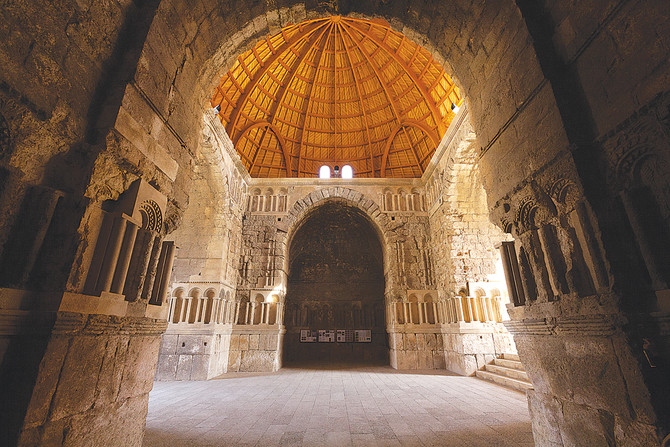
The Umayyad Monumental Gateway once led to a stunning palace from which Islam’s earliest dynasty ruled over Amman. The palace is in ruins now, but the impressive gateway — dating back to the 8th century CE — offers a glimpse into the beginnings of Islam’s very first artistic movement. Byzantine inspiration is clear in the cross-shaped layout of the hall and carved arcades with geometric patterns held aloft by romanesque pillars on the walls — an early take on the horseshoe arch synonymous with Umayyad architecture across the globe. The greatest Christian legacy though, is a reconstruction of a huge wooden dome over the hall. This acknowledges the Umayyads were the first Muslims to experiment with the dome in their designs, a feature that would dominate later Islamic architecture but traces its roots back to Christian monuments.

Close by are the ruins of an actual Byzantine church and later Ottoman buildings. Both are a part of Amman’s fascinating cultural makeup, as is much of this hilltop where visitors can also hear one of the most unique adhans anywhere in the Muslim world, even if they don’t necessarily like it. 

Rixos Obhur Jeddah sets new benchmark for all-inclusive luxury in Saudi Arabia

Updated 19 February 2026
Follow

Rixos Obhur Jeddah sets new benchmark for all-inclusive luxury in Saudi Arabia

  • This resort is an impressive contribution to the Kingdom’s global tourism ambitions

JEDDAH: From the moment you arrive at Rixos Obhur Jeddah, it’s clear this is not just another beachfront resort — it’s a statement. Billed as the first all-inclusive luxury experience “of its kind” in Jeddah, Rixos Obhur signals a shift in how hospitality is being represented in Saudi Arabia. It is a breath of fresh air — both literally and conceptually — introducing a global resort model while remaining rooted in regional culture.

The Kingdom has long been associated mainly with business travel and domestic tourism. But it is now positioning itself as a lifestyle destination for international travelers. Rixos Obhur actively contributes to that change, offering an experience that competes confidently with established upmarket resort destinations around the world. During my stay, it was impossible not to notice the wide range of international visitors alongside Saudi families and regional travelers.

The property is expansive, polished, and unmistakably luxurious. I stayed in a three-bedroom villa designed to accommodate up to six guests. The attention to detail throughout the space was immediately noticeable.

Rixos Obhur Jeddah also excels in its culinary and entertainment offerings, which are central to the all-inclusive concept. (Supplied)

The interiors are modern, sleek, and thoughtfully designed, striking a balance between contemporary aesthetics and warm, welcoming comfort. Everything feels new, curated, and intentional — from the furniture selection to the lighting and layout.

What truly stands out, though, is just how elevated even the smallest details feel. The bathroom amenities, including the shampoo and personal care products, are of exceptional quality — a small but telling detail that separates a luxury resort from a standard beachfront chalet experience. This is not the kind of stay where you feel you’ve “settled” for convenience; it’s one where indulgence is built into every element.

Rixos Obhur Jeddah also excels in its culinary and entertainment offerings, which are central to the all-inclusive concept. One of the highlights of my stay was the dinner and live show experience. Guests are treated to an open buffet that goes far beyond expectations, featuring premium cuts of steak, rich Turkish specialties, Arabic classics, and indulgent desserts — including Turkish Delights that live up to the brand’s heritage.

The food selection is impressively diverse, catering to an international audience while still celebrating regional flavors. This thoughtful balance ensures that every guest, regardless of background, finds something familiar and something new to enjoy. The live entertainment — including dancers and a live band — adds an energetic, celebratory atmosphere that transforms dinner into a full evening experience rather than just a meal, while the range of expertly crafted mocktails on offer further enhances the resort’s appeal.

Another standout feature of the resort is how seamlessly outdoor spaces are integrated into the overall experience. (Supplied) 

Service throughout the property is warm, attentive, and polished, creating an environment where guests feel genuinely welcomed rather than simply accommodated.

Another standout feature of the resort is how seamlessly outdoor spaces are integrated into the overall experience. Even during warmer weather, the presence of outdoor air-conditioning allows guests to enjoy open spaces comfortably — a thoughtful adaptation to the local climate. The beach, too, is immaculately clean, well-maintained, and clearly designed with families in mind.

Rixos Obhur Jeddah offers a vision of Saudi Arabia as a competitive global tourism destination, capable of delivering world-class hospitality experiences without compromise. It successfully highlights what an all-inclusive resort can look like in the Kingdom, blending international standards with regional identity in a way that feels authentic and forward-looking.

If this resort is a glimpse of where Saudi tourism is headed, the future looks both exciting and impressively refined.