San Francisco restaurants open kitchens to refugee chefs

1 / 3
In this photo taken June 19, 2018, Pa Wah, a refugee from Myanmar, mixes shrimp in a turmeric tempura batter at the Hog Island Oyster Co. restaurant in San Francisco during the inaugural Refugee Food Festival. (AP)
2 / 3
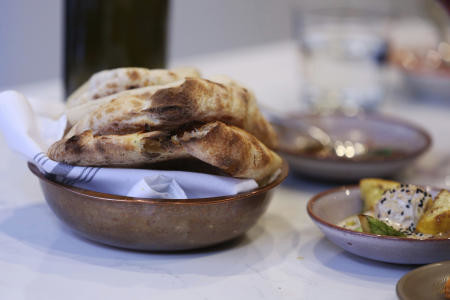
In this photo taken June 20, 2018, a bowl of fresh pita bread made by guest chef Muna Anaee, a refugee from Iraq, beckons from a dining table at Tawla Restaurant in San Francisco during the inaugural Refugee Food Festival. (AP)
3 / 3
In this photo taken June 20, 2018, Muna Anaee, prepares a ball of khobz orouk, a flatbread she would eat frequently in her native Iraq, at the Tawla restaurant kitchen in San Francisco during the inaugural Refugee Food Festival. (AP)
Updated 24 June 2018
Follow

San Francisco restaurants open kitchens to refugee chefs

  • The Refugee Food Festival started in Paris in 2016 and came to the US for the first time this year
  • The program lets refugees aspiring to be chefs work in professional kitchens

SAN FRANCISCO: At San Francisco’s Tawla restaurant, Muna Anaee powdered her hands with flour and gently broke off a piece of golden dough to prepare bread eaten in Iraq, the country she fled with her family.
Anaee was preparing more than 100 loaves for diners Wednesday night as part of a program that lets refugees aspiring to be chefs work in professional kitchens.
The Refugee Food Festival — a joint initiative of the United Nations Refugee Agency and a French nonprofit, Food Sweet Food — started in Paris in 2016 and came to the US for the first time this year, with restaurants in New York participating as well. The establishments’ owners turn over their kitchens to refugee chefs for an evening, allowing them to prepare sampling platters of their country’s cuisine and share a taste of their home.
Restaurants in 12 cities outside the US are taking part in the program this month.
“It’s been a big dream to open a restaurant,” said Anaee, 45, who now has a green card.
Anaee was among five refugees chosen to showcase their food in San Francisco — each at a different restaurant and on a different night, from Tuesday through Saturday. Organizers say the goal is to help the refugees succeed as chefs and raise awareness about the plight of refugees worldwide.
It’s important to “really get to know these refugees and their personal stories,” said Sara Shah, who brought the event to California after seeing it in Belgium.
Anaee and her husband and two children left Baghdad in 2013 over concerns about terrorism and violence. She worked as a kindergarten teacher in Iraq, not a chef, but was urged to pursue cooking as a career by peers in an English class she took in California after they tasted some of her food.
Azhar Hashem, Tawla’s owner, said hosting Anaee was part of the restaurant’s mission to broaden diners’ understanding of the Middle East — a region that inspires some of its dishes.
“Food is the best — and most humanizing — catalyst for having harder conservations,” she said.
The four other aspiring chefs serving food in San Francisco are from Myanmar, Bhutan, Syria and Senegal.
Karen Ferguson, executive director of the Northern California offices of the International Rescue Committee, said San Francisco was a good city for the food festival.
“We have so much diversity, and we see the evidence of that in the culinary expertise in the area,” she said.
The Bay Area has a high concentration of refugees from Afghanistan, Honduras, Guatemala, El Salvador, Eritrea and Burma, though exact numbers are unclear, according to the rescue committee. Its Oakland office settled more than 400 refugees in the Bay Area last year, but the number of refugees settling in the region has fallen dramatically since the Trump administration this year placed a cap on arrivals, Ferguson said.
Pa Wah, a 41-year-old refugee from Myanmar, presented dishes at San Francisco’s Hog Island Oyster Co. on Tuesday. She said she didn’t consider a career in cooking until she moved to California in 2011 and got her green card.
Cooking was a means of survival at the Thailand refugee camp where she lived after escaping civil conflict in Myanmar as a child. Participating in the food festival showed her the challenges of running a restaurant, but also helped her realize she was capable of opening her own, she said.


In the ‘Paris of the Middle East,’ Brigitte Bardot is mourned alongside memories of a golden era

Updated 30 min 41 sec ago
Follow

In the ‘Paris of the Middle East,’ Brigitte Bardot is mourned alongside memories of a golden era

  • Bardot’s visit in 1967 coincided with Lebanon’s cultural zenith
  • Nation highlighted as center of global style and sophistication

BEIRUT: The death of French film legend Brigitte Bardot at 91 has focused attention on one of the 20th century’s most captivating cultural icons — and a remarkable, if brief, moment when her star power intersected with Lebanon’s own golden age.

In March 1967, Bardot arrived in Beirut for a four-day visit that would briefly place the French screen legend at the heart of a Middle Eastern hotspot of glamor and modernity.

Brigitte Bardot in Baalbek, Lebanon. (Instagram)

At the time, Beirut was celebrated as the “Paris of the Middle East,” known for its luxuriant hotels, lively nightlife and cosmopolitan mix of cultures.

Mimi Raad, a noted Lebanese image consultant who is the Head of Image Department at MBC1, said to Arab News, “The 60s were considered the Golden Age of Beirut. Lebanese women, known at that time as the most ‘avant-garde’ and stylish women in the Middle East, were fascinated by Brigitte Bardot’s iconic style as well as by her carefree attitude and freedom. The Lebanese high society would look up to the European glamour and Brigitte Bardot was this breath of novelty in style and attitude.”

“Her visits to Lebanon cemented Lebanon's image as a glamorous Mediterranean destination, often compared to Saint-Tropez, reinforcing Beirut's reputation as a cosmopolitan hub and a trendy holiday destination that mirrored the chicest parts of Europe during that era.”

Meanwhile, Lebanese style consultant Hadia Sinno spoke to Arab News about her lifelong admiration of Bardot. “Since I was young, Brigitte Bardot was an icon I deeply admired, not just for her beauty, but for her effortless style, her natural simplicity and that unmistakable French art de vivre. I was always captivated by her look, especially the headbands she wore in her hair and those signature off-the-shoulder tops,” she said.

“For us as Lebanese, there was always a special connection. We have a deep love for French style, and her visit to Lebanon remains a legendary milestone that bridged our two cultures. Beyond the silver screen, she became a force of nature, leading the anti-fur movement that shocked the world and the fashion industry.

“With her flowing skirts, messy hair and playful confidence, she didn’t just wear clothes, she defined an era. A true icon.

“And even though we hadn’t heard much about her in recent years, it was deeply sad to hear of her passing.”

Brigitte Bardot and husband Gunter Sachs returning from Beirut. (Getty Images)

Bardot stayed in the famed, five-star Phoenicia Hotel where international celebrities lounged by the pool and rubbed shoulders with jet-set elites. Paparazzi captured her in relaxed celebrity mode by the poolside, emblematic of both her global appeal and Beirut’s vibrant scene.

During her short stay the actress wandered through the old Beirut souk, the bustling marketplace that was then a fusion of merchants selling jewelry, watches, and luxury goods.

She visited Assaad Georges Daou, a jeweler celebrated for designing pieces for royalty and film stars — a testament to Beirut’s reputation as a fashion and style hub in the region.

Bardot also ventured beyond the capital to Byblos, an ancient Phoenician port city with sparkling sea views and historic ruins.

There she strolled the scenic harbor and old souk, sampled local seafood and soaked up seaside leisure that mirrored the relaxed Mediterranean allure she embodied onscreen.

Her departure from Lebanon was part of a Mediterranean cruise. According to some accounts, the voyage was interrupted by mechanical trouble that stranded the vessel briefly at sea.


A post shared by BETA (@betalebanon)

Bardot became a global star after appearing in “And God created Woman” in 1956, and went on to appear in about 50 more movies before retiring in 1973.

Bardot then dedicated over four decades to protecting animals, a mission that resonated with animal welfare groups globally, including in Lebanon.

Beirut for the Ethical Treatment of Animals took to social media to post a heartfelt tribute, greeting her death with “immense sadness” and highlighting her “unwavering commitment” to their mission.

“Today, we say goodbye to Brigitte Bardot — a legendary soul whose love for animals reshaped countless lives. From the silver screen to the front lines of animal welfare, she devoted more than four decades to protecting those who cannot speak for themselves,” the post read.

“Through the Brigitte Bardot Foundation, she turned compassion into action and inspired the world to care more deeply, love more fiercely, and stand up for the voiceless.

“At BETA, we extend our deepest gratitude to Brigitte Bardot and the Brigitte Bardot Foundation for their generous support and unwavering commitment.

“Your kindness strengthened our mission, brought hope where there was despair, and helped save so many precious lives.”

Bardot’s visit left a lasting image of Lebanon as a center of international style and sophistication.