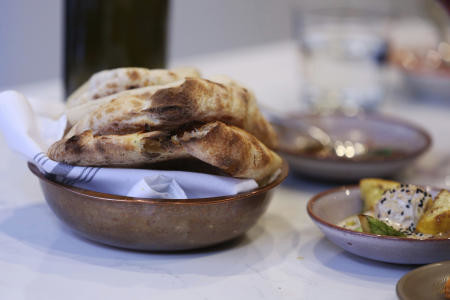
SAN FRANCISCO: At San Francisco’s Tawla restaurant, Muna Anaee powdered her hands with flour and gently broke off a piece of golden dough to prepare bread eaten in Iraq, the country she fled with her family.
Anaee was preparing more than 100 loaves for diners Wednesday night as part of a program that lets refugees aspiring to be chefs work in professional kitchens.
The Refugee Food Festival — a joint initiative of the United Nations Refugee Agency and a French nonprofit, Food Sweet Food — started in Paris in 2016 and came to the US for the first time this year, with restaurants in New York participating as well. The establishments’ owners turn over their kitchens to refugee chefs for an evening, allowing them to prepare sampling platters of their country’s cuisine and share a taste of their home.
Restaurants in 12 cities outside the US are taking part in the program this month.
“It’s been a big dream to open a restaurant,” said Anaee, 45, who now has a green card.
Anaee was among five refugees chosen to showcase their food in San Francisco — each at a different restaurant and on a different night, from Tuesday through Saturday. Organizers say the goal is to help the refugees succeed as chefs and raise awareness about the plight of refugees worldwide.
It’s important to “really get to know these refugees and their personal stories,” said Sara Shah, who brought the event to California after seeing it in Belgium.
Anaee and her husband and two children left Baghdad in 2013 over concerns about terrorism and violence. She worked as a kindergarten teacher in Iraq, not a chef, but was urged to pursue cooking as a career by peers in an English class she took in California after they tasted some of her food.
Azhar Hashem, Tawla’s owner, said hosting Anaee was part of the restaurant’s mission to broaden diners’ understanding of the Middle East — a region that inspires some of its dishes.
“Food is the best — and most humanizing — catalyst for having harder conservations,” she said.
The four other aspiring chefs serving food in San Francisco are from Myanmar, Bhutan, Syria and Senegal.
Karen Ferguson, executive director of the Northern California offices of the International Rescue Committee, said San Francisco was a good city for the food festival.
“We have so much diversity, and we see the evidence of that in the culinary expertise in the area,” she said.
The Bay Area has a high concentration of refugees from Afghanistan, Honduras, Guatemala, El Salvador, Eritrea and Burma, though exact numbers are unclear, according to the rescue committee. Its Oakland office settled more than 400 refugees in the Bay Area last year, but the number of refugees settling in the region has fallen dramatically since the Trump administration this year placed a cap on arrivals, Ferguson said.
Pa Wah, a 41-year-old refugee from Myanmar, presented dishes at San Francisco’s Hog Island Oyster Co. on Tuesday. She said she didn’t consider a career in cooking until she moved to California in 2011 and got her green card.
Cooking was a means of survival at the Thailand refugee camp where she lived after escaping civil conflict in Myanmar as a child. Participating in the food festival showed her the challenges of running a restaurant, but also helped her realize she was capable of opening her own, she said.

San Francisco restaurants open kitchens to refugee chefs
- The Refugee Food Festival started in Paris in 2016 and came to the US for the first time this year
- The program lets refugees aspiring to be chefs work in professional kitchens
Riyadh takes shape at Tuwaiq Sculpture Symposium 2026
RIYADH: This season, one of Riyadh’s busiest streets has taken on an unexpected role.
Under the theme “Traces of What Will Be,”sculptors are carving granite and shaping reclaimed metal at the seventh Tuwaiq Sculpture Symposium, running from Jan. 10 to Feb. 22.
The symposium is unfolding along Prince Mohammed bin Abdulaziz Road, known locally as Al‑Tahlia, a name that translates to desalination. The choice of location is deliberate.
The area is historically linked to Riyadh’s early desalination infrastructure, a turning point that helped to shift the city from water scarcity toward long‑term urban growth.
Twenty‑five artists from 18 countries are participating in this year’s event, producing large‑scale works in an open‑air setting embedded within the city.
The site serves as both workplace and eventual exhibition space, with sculptures remaining in progress throughout the symposium’s duration.
In her opening remarks, Sarah Al-Ruwayti, director of the Tuwaiq Sculpture Symposium, said that this year new materials had been introduced, including recycled iron, reflecting a focus on sustainability and renewal.
She added that the live-sculpting format allowed visitors to witness the transformation of raw stone and metal into finished artworks.
Working primarily with local stone and reclaimed metal, the participating artists are responding to both the material and the place.
For Saudi sculptor Wafaa Al‑Qunaibet, that relationship is central to her work, which draws on the physical and symbolic journey of water.
“My work … presents the connection from the salted water to sweet water,” Al‑Qunaibet told Arab News.
Using five pieces of granite and two bronze elements, she explained that the bronze components represented pipes, structures that carry saline water and allow it to be transformed into something usable.
The sculpture reflected movement through resistance, using stone to convey the difficulty of that transition, and water as a force that enables life to continue.
“I throw the stone through the difficult to show how life is easy with the water,” she said, pointing to water’s role in sustaining trees, environments and daily life.
Formally, the work relies on circular elements, a choice Al‑Qunaibet described as both technically demanding and socially resonant.
“The circle usually engages the people, engages the culture,” she said. Repeated circular forms extend through the work, linking together into a long, pipe‑like structure that reinforces the idea of connection.
Sculpting on site also shaped the scale of the piece. The space and materials provided during the symposium allowed Al‑Qunaibet to expand the work beyond her initial plans.
The openness of the site pushed the sculpture toward a six‑part configuration rather than a smaller arrangement.
Working across stone, steel, bronze and cement, American sculptor Carole Turner brings a public‑art perspective to the symposium, responding to the site’s historical and symbolic ties to desalination.
“My work is actually called New Future,” Turner told Arab News. “As the groundwater comes up, it meets at the top, where the desalination would take place, and fresh water comes down the other side.”
Her sculpture engages directly with the symposium’s theme by addressing systems that often go unseen. “Desalination does not leave a trace,” she said. “But it affects the future.”
Turner has been sculpting for more than two decades, though she describes making objects as something she has done since childhood. Over time, she transitioned into sculpture as a full‑time practice, drawn to its ability to communicate across age and background.
Public interaction remains central to her approach. “Curiosity is always something that makes you curious, and you want to explore it,” she said. Turner added that this sense of discovery is especially important for children encountering art in public spaces.
Saudi sculptor Mohammed Al‑Thagafi’s work for this year’s symposium reflects ideas of coexistence within Riyadh’s evolving urban landscape, focusing on the relationships between long‑standing traditions and a rapidly changing society.
The sculpture is composed of seven elements made from granite and stainless steel.
“Granite is a national material we are proud of. It represents authenticity, the foundation, and the roots of Saudi society,” Al‑Thagafi told Arab News.
“It talks about the openness happening in society, with other communities and other cultures.”
That dialogue between materials mirrors broader social shifts shaping the capital, particularly in how public space is shared and experienced.
Because the sculpture will be installed in parks and public squares, Al‑Thagafi emphasized the importance of creating multi‑part works that invite engagement.
Encountering art in everyday environments, he said, encouraged people to question meaning, placement, simplicity and abstraction, helping to build visual‑arts awareness across society.
For Al‑Thagafi, this year marked his fifth appearance at the symposium. “I have produced more than 2,600 sculptures, and here in Riyadh alone, I have more than 30 field works.”
Because the works are still underway, visitors can also view a small on‑site gallery displaying scaled models of the final sculptures.
These miniature models offer insight into each artist’s planning process, revealing how monumental forms are conceived before being executed at full scale.
As the symposium moves toward its conclusion, the completed sculptures will remain on site, allowing the public to encounter them in the environment that shaped their creation.


