

Saudi businesswomen eye greater role in the economy with end to driving ban

The end of the driving ban is expected to help bring an economic windfall for Saudi women. (Shutterstock)
Updated 23 June 2018
Follow

Saudi businesswomen eye greater role in the economy with end to driving ban

  • The historic move is a huge step forward for businesswomen in the Saudi Arabia, says businesswoman
  • A recent survey by the Jeddah Chamber of Commerce indicated that transportation was a major concern holding Saudi women back from joining the labor market

The end of the driving ban will boost women’s financial power and allow them to play a bigger role in economic and social diversification in line with Vision 2030, prominent businesswomen said on Friday.

Hind Khalid Al-Zahid was the first Saudi woman designated as an executive director — for Dammam Airport Company — and also heads the Businesswomen Center at the Eastern Province Chamber of Commerce and Industry. 

She sees the historic move as a huge step forward for businesswomen in the Kingdom.

“Women being allowed to drive is very important; of course this will help a lot in sustainable development as the lifting of the ban on women driving came as a wonderful opportunity to increase women’s participation in the workforce,” she told Arab News on Friday, ahead of the end of the ban on Sunday.
She added that women in the job market are under-represented; they make up to 22 percent of the national workforce of about six million according to official estimates. Lifting the ban will help to take women’s representation in the workforce to 30 percent by 2030, she said.

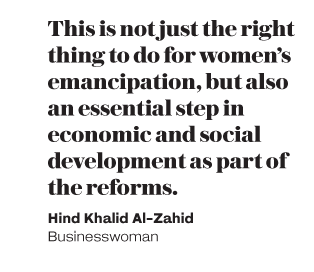
“This is not just the right thing to do for women’s emancipation, but also an essential step in economic and social development as part of the reforms,” she said.

She said that there were different obstacles in increasing women’s participation in the workforce and other productive activities, and the driving ban was one of them. It was a strategic issue that needed to be addressed on a priority basis. With the issue resolved, it would help immensely in giving Saudi women better representation as they would help to diversify the Saudi economy and society.

She said that women could contribute hugely to the workforce and labor market as half of Saudi human resources were female, and unless allowed to excel in different sectors it would not be possible to do better, mainly because of restricted mobility.

A recent survey by the Jeddah Chamber of Commerce indicated that transportation was a major concern holding Saudi women back from joining the labor market.

Nouf Ibrahim, a businesswoman in Riyadh, said: “It will surely boost female economic participation and help increase women’s representation in the workforce immensely. It will also help to reduce the overall national unemployment rate as most of the unemployed are women and many of them are eligible as university graduates.”

She echoed the opinion that the move would help to bring an economic windfall for Saudi women, making it easier for them to work and do business, and thus play a bigger and better role that would help economic and social diversification in line with Saudi Vision 2030.

“Being able to drive from Sunday onwards after the ban is lifted will be a wonderful experience. Earlier we were dependent on a male family member and house driver to take us to workplace, to the shopping center, school or other required places for some work, now we can drive and that will allow active participation in productive work,” Sulafa Hakami, a Saudi woman working as the digital communication manager with an American MNC in Riyadh, told Arab News.

“Saudi women can now share effectively the bigger and better responsibilities,” she said.


Jeddah students get closer look at electric motorsport

Updated 24 January 2026
Follow

Jeddah students get closer look at electric motorsport

  • A PIF-linked initiative highlights technical and engineering careers behind electric racing events

JEDDAH: Students from local and international schools in Jeddah were introduced to STEM-related career pathways in electric motorsport this week, as part of an education program linked to the UIM E1 World Championship held on the Red Sea.

The sessions formed part of Driving Force Presented by the Public Investment Fund, an initiative run by Formula E and its electric racing series partners, to familiarize students aged eight to 18 with science, technology, engineering and mathematics through electric racing and sustainability-focused industries.

The sessions for students formed part of Driving Force Presented by the Public Investment Fund, an initiative run by Formula E and its electric racing series partners. (Supplied)

The programme took place alongside the 2026 E1 Jeddah GP and included workshops, school visits and trackside access designed to show how engineering, data, broadcast technology and event operations function within professional motorsport.

According to organisers, the initiative reached more than 60,000 students globally in 2025, with further expansion planned this year. 

HIGHLIGHTS

• The program took place alongside the 2026 E1 Jeddah GP and included workshops, school visits and trackside access.

• Students learned about E1 races and their technical and environmental dimensions and discussed the engineering and marine aspects of electric boats.

• According to organisers, the initiative reached more than 60,000 students globally in 2025, with further expansion planned this year. 

John Williams, managing director at E1, told Arab News: “The PIF is absolutely vital to everything we do here at the E1. They were crucial initial investment partner since the start of the championship and they continue to support us in a number of ways and more specifically around the Driving Force program.”

The sessions for students formed part of Driving Force Presented by the Public Investment Fund, an initiative run by Formula E and its electric racing series partners. (Supplied)

Elaborating more on the program, he said: “What we are doing is presenting and showing these students the available careers of science, technology, engineering and mathematics, as well as careers in sports, not only pilots but also engineers and mechanics.”

Williams added that the main key to the program was bringing a new generation to the mechanism of sport.

“We are introducing to these exciting new technologies around the race but it could be our technology on the boat or our broadcast products, as well as how to manage the event its self. There are a range of opportunities to show it to the children in addition to enjoying the excitement of the race and meeting the pilots.”

The program’s Jeddah activities began at King Abdulaziz University’s faculty of maritime studies, where students took part in a hands-on workshop focused on STEM careers in the motorsport and sustainability areas conducted by technology experts and famous water pilots such as Dani Clos, Emma Kimilainen and Patricia Pita.

Students learned about E1 races and their technical and environmental dimensions and discussed the engineering and marine aspects of electric boats.

They also enjoyed exclusive behind-the-scenes access at the E1 Jeddah GP, pilot meet-and-greets, and front-row seats to watch the RaceBird boats in action.