

Women go ‘Pink’ with new buses in Mardan

1 / 2
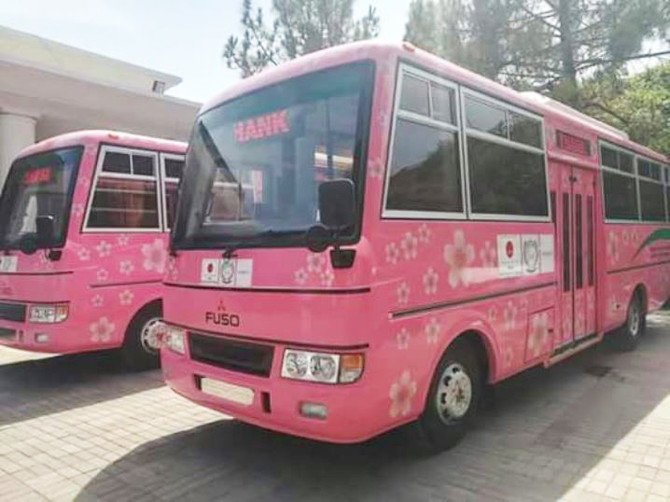
A view of the 'women-only' Pink Buses launched in Mardan on Monday. (Photo courtesy: Project Management Syed Wajid)
2 / 2
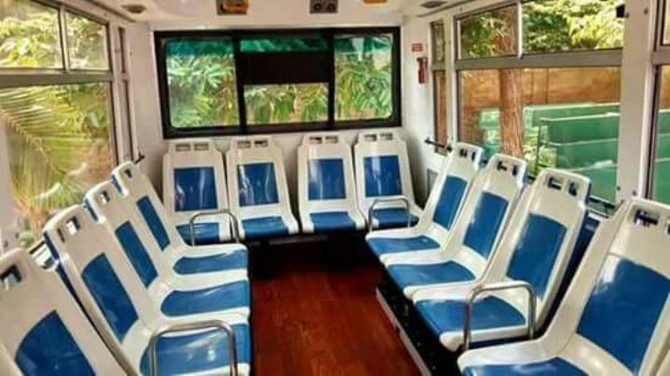
The interior of the 'women-only' Pink Buses launched in Mardan on Monday. (Photo courtesy: Project Management Syed Wajid)
Updated 11 June 2018
Follow

Women go ‘Pink’ with new buses in Mardan

  • The Pink buses launched in Mardan are equipped with all modern features like any other city bus –- but operated only by female drivers.
  • The buses are manufactured and distributed in Pakistan by Mitsubishi Japan.

PESHAWAR: Mardan, Pakhtunkhwa’s second largest city, got the first-of-its-kind women-only transportation facility on Monday, making its female residents enjoy a sense of feminism with pride

“I believe the women-only buses will make it much easier for us to commute around the city,” said Saiqa Shad, a student of Abdul Wali Khan University, complaining that most of the time men occupied seats in public transport making it an uneasy journey for women.

The district administration of Mardan launched the “Pink Bus” service in collaboration with UN Women, a global organization dedicated to gender equality.
According to Deputy Commissioner Usman Mehsud, seven buses have been launched in the district as part of the project to cater to both women and children.
“The facility is meant for every woman in this city,” he told Arab News. “However, working women are likely to benefit more since many of them commute on a daily basis and rely on public transportation for that.”
Different bus stops have been set up across the city designated to these buses, said Mehsud.
“The service will be operated on a no-profit-no-loss basis,” he added, while acknowledging that the fare has to cover the upkeep of the buses, their fuel requirement, and the drivers’ salaries.
According to UN Women’s senior program officer, Syed Wajid, another seven of these Pink Buses will be launched in Abbottabad city on Tuesday.
“Initially, male drivers will run these buses, but they will soon be replaced by female drivers,” he said. “Unfortunately, we could not find women bus drivers at this stage.”
Asked how the Pink Buses would serve UN Women’s motto of gender equality while perpetuating segregation, he said: “There is no proper transport facility for women in these cities. If we have a project like Bus Rapid Transit in all districts, it will be an ideal option. In the absence of such an initiative, however, we have no choice but to launch this women-only service since women face multiple problems while using the ordinary city transportation system.”
Most women in rural areas of Mardan district are hesitant to travel alone in public transport without a male family member, said Anam Mazhar, a frequent commuter in the city. “This project will make us more independent,” she told Arab News. “I think it is a great step toward women empowerment in Mardan.”
Farman Khan, assistant sub-inspector in Mardan Police, told Arab News that the Pink Bus project will also bring a sharp decline in harassment cases reported in public transport.
The project launched in the interest of the female population of the district will cost $1.6 million, Hamayun Zaman, partnership specialist of the United Nations Office for Project Services, told Arab News. “This will include buses, requisite trainings and an e-ticketing system,” he said.

Chinese giant Hoymiles enters Pakistani market to provide high-tech energy storage solutions

Updated 6 sec ago
Follow

Chinese giant Hoymiles enters Pakistani market to provide high-tech energy storage solutions

  • The development comes after Pakistan emerges as one of world’s fastest-growing solar markets, importing nearly 50GW of solar panels
  • Hoymiles entry will address long-hour backup and energy storage challenges facing Pakistan’s growing solar sector, local partner says

KARACHI: Renowned Chinese inverter manufacturer Hoymiles has entered Pakistan to provide high-tech, long-duration energy storage solutions for residential, commercial and industrial buildings by utilizing solar systems for electricity consumption, its Pakistani partner said on Monday.

Over the past few years, a large number of Pakistani industrial, commercial and residential electricity consumers have shifted to solar power systems to address frequent power outages and the rising cost of electricity. Reports indicate that net-metering capacity currently stands at 6,000 megawatts (MWs), while off-grid solar capacity has increased to 12,000 MWs in Pakistan by the end of 2025.

Hoymiles has formed strategic partnerships with Superstar, a renowned name in Pakistan’s automotive industry, and Harisun Energy, a new entrant in the energy solutions sector, to explore the Pakistani market, which is witnessing rapid growth in solar power adoption. In this regard, launch events were held simultaneously in Karachi and Lahore, unveiling multiple storage solutions produced by Hoymiles under the brands of Harisun Energy and Superstar.

Speaking as the chief guest at the Hoymiles launching ceremony in Karachi, Ali Rashid, advisor to Sindh chief minister on science and information technology (IT), said the provincial government appreciates foreign investors, particularly Chinese companies, establishing their industries, assembly, and distribution units in Karachi to meet the demand of the local market as well as export solutions to other countries.

“The government is working rigorously to facilitate foreign investors and companies to enhance their business and commercial activities, mainly in the technology and renewable energy sectors, to improve the living standards of the public and boost economic activity within the country and the province of Sindh,” he said.

The Sindh government is currently collaborating with various Chinese companies across different sectors, including logistics and renewable energy, and it welcomes further cooperation between the private and public sectors, according to Rashid.

The provincial government is considering establishing its own regulatory authority and transmission company, aimed at setting up a separate electricity grid system at the provincial level, which could provide affordable electricity to the masses and enhance connectivity to remote areas, preferably through renewable energy resources.

According to a report by the International Energy Agency (IEA), Pakistan has emerged as one of the world’s fastest-growing solar markets, importing approximately 50 GW of solar panels amid falling prices and widespread adoption across sectors in the first half of the year. This surge has made Pakistan the third-largest market for Chinese solar panels, a growth that has attracted global attention.

Superstar Solar Energy and Harisun Energy are introducing Hoymiles’ innovative range of solar inverters, energy storage solutions, and smart energy management systems to the Pakistani market. These solutions are designed to deliver reliable, efficient, and sustainable energy, empowering individuals and businesses to harness solar power as a clean and green energy source.

“Pakistan’s growing solar sector is facing a major challenge related to long-hour backup and energy storage solutions, which will soon be addressed with the entry of a global leader in energy solutions,” said Haris Jamsheed, CEO of Harisun Energy.

“Our partnership with the Chinese company will provide innovative energy storage solutions for residential, commercial, and industrial solar systems, enabling uninterrupted electricity supply at workplaces, factories, and homes during nighttime hours.”

Solarization has continued to expand across the country on a large scale due to prolonged load-shedding in remote areas and the high cost of electricity, which has become unaffordable for many households and industrial units, particularly in recent years.

“We have vowed to bring an energy revolution to Pakistan through innovative storage solutions, as the industrial and commercial sectors can enhance productivity with low-cost electricity backup systems,” said Saleem Umar, Chairman of Superstar.

“Affordable electricity will reduce operational costs at the domestic level, enabling exporters to compete more effectively in global markets.”