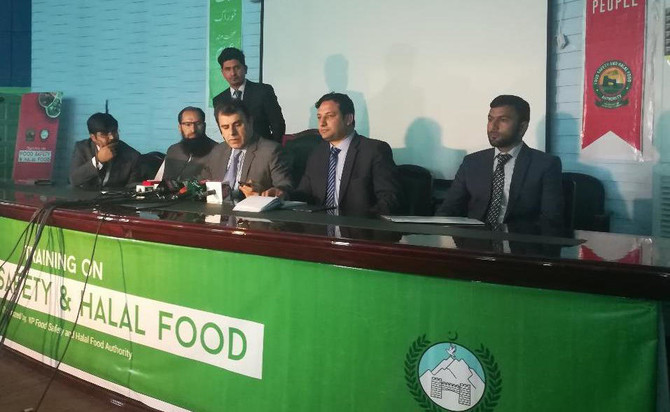
PESHAWAR: Khyber Pakhtunkhwa (KP) government on Monday inaugurated the province’s first Food Safety and Halal Food Authority.
Officials say the authority will monitor and improve the quality of food in the province.
Speaking at the inaugural ceremony, the authority’s Director General, Riaz Mehsud, said the body, which commenced operations on March 1, will have its headquarters in Peshawar in addition to seven divisional headquarters across the province.
“It is being set up in Peshawar, Swat, Abbottabad, Mardan, D. I. Khan, Bannu, and Kohat for now, but will be extended to the entire province in due course,” he said.
Seven mobile testing labs have also been arranged to check food standards on the spot, while more will be arranged in the coming days, added Mehsud.
The KP Food Authority will lay down standards, procedures and guidelines for any food-related enforcements including labeling and food additives. The authority staff will monitor and regulate the manufacture, storage, and distribution of food across the province. The body will also regulate regional sales and imports.
The authority staff will also visit food outlets and hotels, giving their employees and owners health certificates after their medical tests.
“Besides health certificates, we will register all general stores and food outlets. Our mechanism for registration is of two kinds: One, the hotels’ management can register online, and secondly, our food and safety officers will visit food outlets to register them in rural areas where people either don’t have access to the Internet or they don’t have the know-how to register online,” said Mehsud.
The authority, set up under the KP Food Safety Authority Act of 2014, has hired volunteers to monitor food safety and quality, working alongside regular staff in the field.
Hashim Javed, a graduate in food science and technology from the University of Agriculture in Peshawar, told Arab News that the volunteers are now being trained by the authority.
“Previously, food inspectors were hired by the KP Food Department but those inspectors did not have any specialized education in food. Now the authority has hired volunteers, all of whom are from the relevant discipline. We have studied theory on food safety but now we are going to work practically in the field,” said Javed.
The Food Authority staff will first issue a notice to a hotel in a case of insanitary conditions or substandard food, and if that does not work fines will be slapped on such hotels and eateries, or they might even have their assets confiscated, according to officials.
KP Food Authority, operating under the province’s Health Department, is the second such regulatory body in the country after Punjab set up its Food Authority in 2011.

Khyber Pakhtunkhwa gets its first food safety authority
Evictees of slum near Islamabad’s diplomatic quarter claim abandonment as city cites security, illegal settlement
- Authorities say evictees were compensated in the early 2000s, settlement built later illegally
- Evictees, for whom historical and emotional costs outweigh legal arguments, say they feel abandoned
ISLAMABAD: Muzaffar Hussain Shah bends down, picks up a brick from the rubble and cleans it with a hammer. Until a few weeks ago, the brick had been part of a home where Shah had lived for nearly five decades, since his birth.
The house in an informal settlement in Islamabad, which came to be known as Muslim Colony, was demolished in an anti-encroachment drive. Shah said he has spent past three weeks sleeping under the open sky and has been collecting the last remaining bricks to get by for a few more days.
Shah, 48, is one of nearly 15,000 people evicted by the Capital Development Authority (CDA) from the settlement, which was established in the 1960s to house laborers who built Pakistan’s capital of Islamabad, during a drive that began in November.
The decades-old settlement, located near the prime minister’s official residence and the Diplomatic Enclave, a specially designated area within the city that houses foreign embassies, high commissions and international missions, has now been reduced to a 712-kanal (89-acre) stretch of dust and debris.
“It feels as if there is neither a sky over our heads nor anyone behind our backs,” Shah told Arab News on Tuesday, surrounded by the rubble of his demolished home. “Nor is there anything ahead of us. We cannot see anything at all.”
While evacuated residents recount a tale of what they described as broken political promises and affiliation with the place, authorities say there were “obviously security concerns”, and that claims to the land were settled two decades ago.
During an interview with Arab News, Dr. Anam Fatima, director of municipal administration at the Islamabad Metropolitan Corporation, showed satellite images of the “informal settlement” from 2002.
The images showed significant population growth over the years, which she said indicated that most current residents arrived after 2002, when the government negotiated the resettlement of original residents in return for compensation.
“In 2002, it was decided that these people will be compensated, and they were accordingly compensated,” Fatima said.
“Seven hundred and fifty [residents] were found eligible. They were given plots in Farash Town,” she said about a neighborhood on Islamabad’s outskirts. “Some of them moved, some of them did not, but the original settlement was not removed, unfortunately.”
The official attributed the survival of the settlement and its subsequent growth to “enforcement failure” and “changing policies” over the years, insisting that all legal formalities were met before the latest operation.
“Notices were given first to vacate and then after the evacuations had been done... people had completely moved their belongings, only then bulldozers were sent into the area,” Fatima said.
For the evacuated residents, the historical and emotional costs outweigh the legal arguments, they say. Many claim their families moved there more than six decades ago and were promised permanent housing in exchange for their labor.
Muhammad Hafeez, whose father arrived in 1972, lamented that the ones who had helped built Islamabad were being rewarded in the form of eviction from the same city.
“Allah will definitely question you about this,” he said.
Muhammad Khalil, 62, another evictee, blamed CDA officials for allowing the settlement not just to exist but also to grow over the years.
“We did not bring these houses down from space and place them here. CDA officials were present here, they were aware of the developments taking place every single minute, every moment,” he said.
“Their vehicles would come daily. We built these houses right in front of them.”
As bulldozers cleared the land this month, many residents of Muslim Colony said they felt abandoned by the city they once helped build.
“All of this Islamabad that has been built was built by our elders,” Shah said. “Laborers used to live here. And today, after having built Islamabad, today, we have become illegal.”
Authorities, however, say the evictees had been residing illegally and had been compensated, maintaining that they had to be relocated.
“It was entirely illegal because whatever right that they had, it was already compensated in 2003 by the authority,” Dr. Fatima said.