

Pakistan army denies abducting British activist

The army is not behind the abduction of Gul Bukhari, Major General Asif Ghafoor, chief military spokesman, told reporters late Friday. (AP)
Updated 09 June 2018
Follow

Pakistan army denies abducting British activist

ISLAMABAD: Pakistan’s army has denied abducting a British-Pakistani activist known for criticizing the military, in an incident that prompted a wave of condemnation and increased fears of a crackdown on free speech.
Gul Bukhari, 52, was detained for several hours by unknown men in the eastern city of Lahore late Tuesday, one day after the military held a press conference warning that it is monitoring citizens who criticize Pakistan.
She was released early Wednesday.
Pakistan has a history of enforced disappearances, often of people who criticize the security establishment — largely seen as a red line few dare cross. The kidnappings have become increasingly brazen in recent years.
Bukhari is known for advocating human rights online and is also a prominent columnist whose articles are often highly critical of the military and its policies.
When news of her abduction broke it caused a furor, with widespread calls for her release and fingers broadly pointed at the military.
The British High Commission expressed “concern” at the incident as activists called on the army, which is the most powerful institution in Pakistan and has ruled the country for nearly half its 70-year history, to tolerate dissent.
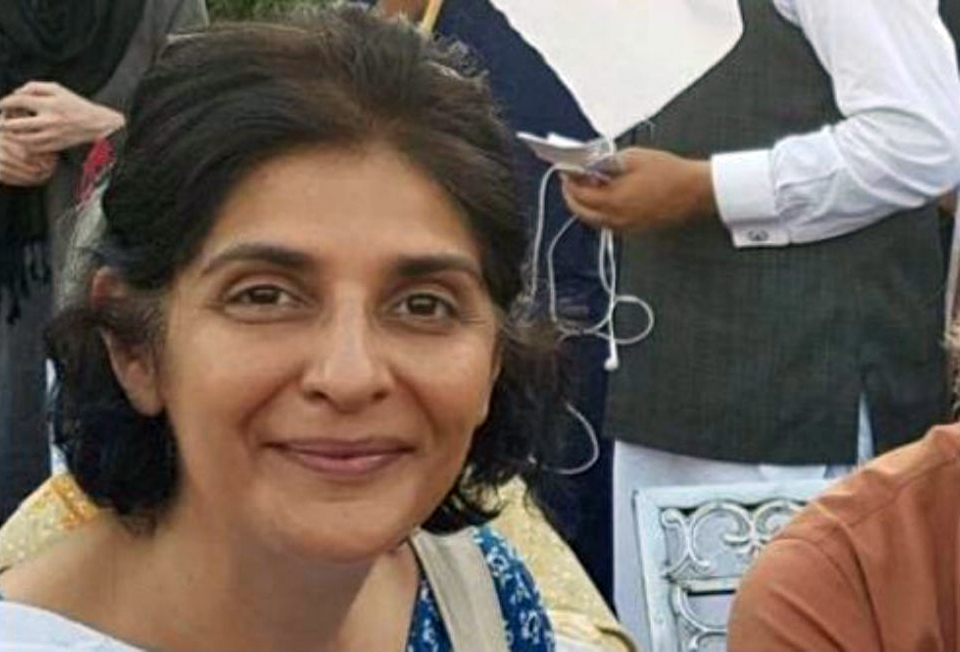


Gul Bukhari. (Photo courtesy: Gul Bukhari/Twitter)

“(The) army is not behind the abduction of Gul Bukhari,” Major General Asif Ghafoor, chief military spokesman, told reporters late Friday.
“We actually want a thorough investigation in this case,” he said.
The military routinely says it is not involved in enforced disappearances, but the statement was a rare on-the-record denial.
It came as the powerful army is facing growing criticism of its policies within Pakistan, from disappearances to the use of militant proxies in Afghanistan and India.
A burgeoning civil rights movement by the country’s ethnic Pashtuns and recent comments from former prime minister Nawaz Sharif have increasingly criticized the generals and caused uproar in the country.
Journalists have spoken of “pressure” not to cover the criticisms, adding to an atmosphere of repression.
During a wide-ranging press conference Monday that appeared to address the mounting criticism, the military issued a veiled warning to online critics, saying it has the capacity to monitor social media accounts.
Ghafoor briefly flashed an image on screen showing what appeared to be Twitter handles and names, including of at least one prominent journalist, but refused to elaborate further, fueling the outcry over free speech.
Late Friday he said they “did not intend to implicate journalists.”
Activists remained skeptical of the military’s role in disappearances and curtailing of free speech.
“If they did not do it, then they need to come up with an action, a plan of enquiry (to investigate) who did,” said Shahzad Ahmed, head of Bytes for All, a think-tank working for digital security and free speech.
“So far the fingers are being pointed toward them.”

UK police to arrest those chanting ‘globalize the intifada’

Updated 58 min 1 sec ago
Follow

UK police to arrest those chanting ‘globalize the intifada’

  • Pro-Palestinian groups say the move will infringe on the right to protest and misunderstands the meaning of the word
  • UK police say the context surrounding the chants has changed after the Bondi Beach attack

LONDON: People publicly chanting pro-Palestinian calls to “globalize the intifada” will be arrested, UK police warned Wednesday, saying the “context had changed” in the wake of Australia’s Bondi Beach attack.
The announcement by the police forces of London and the northwest English city of Manchester swiftly prompted accusations of political repression by some campaigners.
The move follows father-and-son gunmen killing 15 people Sunday at a Hanukkah festival on the Sydney beach and an October attack on a Manchester synagogue on Yom Kippur, the holiest day of the Jewish calendar.
“We know communities are concerned about placards and chants such as ‘globalize the intifada’,” the UK capital’s Metropolitan Police and Greater Manchester Police said in a joint statement vowing to “be more assertive.”
“Violent acts have taken place, the context has changed — words have meaning and consequence. We will act decisively and make arrests.”
Jewish groups welcomed the announcement, with the UK’s Chief Rabbi Ephraim Mirvis calling it “an important step toward challenging the hateful rhetoric we have seen on our streets, which has inspired acts of violence and terror.”
But Ben Jamal, from the Palestine Solidarity Campaign, said in a statement that it infringes on the right to protest.
“The statement by the Met and GMP marks another low in the political repression of protest for Palestinian rights,” he said, ahead of a planned central London pro-Palestinian protest Wednesday evening.
He criticized the lack of consultation over the move, adding “the Arabic word intifada means shaking off or uprising against injustice.”

‘Sickening’

“It came to prominence during the first intifada which was overwhelmingly marked by peaceful protest that was brutally repressed by the Israeli state,” Jamal said.
The intifada refers to Palestinian uprisings against Israel. The first raged from 1987 to 1993, while the second flared between 2000 and 2005.
UK police have already stepped up security around the country’s synagogues, Jewish schools and community hubs in the wake of this year’s violent incidents.
Israeli Foreign Minister Gideon Saar urged Australia to act against a “surge” of antisemitism after Sunday’s atrocity, echoing similar previous demands aimed at Britain.
In a social media post, Saar branded slogans heard at pro-Palestinian protests such as “Globalize the Intifada” “Death to the IDF,” the Israeli military, as antisemitic and violent incitement.
UK Prime Minister Keir Starmer, whose wife is Jewish, denounced the weekend gun rampage in Australia as “sickening,” saying it was “an antisemitic terrorist attack against Jewish families.”
Chief prosecutor Lionel Idan said Britain’s Crown Prosecution Service (CPS) was “already working closely with police and communities to identify, charge and prosecute antisemitic hate crimes.”
“We will always look at ways we can do more,” he added.
Hate crime referrals and completed prosecutions rose by 17 percent to 15,561 in the year to June 2025, according to the CPS.