

Lebanese FM ‘punishes’ UNHCR for ensuring Syrians’ safe return

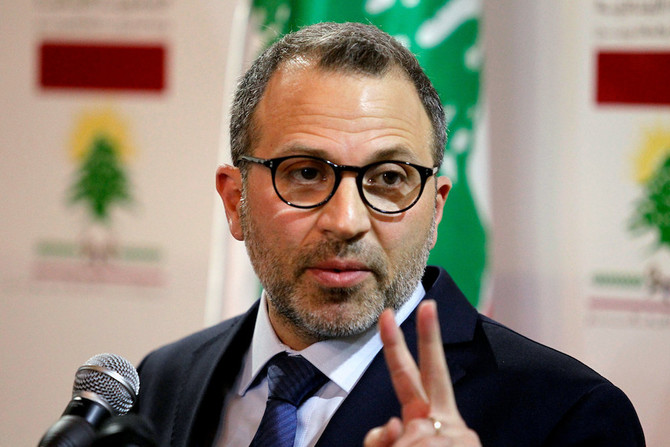
In this file photo, Lebanon's Foreign Minister Gebran Bassil gestures as he speaks during a news conference in Beirut, Lebanon. (Reuters)
Updated 09 June 2018
Follow

Lebanese FM ‘punishes’ UNHCR for ensuring Syrians’ safe return

  • Gibran Bassil: UNHCR is not encouraging Syrian refugees to return home.
  • UNHCR spokeswoman: The agency has so far not been formally informed about the Lebanese Government decision.

Lebanon’s Foreign Minister Gebran Bassil on Friday ordered a freeze on residency applications from staff working for the UN refugee agency, UNHCR, “until further instructions are issued.” 

It came as he accused the organization of intimidating and spreading fear among refugees to prevent them returning to Syria. The move shocked Lebanese politics and has angered officials involved in refugees’ affairs.

“Bassil’s order will have repercussions,” said Nadim Munla, senior adviser to Prime Minister Saad Hariri. “All UN-related residency documents pass through the Ministry of Foreign Affairs.” He described the foreign minister’s actions as “a unilateral decision that does not reflect the government’s policy.”

“Bassil has made a mistake and he isn’t the right authority for carrying out investigations and issuing and implementing orders,” he added.

“Bassil should have discussed the matter with PM Saad Hariri and the minister of refugees’ affairs if he had all the required information, and only then a government decision could be made based on this information.” He added that Bassil “should withdraw his order” and “was meddling with other officials’ responsibilities.”

Minister of Refugees Affairs Moeen Al-Marabi also called on Bassil to withdraw the order.

“The government is like a beehive, which means any decision concerning Lebanon’s supreme interest cannot be made by a minister alone,” he said. “We have not held a meeting and there is a ministerial committee responsible for refugees ... but it has not looked into the matter.

“Minister Bassil is acting as if he were Lebanon’s Pharaoh. We care for Syria, its unity, and its people and we have welcomed Syrian refugees from a humanitarian perspective. We rely on UNHCR to coordinate with all the Syrian parties in order to send refugees back to their country.

“Why doesn’t Bassil speak to his ally, Hezbollah, and ask them to withdraw their men from Syria so that refugees can return to their country?”

Al-Marabi also said Bassil had refused to set up shelters for Syrian refugees in 2013 and 2014 “but is now upset because the international community is supporting refugees and Lebanon.”

Bassil was quoted as saying that a team assigned by him visited the Lebanese border town of Arsal, where many refugees reside, and reported that some of them who initially planned to return to Syria as part of the reconciliation process were now reluctant to do so because UNHCR representatives had asked them questions that increased their fears and made them hesitant.

On Thursday night, he said that his team Arsal had reported there were refugees who wanted to return to Syria but the UNHCR was spreading fear among them. He posted on Twitter: “We sent a mission that verified that the UNHCR is intimidating the displaced who wish to return voluntarily.”

“The questions we asked Syrian refugees were not solely for Syrians but a procedure implemented across the world,” said UNHCR spokeswoman Lisa Abou Khaled, who stressed that the organization’s activities in Lebanon complied with international standards.

She said the UNHCR team had asked the same questions to refugees in the southern Lebanese town of Shebaa before they returned to Syria, and that “these questions did not cause fear or hesitation.”

“On the contrary, 500 refugees have returned to Syria from Shebaa,” she added.

Abou Khaled refused to comment on Bassil’s announcement, but said: “We have not received anything official from the Lebanese Ministry of Foreign Affairs until now and when we do, we’ll study the matter and comment on it.”

She also highlighted the fact that the team working with UNHCR in Lebanon is made up of 600 Lebanese and foreigners.

In April, UNHCR suggested that a government-organized return of 500 refugees was premature, explaining that it was not involved due to the prevailing humanitarian and security situation in Syria.
The world body’s position infuriated Bassil, who warned Lebanon could “re-evaluate” the UN agency’s work.

Lebanon hosts an estimated 1.5 million people displaced by the war in neighboring Syria, equivalent to more than a quarter of its population before the conflict began.

European Union ambassadors to Lebanon will meet on Monday with UNHCR Representative in Lebanon Mireille Girard, who is currently overseas but expected to return to Lebanon within hours.


Egyptian woman faces death threats for filming alleged harasser

Updated 13 February 2026
Follow

Egyptian woman faces death threats for filming alleged harasser

  • Case revives longstanding national debate in Egypt over harassment and violence against women
  • A 2013 UN study found that 99.3 percent of Egyptian women reported experiencing harassment

CAIRO: A young Egyptian woman is facing death threats after posting a video showing the face of a man she says repeatedly harassed her, reviving debate over how victims are treated in the country.
Mariam Shawky, an actress in her twenties, filmed the man aboard a crowded Cairo bus earlier this week, accusing him of stalking and harassing her near her workplace on multiple occasions.
“This time, he followed me on the bus,” Shawky, who has been dubbed “the bus girl” by local media, said in a clip posted on TikTok.
“He kept harassing me,” added the woman, who did not respond to an AFP request for comment.
Hoping other passengers would intervene, Shawky instead found herself isolated. The video shows several men at the back of the bus staring at her coldly as she confronts her alleged harasser.
The man mocks her appearance, calls her “trash,” questions her clothing and moves toward her in what appears to be a threatening manner.
No one steps in to help. One male passenger, holding prayer beads, orders her to sit down and be quiet, while another gently restrains the man but does not defend Shawky.
Death threats
As the video spread across social media, the woman received a brief flurry of support, but it was quickly overwhelmed by a torrent of abuse.
Some high-profile public figures fueled the backlash.
Singer Hassan Shakosh suggested she had provoked the situation by wearing a piercing, saying it was “obvious what she was looking for.”
Online, the comments were more extreme. “I’ll be the first to kill you,” one user wrote. “If you were killed, no one would mourn you,” said another.
The case has revived a longstanding national debate in Egypt over harassment and violence against women.
A 2013 UN study found that 99.3 percent of Egyptian women reported experiencing harassment, with more than 80 percent saying they faced it regularly on public transport.
That same year, widespread protests against sexual violence rocked the Egyptian capital.
In 2014, a law criminalizing street harassment was passed. However, progress since then has been limited. Enforcement remains inconsistent and authorities have never released figures on the number of convictions.
Public concern spiked after previous high-profile incidents, including the 2022 killing of university student Nayera Ashraf, stabbed to death by a man whose advances she had rejected.
The perpetrator was executed, yet at the time “some asked for his release,” said prominent Egyptian feminist activist Nadeen Ashraf, whose social-media campaigning helped spark Egypt’s MeToo movement in 2020.
Denials
In the latest case, the authorities moved to act even though the bus company denied any incident had taken place in a statement later reissued by the Ministry of Transport.
The Interior Ministry said that the man seen in the video had been “identified and arrested” the day after the clip went viral.
Confronted with the footage, he denied both the harassment and ever having met the woman before, according to the ministry.
Local media reported he was later released on bail of 1,000 Egyptian pounds (around $20), before being detained again over a pre-existing loan case.
His lawyer has called for a psychiatric evaluation of Shawky, accusing her of damaging Egypt’s reputation.
These images tell “the whole world that there are harassers in Egypt and that Egyptian men encourage harassment, defend it and remain silent,” said lawyer Ali Fayez on Facebook.
Ashraf told AFP that the case revealed above all “a systemic and structural problem.”
She said such incidents were “never taken seriously” and that blame was almost always shifted onto women’s appearance.
“If the woman is veiled, they’ll say her clothes are tight. And if her hair is uncovered, they’ll look at her hair. And even if she wears a niqab, they’ll say she’s wearing makeup.”
“There will always be something.”