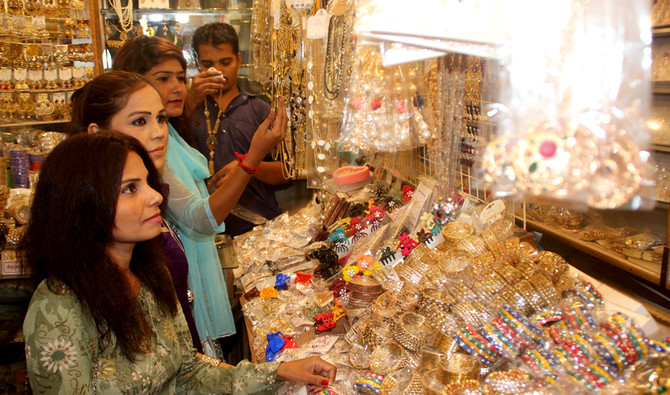
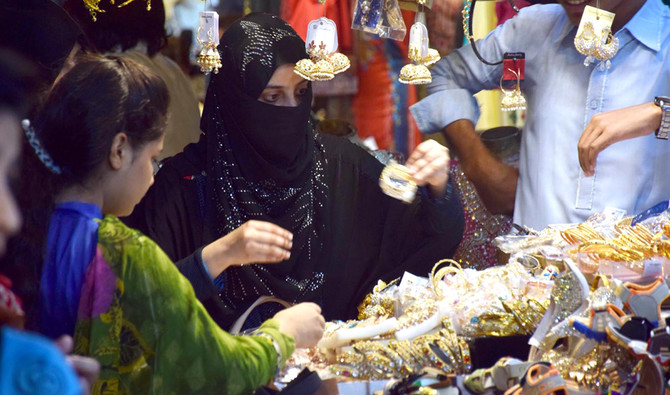
KARACHI: As Eid festivities draw closer, shopping centers in the seaside metropolis have opened their gates to welcome the growing number of people every night — and conduct their business activities till dawn.
This is true of more than 20 major shopping centers in Karachi that get crowded in the evening after the city’s soaring temperatures cool down.
“All facilities have been provided to carry out business activities in the major shopping centers across the port city,” Atiq Mir, chairman of All Karachi Tajir Ittehad, an umbrella organization of nearly 100 business centers in the city, told Arab News.
He said that an estimated PKR 100 billion of business was expected in the country’s biggest and most densely populated city, as people make arrangements for Eid celebrations. “The mega city is home to 20 million people who are known for their passion for shopping. On this mega event, an average buyer normally spends a minimum of PKR5,000 on shopping. If the situation remains stable, more than PKR 100 billion of business will be done as goods are also transported to other parts of the country from Karachi,” Mir said.
Traditionally, Pakistan undergoes a major shopping frenzy in the last 10 days of Ramadan. These commercial activities culminate hours before the Eid prayer. “We have been advising people to start shopping earlier since they will otherwise get caught in a huge rush during the last few days,” Mir said.
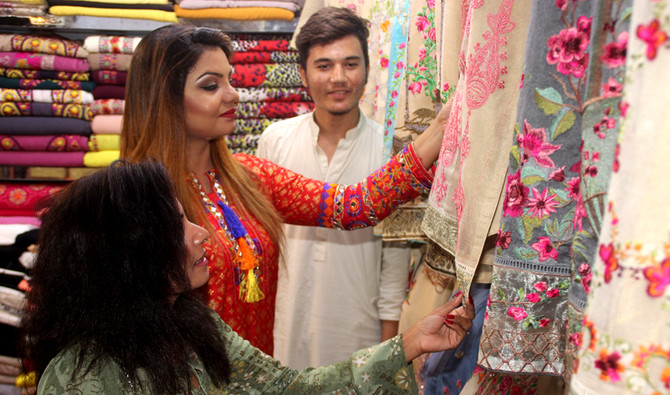
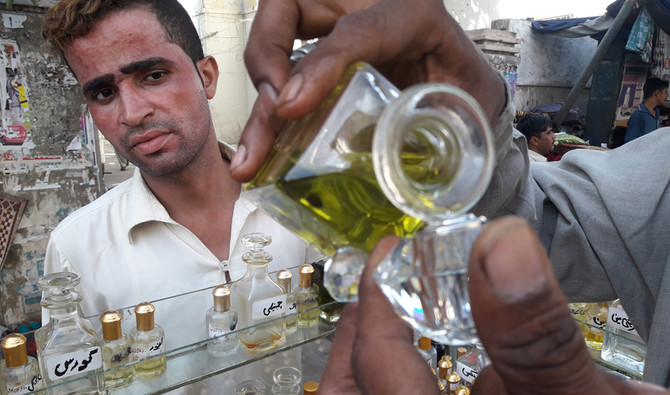
A large number of Pakistanis buy clothes, shoes, children’s garments and jewelry ahead of the Eid celebrations. Demand for unstitched fabrics, perfumes and cosmetics also remain high before the mega festivity.
Apart from producers of local fabric, however, local manufacturers this year may not be able to capture a huge market share since their Chinese counterparts have started aggressively marketing their products.
“There is a huge rush at the Jama Cloth Market as people are busy with Eid shopping. Besides local products, items from China, India and other countries are also displayed in large quantities,” Asif Gulfam, who is part of the Alliance of Arambagh Market Association, told Arab News.
Almost 80 percent of children’s garments available in the local market have been imported from China, Malaysia, Bangladesh, Taiwan and Singapore, Mir said, adding that only unstitched and semi-stitched garments by local manufacturers are in a great demand.
As some shoppers wait for the last days of Ramadan, others prefer to avoid the market hassle that accompanies 11th-hour shopping sprees. “I do not feel comfortable while shopping in a congested environment. Sometimes you find what you are looking for, though you are also forced to make unnecessary compromises quite frequently. It is better to buy stuff in a hassle-free environment,” one shopper, Samina Ahmed, said.
It is only in the recent past that the concept of mega shopping malls in the major urban centers of the country have taken root in Pakistan. Given the cutthroat competition in retail business, these malls in most cases have adversely affected the business of small and medium enterprises.
“Almost 40 percent of our business has shifted to these malls since they offer a better environment to shoppers. You will not see many discount schemes during the last few days of Ramadan since shopkeepers want to cover all their expenses by selling products at maximum prices,” said Muhammad Tahir Khan, joint secretary of a traders’ welfare association in Karachi. “Chinese products can be seen everywhere in shopping centers,” Khan added.
According to Abdullah Zaki, an industrialist and former chairperson of the Pakistan Yarn Merchants Association: “Local industry is suffering up to 20 percent due to the influx of cheap Chinese products. The local industry also suffers due to the inflow of smuggled goods from neighboring Afghanistan.”
In Pakistan, many local charities, philanthropists and humanitarian organizations step forward during Ramadan to provide financial assistance to thousands of poor, making it possible for them to participate in Eid festivities and giving greater impetus to commercial activities in the country.


Eid shopping gains momentum in Pakistan





Eid shopping gains momentum in Pakistan
- More than PKR100 billion of business activities are likely to take place ahead of the festivity.
- Chinese products have deeply penetrated the market, making local manufacturers suffer significant losses.


Mohammed Bakri, filmmaker who championed Palestinian cause, dies aged 72
- Bakri was known for his documentary “Jenin, Jenin” which denounced alleged Israeli war crimes in the Jenin refugee camp
- The father of six also directed several socially conscious documentaries about the situation of Palestinian citizens of Israel
JERUSALEM: Actor and filmmaker Mohammed Bakri, a champion of the Palestinian cause, died on Wednesday aged 72, a hospital spokesperson said.
He was known for his documentary “Jenin, Jenin” and his commitment to the Palestinians, which led to frequent confrontations with Israeli authorities.
“Mohammed Bakri died this Wednesday at the Galilee Medical Center” in the northern Israeli city of Nahariya, hospital spokesperson Gal Zaid told AFP.
He died from heart and lung problems, according to his family.
Born in Galilee in 1953 into a Muslim family, Bakri was an Israeli citizen.
He appeared in leading Israeli films but was also directed by the French-Greek director Costa-Gavras and Italian filmmakers Paolo and Vittorio Taviani.
His role as a Palestinian inmate in an Israeli prison in the 1980s film “Beyond the Walls” earned him critical acclaim in Israel and around the world.
But his international renown grew with the release of 2002’s “Jenin, Jenin,” which denounced alleged Israeli war crimes in the Jenin refugee camp in the occupied West Bank during the Second Intifada.
The Israeli Supreme Court upheld a ban on the film in 2022, deeming it “defamatory.”
The father of six also directed several socially conscious documentaries about the situation of Palestinian citizens of Israel.
Arab-Israeli radio station A-Shams published a tribute on its social media, describing Bakri as a “free voice.”
“From his early days in theater, art was not simply a pastime for Mohammed Bakri, but a tool for raising awareness and engaging in dialogue,” the radio station said.
“The legacy left by Mohammed Bakri will remain, reminding us that art can be an act of resistance.”


