

American-French filmmaker Roman Hill discusses his installation ‘Inflow:Outflow’ 

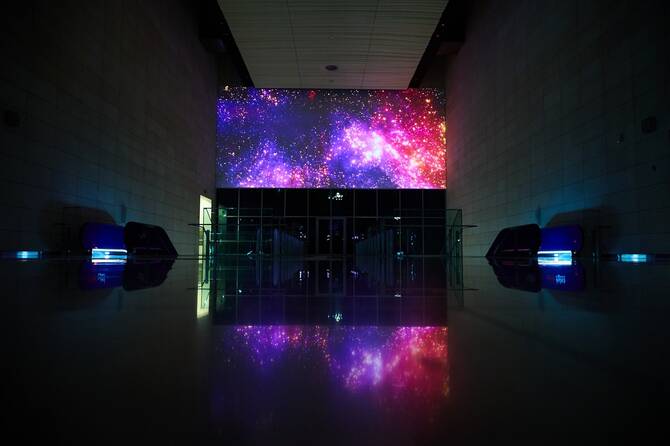
Roman Hill’s “Inflow:Outflow” consisted of two 15x7-meter projections in Riyadh’s STC metro station. (Supplied)
Short Url
Updated 18 December 2025
Follow

American-French filmmaker Roman Hill discusses his installation ‘Inflow:Outflow’ 

RIYADH: For filmmaker and artist Roman Hill, Noor Riyadh — the festival of light art which took place this year from Nov. 20 to Dec. 6 under the theme “In the Blink of an Eye” — is “a rare opportunity to create truly monumental, immersive work.”  

Hill’s “Inflow:Outflow” consisted of two 15x7-meter projections in Riyadh’s STC metro station. He described it in a statement to Arab News as “a visual poem” that “celebrates universal movement.” 

“At every moment, everything — from the cells in our bodies to the microorganisms around us, and all the way up to the stars and galaxies — is engaged in a continuous dance of creation and destruction,” Hill elaborated. 

His installation, according to the Noor Riyadh website, “translates microscopic realities into monumental projections. Illumination magnifies chemical reactions filmed through polarized light, expanding them to an architectural scale. Color and textures cascade like slow galaxies, enveloping surfaces in living pigment. 

“By revealing the sublime within the small, the work bridges science and mysticism,” it continues. “Hill’s imagery, neither abstract nor representational, invites contemplation of unseen beauty.” 

The theme of this year’s festival “resonates” with his work, Hill said, “because it reminds us that, in a single instant, we are both observing and participating in this vast cosmic choreography.  

“The installation invites viewers to feel themselves at the center of this dance, even if only for a moment of heightened attention,” he continued. “For me, that moment of contemplation — like suddenly noticing a sunrise or a sky full of stars — is where an artwork truly stays with somebody. 

“This fascination with light and the universe is at the core of my practice, and runs through many of my projects,” he added. 

Indeed, he has just finished directing a new French series for European TV channel ARTE telling “the entire history of the universe — from the Big Bang to the very end of time — through the voice of light itself,” which he hopes to have dubbed into Arabic. All the imagery was created in Hall’s studio “using only physical and chemical phenomena, without CGI or AI.” 

Light art, Hall said, is “universal, immediate, and speaks to people beyond language or cultural background.” He believes Noor Riyadh is playing an important cultural role. 

“It brings together artists from many continents and very different cultures and places them in dialogue with Saudi artists … This mix, and the scale of the festival, make it one of the most exciting platforms for light-based work today.” 


Mini op-ed: Recognising a shift in how people relate to wellness, self-care

Updated 05 March 2026
Follow

Mini op-ed: Recognising a shift in how people relate to wellness, self-care

DUBAI: I have spent nearly a decade working in the beauty industry in Saudi Arabia and the UAE, and Ramadan always has a way of prompting change; in habits, in priorities, and in the routines people have been carrying without question. Speaking from my own corner of the industry, one of these habits is often hair removal.

Saudi Arabia’s beauty and personal care market was valued at about $7.56 billion in 2025 and is set to grow to an estimated $8.03 billion in 2026. Within that growth, personal care encompassing the daily (sometimes unglamorous) routines hold the largest share. But market size alone does not tell the full story. A study conducted at King Abdulaziz University Hospital, Jeddah, found that three quarters of Saudi women experienced complications from temporary hair removal methods, including skin irritation, in-grown hairs and hyperpigmentation. A separate 2025 study published in the Majmaah Journal of Health Sciences found that laser hair removal was both the most considered and most commonly undergone cosmetic procedure among Saudi respondents, yet dissatisfaction with cosmetic procedure outcomes was reported by nearly half of all participants. The numbers point to a gap not in demand, but in results. 

When I launched a specialized electrolysis practice in the UAE in 2016, it was with a clear gap in mind; safe, regulated, permanent hair removal for the region’s specific needs. The range of hair types here and the prevalence of conditions such as polycystic ovary syndrome, or PCOS, demanded a method that works across all of them.  Electrolysis is the only method recognized by the US Food and Drug Administration and American Marketing Association as achieving true permanent results, regardless of hair color or type. 

Despite this, awareness in Saudi Arabia remains limited. Part of this is familiarity, laser has dominated the conversation for years, and electrolysis, which requires more sessions and a licensed electrologist’s precision, has struggled to break through. Part of it is education. Many clients who come to us have never heard of electrolysis; they come because they have exhausted everything else. 

Right now, Saudi Arabia is in the middle of a genuine transformation in how people relate to wellness and self-care. The beauty market is maturing, consumers are asking harder questions of the brands they choose and Vision 2030 has not just shaped the economy, it has shaped how Saudis are showing up in their own lives. In that context, the idea of choosing permanence over repetition lands differently.
 
Mariela Marcantetti is a beauty industry entrepreneur based between Saudi Arabia and the UAE.