Creative youth from across Saudi Arabia speak up about their art

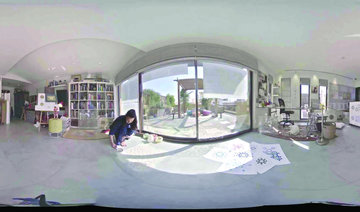
A participant renders a poem during the event. (AN photo)
Updated 30 June 2018
Follow

Creative youth from across Saudi Arabia speak up about their art

  • The founder of the project Ward Magazine is a student of only 18. The project started in December 2017.
  • Ward has organized three events so far and the magazine has seven electronic and one printed edition

JEDDAH: An e-magazine held a special evening on Saturday to enable young Saudis from all over the Kingdom to showcase their ideas, poems and artwork.

Ward Magazine, which was also launching its first printed edition, is an e-magazine that aims to support and encourage artists in Saudi Arabia whatever their ages, nationalities and the topics they want to be discussed in their work.

Due to the limitation of available opportunities and spaces for Saudi-based artists, and their centralization in particular cities, Ward was founded to publish their work, and it includes all forms of creativity.

On June 2, Ward organized a special cultural night giving space to young Saudi dreamers from both genders to disclose their thoughts in a creative, literary way.

The spoken-word event gathered a large number of intellectual, ambitious youth from all over the Kingdom and offered them the chance to showcase their ideas and work.

The theme of the evening was "Beyond the frame." It was presented through three categories, each aiming to deliver a different message through an artwork or a poem by eight participants.

Ward offers painters, writers, photographers and anyone in between the chance to submit their work freely, with no limitations on their age or the topics of their work.

The founder of the Ward project, 18-year-old Khalid Alqahtani, told Arab News: "We wanted art enthusiasts to grow with us by volunteering their skills in editing, translation and graphic design. I created a team of nine people, including myself.”

All of them are secondary school and university students from different disciplines and parts of the Kingdom.

“The main goal of Ward is to give art and literature lovers the opportunity to know the reasons behind the creation of a particular work of art,” Al-Gjahtani said. “I believe that art encompasses all forms of creativity.”

The evening was against the famous quote of "Explanation kills art" because when we hear a poem or a work vision we face endless possibilities for interpretation.

During the event the first printed issue of the magazine was launched for the first time as it is considered the seventh edition of the e-magazine.

Ward Magazine aims to remove the stereotypical ideas about the Saudi nation as a mere geographical border, and to prove that it has a wholly different perspective.

The magazine contains articles, poems and other collective artworks of ever-growing young talents.

Al-Ghahtani said: "We are trying to break down the obstacles that artists face in reaching their audiences, by creating solutions to make their art see the light, such as showcasing their works through exhibitions and electronic editions.”

The event took place at 3alsat7 in Alrawdah district.

Decoder

Ward and 3alsat7

Ward is an Arabic word referring literally to flowers and metaphorically to youth and beauty. 3alsat7 is an Arabic word for the English phrase "on the roof."


Berlinale responds to backlash over Gaza-related comments

Updated 59 min 53 sec ago
Follow

Berlinale responds to backlash over Gaza-related comments

The Berlin International Film Festival has issued a statement after what organisers described as a growing “media storm” linked to comments about the war in Gaza and the broader role of politics in cinema.

Festival director Tricia Tuttle released a lengthy note late Saturday following criticism directed at several high-profile guests. The controversy began during the opening day press conference when jury president Wim Wenders was asked about the conflict in Gaza. He responded: “We have to stay out of politics because if we make movies that are dedicatedly political, we enter the field of politics,” a remark that sparked swift backlash online.

Indian author Arundhati Roy later withdrew from the festival, reportedly angered by the remarks.

Other prominent figures, including Michelle Yeoh and Neil Patrick Harris, also faced online criticism after responding cautiously to questions about politics. Harris stated that he was interested in “doing things that were ‘apolitical,’” a comment that further fuelled debate.

In her statement, Tuttle defended the festival and its participants, stressing the importance of artistic freedom. “People have called for free speech at the Berlinale. Free speech is happening at the Berlinale. But increasingly, filmmakers are expected to answer any question put to them. They are criticised if they do not answer. They are criticised if they answer and we do not like what they say. They are criticised if they cannot compress complex thoughts into a brief sound bite when a microphone is placed in front of them when they thought they were speaking about something else,” she said.

She added: “It is hard to see the Berlinale and so many hundreds of filmmakers and people who work on this festival distilled into something we do not always recognise in the online and media discourse… It is a large, complex festival.”

“Artists are free to exercise their right of free speech in whatever way they choose… nor should they be expected to speak on every political issue raised to them unless they want to,” Tuttle said.