Macron tells Trump US tariffs are ‘illegal’, EU will respond

French President Emmanuel Macron speaks at a conference at the Elysee Palace in Paris on May 31, 2018. (Christophe Petit Tesson/Pool via Reuters)
Updated 01 June 2018
Follow

Macron tells Trump US tariffs are ‘illegal’, EU will respond

  • The phone call between Macron and Trump came after the US announced the steep metals tariffs would be imposed on the European Union, Canada and Mexico as of midnight.
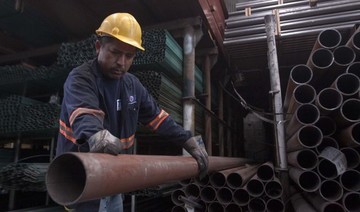
  • French Finance Minister Bruno Le Maire said Thursday that France will refuse to enter into trade talks with the United States while punishing steel and aluminum tariffs are in effect.

PARIS: Emmanuel Macron told Donald Trump late Thursday that tariffs on steel and aluminum imports from the European Union were “illegal” and that the EU would respond in a “firm and proportionate manner,” the Elysee Palace said.
The phone call between the French president and his US counterpart came after the US announced the steep metals tariffs would be imposed on the European Union, Canada and Mexico as of midnight (0400 GMT Friday).
Macron, who has forged a good relationship with the US president, spoke to Trump on the phone, urging him to take part in negotiations with the EU, China and Japan to strengthen the rules of the World Trade Organization.
He called the decision to impose tariffs a “mistake,” warning that “economic nationalism” would penalize everyone including the US.
Earlier Thursday Macron told journalists at the Elysee Palace that he deplored the American decision.
“I think this decision is a mistake in many ways because it responds to existing international imbalances in the worst way — by breaking up and creating economic nationalism.
“And nationalism is war. That’s exactly what happened in the 30s,” he added.
French Finance Minister Bruno Le Maire said Thursday that France will refuse to enter into trade talks with the United States while punishing steel and aluminum tariffs are in effect.
“We refuse to negotiate under pressure,” Le Maire told reporters while en route to a Group of Seven meeting in Canada. And “being hit by the tariffs will not help us to open the door to any kind of negotiation.”


Profit scents lure new investors into Saudi perfume market 

Updated 4 sec ago
Follow

Profit scents lure new investors into Saudi perfume market 

RIYADH: In Saudi Arabia’s perfume market, which at first glance appears saturated with local and global brands, new investors are still entering the sector with fresh labels, indicating that domestic demand can accommodate new competitors. 

Speaking to Al-Eqtisadiah at the Blue Oud and International Perfumes Exhibition in Riyadh, Badr Al-Sayyed, owner of the “Amour” perfume brand, said launching his brand cost SR250,000 ($66,660), with retail prices set at around SR249 per bottle, citing the quality and purity of the essential oils used. 

Al-Sayyed added that the brand was launched in September 2025, initially through an online store, with plans to expand physically in the Eastern Province within the next two years. 

High profit margins  

He noted that the online store receives more than 7,000 visits a month from customers across the Gulf region, with sales growth of between 5 percent and 8 percent from September to December 2025. 

He emphasized that Saudi Arabia leads the region in sales, followed by the UAE, Oman and Bahrain, describing profit margins in the perfume sector as excellent. 

Naif Al-Juwair, a procurement representative at Oud Al-Edan, said the company’s most popular oud types are Moroccan Live and Moroccan Dead oud, with the latter in higher demand. 

He explained that the difference lies in the extraction location on the tree and its condition, with Dead oud known for its classic, cool and long-lasting incense aroma. 

Al-Juwair added that the company operates five offices outside Saudi Arabia and works with oud manufacturers in Indonesia and Vietnam. 

Gulf markets support domestic demand 

Al-Juwair said online sales account for 10 to 15 percent of total sales, while overall company sales grew by up to 70 percent last year. 

He stressed that maintaining quality is essential to balancing profit margins and customer trust, describing the Saudi oud market as strong, with Kuwait ranking second in purchasing power. 

Abdulrahman Baraka, a marketer for the Vanilla perfume brand, said Saudi Arabia accounts for 80 to 90 percent of the brand’s total sales, followed by the UAE at 7 percent and Qatar. 

He said the average bottle sells for around SR300, with the brand focusing on exhibition participation, where sales often outperform traditional stores, generating profits of between SR50,000 and SR100,000 over the 10-day exhibition period. 

He added that the most active consumer group is aged 20 to 30, of both genders, with essential oils imported from Turkiye and perfumes manufactured in Saudi Arabia. He emphasized that all fragrances are proprietary creations, including a recent cola-scented perfume. 

Seasonal trends shape fragrance preferences 

Al-Sayyed explained that fragrance notes vary by taste, individual preference and season, noting that citrus notes such as lemon and bergamot remain popular year-round. 

Summer fragrances, he added, emphasize light, refreshing fruit and herbal notes, while winter scents favor warm, deep notes such as wood, leather, oud and amber. He said men’s perfumes generally lean toward citrus notes, while women’s fragrances focus more on floral accords. 

The perfumer emphasized that he does not seek to compete with others, noting that quality is the core principle and source of strength at every stage of his work. 

He added that essential oils are imported from Grasse, France — renowned worldwide for perfume production — in addition to relying on high-quality perfume factories in Italy, the UK and Switzerland.