PARIS: Libya’s rival leaders are expected in Paris on Tuesday under pressure to agree to a political roadmap for the war-struck country that could see elections held before the end of 2018, according to the French presidency.
The major international conference dedicated to the oil-rich north African country has been organized to bring together the rival factions for power, as well as neighboring countries and regional backers.
“After seven years of conflict and tensions, this unprecedented conference ... aims to open a new period of stability and cooperation which is awaited by the Libyan people,” a statement from the French presidency said.
An aide to French president Emmanuel Macron said the Libyan leaders had agreed in principle to a roadmap that would pave the way for parliamentary and presidential elections, if possible before the end of the year.
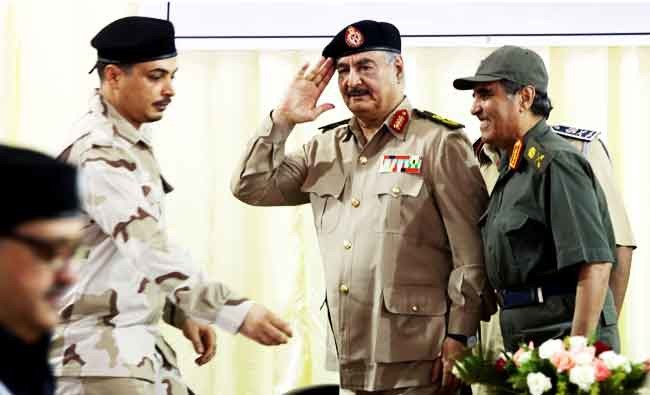
The invitees include Prime Minister Fayez Al-Sarraj, head of Libya’s UN-backed unity government in Tripoli in the west, and 75-year-old military strongman Khalifa Haftar, whose rival Libyan National Army dominates the country’s east.
Aguila Saleh Issa, the Parliament speaker based in the eastern town of Tobruk who opposes the UN-backed administration, is also expected, as is Khalid Al-Mishri, the newly elected head of the High Council of State.
Years of mediation by the US, as well as former colonial power Italy, have failed to bring stability to Libya which descended into chaos after the ousting of dictator Muammar Qaddafi in 2011.
Since then, the country has become a new base for terrorists, as well as a departure point for hundreds of thousands of African migrants seeking to enter Europe.
European leaders see stabilizing the country as key to tackling the joint security and immigration threats, and Macron threw himself into finding a solution shortly after his election in May last year.
The 40-year-old French leader brought Sarraj and Haftar together in Paris where they agreed a ceasefire and to hold elections in 2018 — a move that irked the Italian government at the time which was blindsided by Macron’s diplomacy.
It remains to be seen if the conference on Tuesday will lead to real change on the ground, after several false dawns since the fall of Qaddafi and peace deals that have failed to be honoured.
The UN special envoy for Libya, Ghassan Salame, has given up trying to implement a 2015 political agreement to set up a unity government, instead focusing on trying to hold elections as a way to unify the country.
Representatives from 19 countries involved in Libya have been invited — an acknowledgement that the country’s problems can only be resolved if regional powers agree on the roadmap.
These include Egypt, Russia and the UAE which have backed Haftar and the rival administration in Tobruk in the east, not the UN-recognized government based in the capital Tripoli.
Qatar, Kuwait, Saudi Arabia and Turkey, as well as neighbors Algeria and Tunisia will also send representatives to the talks.


![]()

Libya breakthrough to be sought at Paris conference
Libya breakthrough to be sought at Paris conference
- The 40-year-old French leader brought Sarraj and Haftar together in Paris
- Representatives from 19 countries involved in Libya have been invited


Latest updates


© 2026 SAUDI RESEARCH & PUBLISHING COMPANY, All Rights Reserved And subject to Terms of Use Agreement.